
On this page
- Hunger Is a Signal, Not a Weakness
- Reason 1 — You're Not Eating Enough Protein
- Reason 2 — You're Not Eating Enough Fiber
- Reason 3 — You're Not Sleeping Enough
- Reason 4 — You're Drinking Your Calories
- Reason 5 — You're Actually Thirsty
- Reason 6 — You're Eating Ultra-Processed Food
- Reason 7 — Your Calorie Deficit Is Too Aggressive
- Reason 8 — You Lost Muscle From Crash Dieting
- Which One Is You?
- Frequently Asked Questions
- Why am I still hungry after eating a full meal?
- Does drinking water actually reduce hunger?
- Can being hungry all the time be a medical issue?
- Why am I hungrier on some days than others?
- Does being in a calorie deficit always mean being hungry?
- Will eating more protein really stop my hunger?
- Is it normal to feel hungry when losing weight?
- The Bottom Line
Let me reframe the question before answering it, because the framing is where most people go wrong. When you ask "why am I always hungry," you're usually really asking "why am I so weak that I can't stop wanting food?" The premise is that constant hunger is a character flaw — a willpower deficit you should be able to muscle through.
It isn't. Constant hunger is a signal, and signals have mechanical causes. Your body has an elaborate system for telling your brain when you've had enough to eat — multiple hormones, stretch receptors, blood sugar feedback — and when you're hungry all the time, one or more parts of that system isn't working. That's not weakness. That's a broken or missing signal, and broken signals can be diagnosed and fixed.
This matters because the willpower framing leads to the wrong solution (suffer harder) while the signal framing leads to the right one (find what's broken and repair it). You can white-knuckle hunger for a while, but you'll lose eventually, because you're fighting biology. Fix the underlying signal and the hunger fades on its own — no white-knuckling required.
Here are the 8 real reasons you're always hungry, the science behind each, and exactly how to fix them. Most people find their answer in the first three.
Hunger Is a Signal, Not a Weakness
Before the list, you need to understand how fullness actually works — because once you see it, the reasons make sense.
Feeling full isn't one switch flipping. It's several distinct signals firing together, and your brain adds them up to decide you've had enough:
- Stomach stretch. Physical volume in your stomach triggers stretch receptors that signal fullness. This is why high-volume, water-rich foods fill you up.
- Protein-triggered gut hormones. When you eat protein, your gut releases hormones — GLP-1, PYY, and CCK — that signal satiety to your brain, while simultaneously lowering ghrelin, the hunger hormone. Research shows protein is the most powerful macronutrient for this.
- Fiber slowing digestion. Fiber adds bulk and slows the rate food leaves your stomach, which keeps blood sugar stable and prevents the crash-and-crave cycle.
- Leptin (the long game). Leptin, produced by your fat cells, manages long-term energy balance and overall appetite regulation.
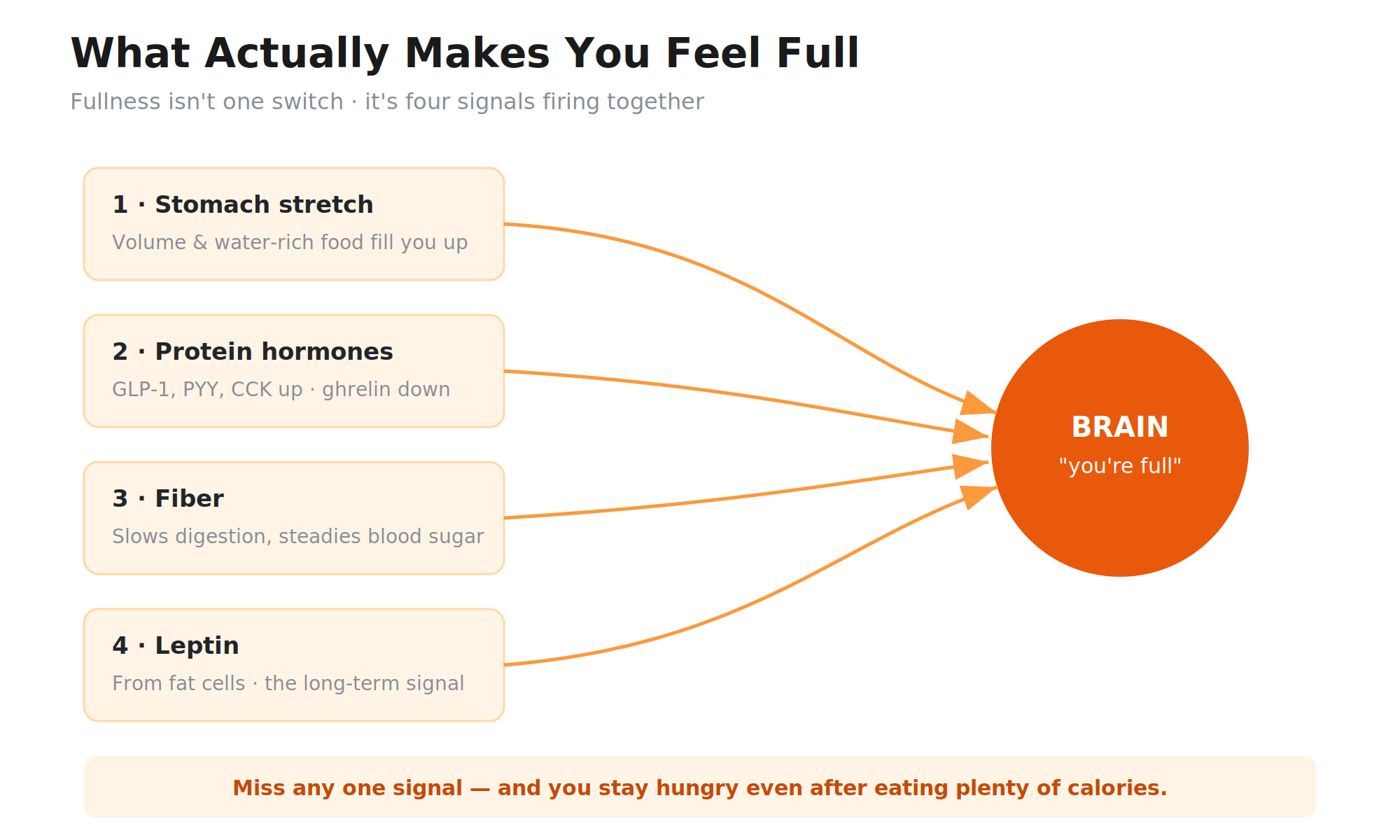
Here's the key insight: you can eat a large number of calories and still feel hungry if the meal didn't trigger these signals. A 600-calorie pastry has almost no protein, no fiber, and minimal volume — so despite the calories, none of your fullness signals fire, and you're hungry again within the hour. Meanwhile, a 400-calorie meal of eggs, vegetables, and Greek yogurt fires all of them and keeps you satisfied for hours.
Constant hunger almost always traces back to one of these signals being missing or disrupted. Now let's find yours.
Reason 1 — You're Not Eating Enough Protein
This is the most common cause, by a wide margin. Protein is the most satiating macronutrient — it triggers the strongest release of the fullness hormones (GLP-1, PYY, CCK) and suppresses ghrelin more than carbs or fat. If your meals are built around bread, pasta, rice, and snacks with protein as an afterthought, you'll be hungry no matter how many calories you eat.
The tell: you eat a full meal, feel satisfied for an hour, then you're hungry again. Or you finish a meal and don't feel like you "really ate." That's low protein.
The fix: Build every meal around a protein source first. Aim for 25–40 grams per meal — eggs, Greek yogurt, chicken, fish, cottage cheese, legumes. Most people who fix nothing else but their protein intake find their constant hunger largely resolves. For exactly how much you need, see our guide on how much protein per day to lose weight, and for the most filling options, high protein low calorie foods.
Reason 2 — You're Not Eating Enough Fiber
Fiber is protein's partner in satiety, and almost everyone is short on it. Most adults need 25–35 grams per day, and the average person eats roughly half that. Fiber adds bulk to meals, slows digestion, and — critically — prevents the rapid blood sugar swings that drive hunger.
Here's the blood sugar mechanism: when you eat refined carbs with no fiber (white bread, sugary snacks, juice), your blood sugar spikes fast, your body releases a surge of insulin, and then blood sugar crashes below where it started. That crash reads as hunger — often intense, sudden hunger — even though you just ate. Fiber blunts this entire cycle.
The fix: Add fiber-rich foods to every meal — vegetables, fruit, beans, lentils, whole grains, nuts. Vegetables in particular add huge volume for almost no calories, filling your stomach (the stretch signal) while delivering fiber. This is the entire principle behind volume eating, one of the most effective strategies for staying full in a deficit.
Reason 3 — You're Not Sleeping Enough
Poor sleep is one of the most underrated drivers of constant hunger, and the mechanism is purely hormonal. After even a single night of bad sleep, your leptin (the satiety hormone) drops and your ghrelin (the hunger hormone) rises. Stanford Lifestyle Medicine notes that this leaves you with "an overall experience of constantly being hungry" — and that the cravings skew toward ultra-processed foods, sugar, and alcohol.
So when you're sleep-deprived, you're hungrier overall and specifically craving the worst foods, all from a hormonal shift you have no conscious control over. You wake up after five hours of sleep and feel ravenous all day — that's not in your head, it's your hunger hormones recalibrated in the wrong direction.
The fix: Prioritize 7+ hours of sleep. Even partial sleep recovery begins to normalize ghrelin and leptin. If you've been blaming your willpower for a hunger problem that's actually a sleep problem, this is the fix that unlocks everything else. Our full guide on how sleep affects weight loss covers the mechanism in depth.
Reason 4 — You're Drinking Your Calories
Liquid calories are uniquely bad at triggering fullness. When you drink a 500-calorie smoothie or a sweetened coffee, the calories go down fast and your stomach barely registers them — liquids empty quickly, and the fullness signals that solid food triggers don't fire the same way. You consume the calories of a meal and feel like you ate nothing.
This is a double problem: you're taking in significant calories (which works against weight loss) while getting almost no satiety in return (which keeps you hungry, so you eat more on top). Smoothies, juices, sweetened coffees, sodas, and alcohol all do this.
The fix: Eat your calories, don't drink them. Choose water, black coffee, or unsweetened tea, and get your nutrition from food you chew. If you love smoothies, treat them as an occasional meal replacement — not an addition — and add protein and fiber to at least give them a fighting chance at filling you up. See our guide on what to drink to lose weight for the full breakdown.
Reason 5 — You're Actually Thirsty
This one is simple but real: the body's signals for thirst and hunger are easy to confuse, and mild dehydration often masquerades as hunger. You feel a vague urge to eat, when what your body actually wants is water.
It's not that thirst "feels exactly like" hunger — it's that the signals are ambiguous enough that people frequently reach for food when water would have resolved the feeling. If you're chronically under-hydrated, this can show up as near-constant low-level "hunger" throughout the day.
The fix: When you feel hungry between meals — especially shortly after eating, when you can't plausibly be truly hungry — drink a glass of water and wait ten minutes. If the hunger fades, it was thirst. Staying well-hydrated throughout the day reduces these false hunger signals. It's the easiest fix on this list to test.
Reason 6 — You're Eating Ultra-Processed Food
Ultra-processed foods are, in many cases, literally engineered to not fill you up. Food scientists optimize them for "palatability" and consumption volume — the industry term is the "bliss point," the precise combination of sugar, fat, and salt that makes you want to keep eating. These foods are calorie-dense, low in protein and fiber, and designed to bypass your natural fullness signals.
This is why you can eat an entire bag of chips or a sleeve of cookies and not feel full — they're built to be eaten in large quantities without triggering satiety. Whole foods do the opposite: they're harder to overeat precisely because they fill you up before you've consumed too many calories.
The fix: Shift the bulk of your diet toward whole, minimally processed foods — meat, fish, eggs, dairy, vegetables, fruit, legumes, whole grains. You don't have to be perfect or eliminate processed food entirely. Just make whole foods the foundation, and you'll naturally feel fuller on fewer calories because those foods work with your satiety signals instead of against them.
Reason 7 — Your Calorie Deficit Is Too Aggressive
If you've slashed your calories dramatically to lose weight fast, hunger is the predictable result. An overly steep deficit — eating far below what your body needs — sends strong hunger signals as your body tries to correct the shortfall. Crash diets don't fail because people are weak; they fail because the hunger they create is biologically unsustainable.
The tell: you cut your calories hard, lost weight quickly for a week or two, and now you're ravenous all the time and fighting the urge to binge. That's not a character flaw — that's your body responding exactly as designed to an extreme deficit.
The fix: Use a moderate deficit, not an extreme one. A deficit of 300–500 calories per day produces sustainable fat loss without triggering the intense hunger of a crash diet. You'll lose weight slightly slower but actually keep it off, because you can sustain it. Our guide on how to lose weight fast explains how to do this without destroying your adherence, and the TDEE calculator helps you set the right target.
Reason 8 — You Lost Muscle From Crash Dieting
This is the long-term consequence of Reason 7, and it's a vicious cycle. When you crash diet without enough protein or resistance training, you lose muscle along with fat. Muscle is metabolically active tissue, so losing it lowers your metabolism and disrupts the appetite-regulating signals tied to your body composition. You end up with a slower metabolism and a dysregulated appetite — hungrier, on fewer calories, with less muscle to show for it.
This is how repeated crash diets make people progressively hungrier and heavier over time. Each cycle strips muscle, lowers metabolism, and worsens the hunger signals, making the next diet harder than the last.
The fix: Break the cycle by dieting in a way that preserves muscle: a moderate deficit, adequate protein (around 1 gram per pound of goal body weight), and resistance training 2–3 times per week. This protects your metabolism and keeps your appetite signals healthier. If you've been through multiple crash diets, prioritizing muscle preservation on your next attempt is the single most important change you can make.
Which One Is You?
With eight possibilities, the question becomes: which one is actually driving your hunger? Run yourself through this quick diagnostic. (This article is about chronic, all-day hunger; if your problem is specifically late-night eating, that's a different pattern with its own fixes — see how to stop eating at night.)
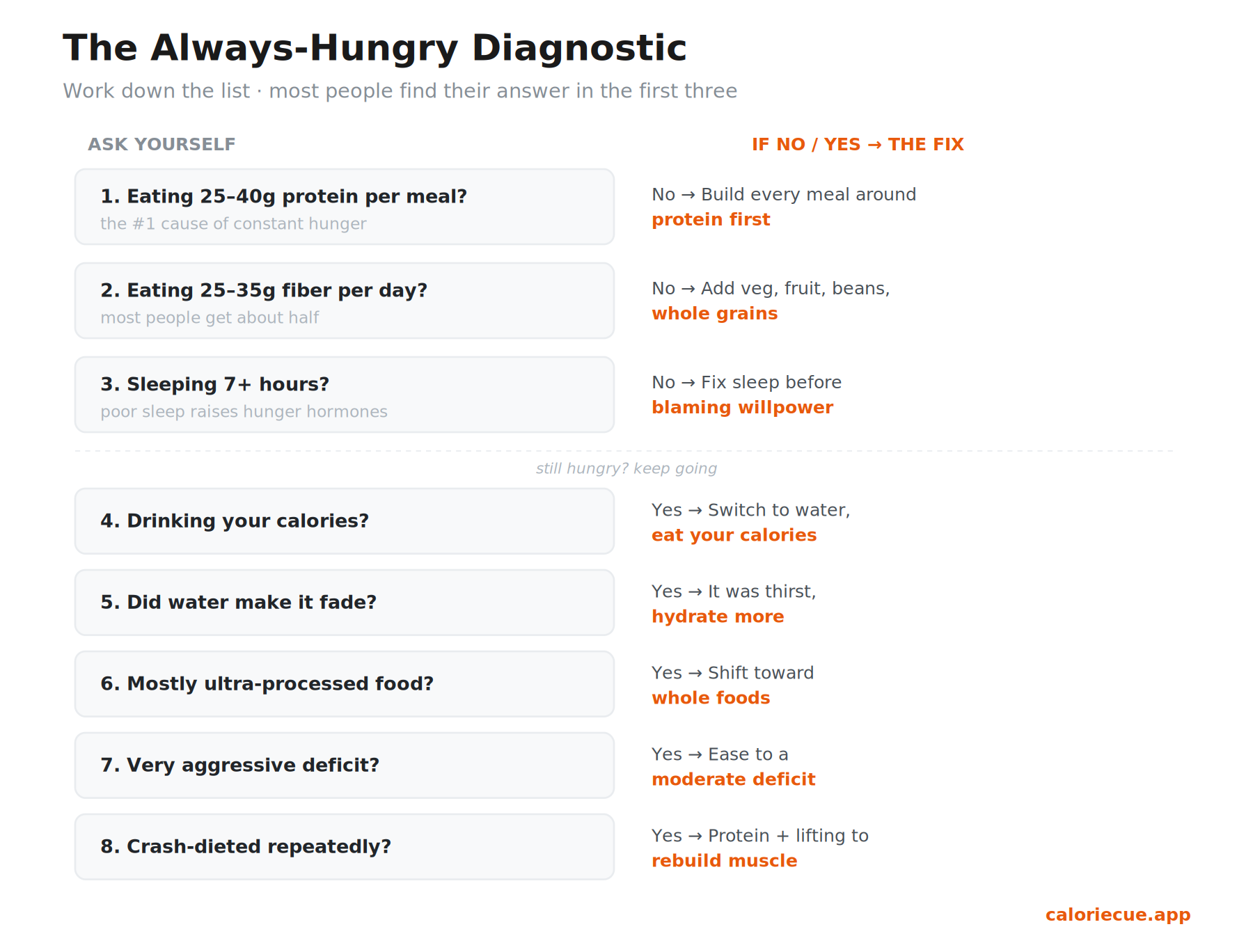
Ask yourself, in order:
- Am I eating 25–40g of protein per meal? If no — start here. This is the most common cause.
- Am I eating 25–35g of fiber per day? If no — add vegetables, fruit, beans, whole grains.
- Am I sleeping 7+ hours? If no — fix this before blaming anything else.
- Am I drinking my calories? If yes — switch to water and eat your calories instead.
- Did a glass of water make the hunger fade? If yes — you were thirsty; hydrate more.
- Is most of my food ultra-processed? If yes — shift toward whole foods.
- Is my deficit very aggressive? If yes — ease off to a moderate deficit.
- Have I crash-dieted repeatedly? If yes — prioritize protein and lifting to rebuild.
Most people find their answer in the first three boxes — protein, fiber, sleep. Those three account for the overwhelming majority of "I'm always hungry" cases. Fix those, and if you're still hungry, work down the list.
Frequently Asked Questions
Why am I still hungry after eating a full meal?
Almost always because the meal didn't trigger your fullness signals — typically too little protein, too little fiber, or too little volume. A meal can have plenty of calories (a pastry, a bowl of pasta) and still leave you hungry because it doesn't fire the satiety hormones. Build meals around protein and fiber-rich, high-volume foods and the after-meal hunger usually resolves.
Does drinking water actually reduce hunger?
It helps in two ways: it can resolve hunger that was actually thirst in disguise, and a glass of water before meals adds stomach volume that contributes to fullness. It's not a magic appetite suppressant, but staying well-hydrated genuinely reduces false hunger signals throughout the day.
Can being hungry all the time be a medical issue?
Usually it's one of the dietary or lifestyle causes in this article. But persistent, extreme hunger that doesn't respond to adequate protein, fiber, and sleep can occasionally signal a medical issue — certain thyroid conditions, blood sugar dysregulation, diabetes, or medication side effects. If you've genuinely addressed the causes here and you're still ravenous, it's worth talking to a doctor.
Why am I hungrier on some days than others?
Several factors fluctuate day to day: how you slept the night before (sleep directly affects hunger hormones), how much you ate the previous day, your activity level, stress, hydration, and — for women — your menstrual cycle, which affects appetite. A hungrier day is usually explained by poor sleep, a hard workout, or under-eating the day before.
Does being in a calorie deficit always mean being hungry?
No. A moderate deficit built around protein, fiber, and high-volume foods can be remarkably comfortable. The hunger people associate with dieting usually comes from a deficit that's too aggressive, too low in protein, or too reliant on processed foods. Fix those and a deficit doesn't have to mean constant hunger.
Will eating more protein really stop my hunger?
For most people, yes — it's the single most effective change. Protein triggers the strongest satiety hormone response and suppresses ghrelin more than carbs or fat. If you're under-eating protein (most people are), increasing it is the highest-leverage fix for constant hunger.
Is it normal to feel hungry when losing weight?
Some hunger is normal in a deficit, but constant, intense hunger is a sign something's off — usually one of the eight reasons here. Mild hunger before meals is fine and expected. Feeling ravenous all day is a signal to check your protein, fiber, sleep, and deficit size.
The Bottom Line
Constant hunger isn't a character flaw, and the solution isn't to suffer through it with sheer willpower. Hunger is a signal, and when it won't quiet down, it means one of your fullness mechanisms is missing or broken. Find the broken signal, fix it, and the hunger fades on its own.
The eight real reasons, in roughly the order they matter: too little protein, too little fiber, too little sleep, drinking your calories, dehydration, ultra-processed food, too aggressive a deficit, and muscle loss from repeated crash dieting. Most people find their answer in the first three — protein, fiber, and sleep account for the vast majority of cases. Start there, work down the list if you need to, and see a doctor if you've genuinely addressed all of them and you're still ravenous.
Notice the through-line: every fix works with your biology instead of against it. Eat protein and fiber, and your satiety hormones fire. Sleep enough, and your hunger hormones stay balanced. Use a moderate deficit, and your body doesn't sound the alarm. This is the opposite of white-knuckling — it's making your body want to stop eating at the right point, instead of forcing it to.
The hardest part of fixing hunger is seeing what you're actually eating — most people dramatically underestimate how little protein and fiber they get. CalorieCue shows your protein adding up in real time as you photograph your meals, so you can see at a glance whether you're hitting the protein and food choices that keep you full — or whether a 600-calorie meal that left you hungry was missing the signals that matter. Take the guesswork out, fix the broken signal, and stop fighting your own body. 7-day free trial, then paid.
You were never weak. You were just missing a signal. Now you know which ones to check.
Download CalorieCue