On this page
- The Math Is Brutal (And Most People Avoid It)
- Why a Single Cheat Meal Is Totally Fine
- The Metabolic Boost Is Mostly a Myth
- The Three Approaches (And Which to Use)
- The Cheat Meal — Low Risk, Use Freely
- The Cheat Day — High Risk, Mostly Avoid
- The Planned Refeed — Smart, For Those Who Want Structure
- How to Have a "Cheat" Without Wrecking Your Week
- Reframe It as a "Free Meal," Not a "Cheat"
- Plan It in Advance
- Don't "Save Up" All Day for It
- Get Right Back to Normal — Immediately
- Expect the Scale to Jump (And Ignore It)
- Frequently Asked Questions
- Are cheat days bad for weight loss?
- How often can I have a cheat meal?
- Do cheat days actually boost your metabolism?
- What's the difference between a cheat day and a refeed?
- Will one cheat meal ruin my progress?
- Why did I gain 2 pounds after my cheat meal?
- Should I work out harder to "burn off" a cheat meal?
- The Bottom Line
Let me settle the core question immediately: a cheat meal almost never wrecks your progress, and a cheat day almost always can. The difference between them isn't willpower or guilt — it's arithmetic. "Day" is simply the wrong unit of measurement, and that single error is why so many people diet hard all week and never lose weight.
Here's the thing nobody in cheat-day culture wants to do: the math. One meal off-plan — even an indulgent one, say 1,000 calories over your target — is a rounding error against a week of disciplined eating. But a full day of genuinely unrestricted eating, the kind people actually mean when they say "cheat day," routinely hits 3,000 or more surplus calories. That doesn't dent your week. It erases it.
This post is about what actually happens, physically, when you have a cheat meal or a cheat day — including the "it boosts your metabolism" claim, which is mostly a myth — and how to indulge in a way that gives you the psychological break you want without quietly undoing everything you worked for. The short version: stop thinking in days. Think in meals.
The Math Is Brutal (And Most People Avoid It)
The reason cheat days fail isn't mysterious. It's that the calorie surplus from a day of unrestricted eating is far larger than people realize, and it's measured against a weekly deficit that's smaller than people think.
Let's run a normal example. You're eating in a 500-calorie daily deficit — a standard, sustainable rate aimed at losing about a pound a week. From Monday through Friday, you bank 2,500 calories of deficit. You've been disciplined. You've earned some progress.
Then Saturday's "cheat day" arrives. Here's what an actual unrestricted day looks like: a big breakfast out (pancakes, bacon, juice — 1,200 calories), a casual lunch (another 800), snacking through the afternoon (500), an indulgent dinner with drinks (1,500), and dessert (600). That's 4,600 calories on a day your maintenance is maybe 2,200. You've just eaten a 2,400-calorie surplus in a single day.
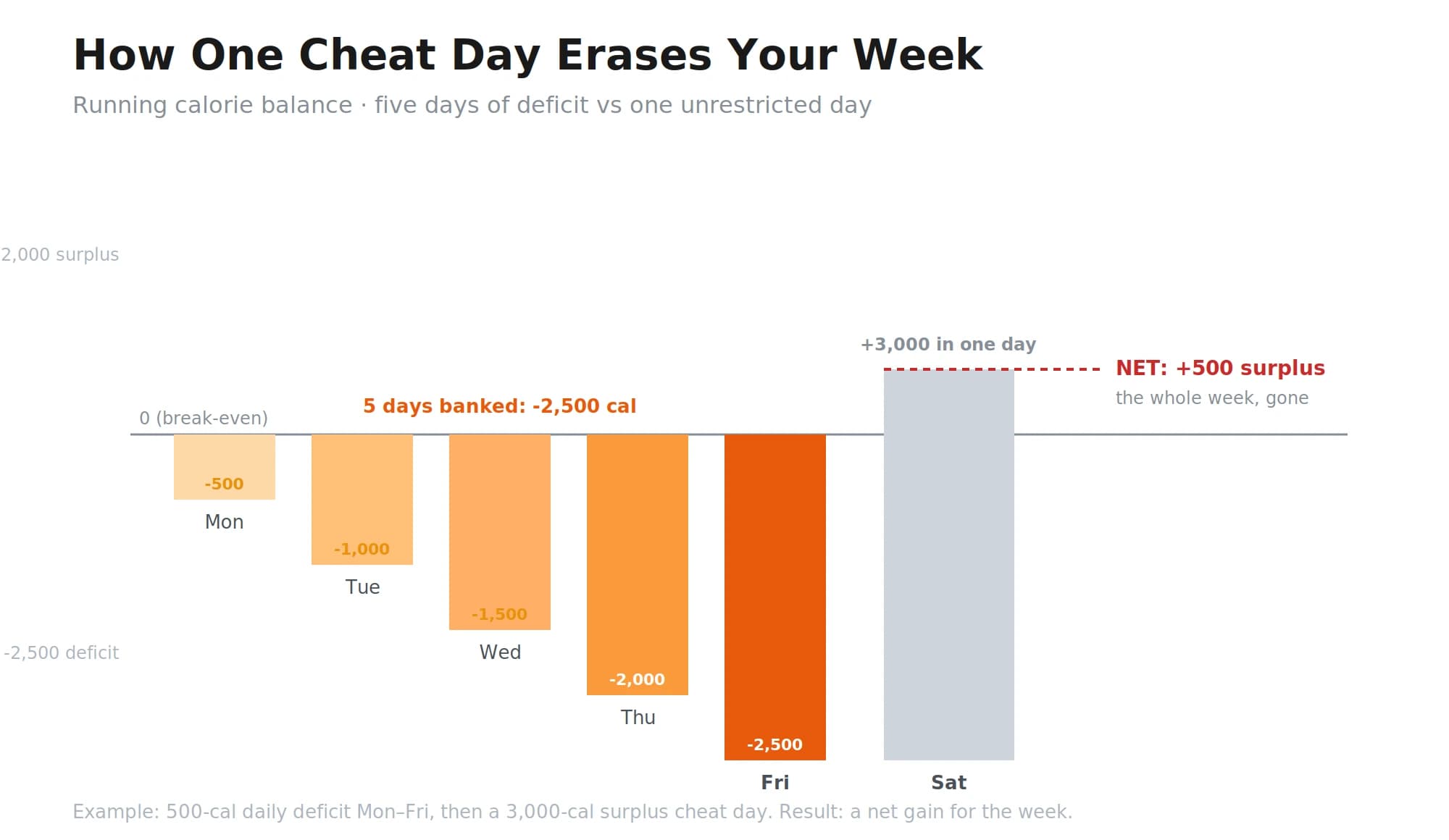
Do the weekly tally: you banked 2,500 calories of deficit over five days, then erased nearly all of it (and then some) in one. Your net for the week is roughly break-even or slightly positive. You didn't lose weight. You may have gained. And the cruelest part is that it felt like you were doing everything right — five great days and just "one day off."
This is the core problem. A day is enough time to consume a surplus large enough to erase a week. A single meal almost never is. Which is exactly why the unit matters so much. If you've been dieting hard and the scale won't move, a hidden weekend surplus is one of the first suspects to rule out — see why your calorie deficit isn't working. For help nailing down your actual deficit numbers, see our calorie deficit guide and the TDEE calculator.
Why a Single Cheat Meal Is Totally Fine
Now the good news, because this isn't an argument for joyless perfection.
A single cheat meal — one indulgent meal, even a big one — is mathematically trivial against a well-run week, and it carries real benefits that have nothing to do with calories. Let's say your cheat meal is 1,000 calories over what that meal would normally be. Against five days of 500-calorie deficits (2,500 banked), you're still net negative 1,500 for the week. You still lost weight. The indulgence cost you a little progress, not all of it.
And the psychological value is real. Dieting with zero flexibility is how most diets die. The research is consistent that overly rigid restriction tends to backfire into binging — Healthline notes that food restriction ultimately leads to overeating or binging for most people, which is the entire reason the cheat concept became popular in the first place. A planned indulgence relieves that pressure. It satisfies the craving, gives you something to look forward to, and makes the disciplined days sustainable.
The key word is meal. One meal has a natural stopping point — it ends. You eat the burger and fries, you enjoy the dessert, and then the meal is over and you go back to normal. A "day" has no built-in brake. It's twelve-plus waking hours of permission, and permission tends to expand to fill the time available. That structural difference — a meal ends, a day sprawls — is why one works and one doesn't. (That cheat meal is often a restaurant meal, which makes the number hard to eyeball — here's how to track calories when eating out so you can still see roughly where it lands.)
The Metabolic Boost Is Mostly a Myth
Here's where cheat-day culture gets its pseudoscience. The popular claim is that a cheat day "resets your metabolism," "boosts leptin," and "prevents starvation mode," so that day of eating actually helps you lose fat. It's a comforting story. It's mostly wrong.
There's a kernel of truth: overeating, especially carbs, does temporarily raise leptin — the hormone that signals fullness and slightly influences metabolic rate. After a period of dieting, a big meal can bump leptin by roughly 20–30%. That part is real.
But look at the timeline. That leptin spike lasts less than 24 hours — some research suggests the meaningful elevation is more like 6 hours. It does not last the 48–72 hours that cheat-day advocates claim, and the metabolic effect during that brief window is small. One landmark study (Dirlewanger and colleagues) found a 28% leptin increase only after participants ate 140% of maintenance calories for three straight days — not from a single meal or day.
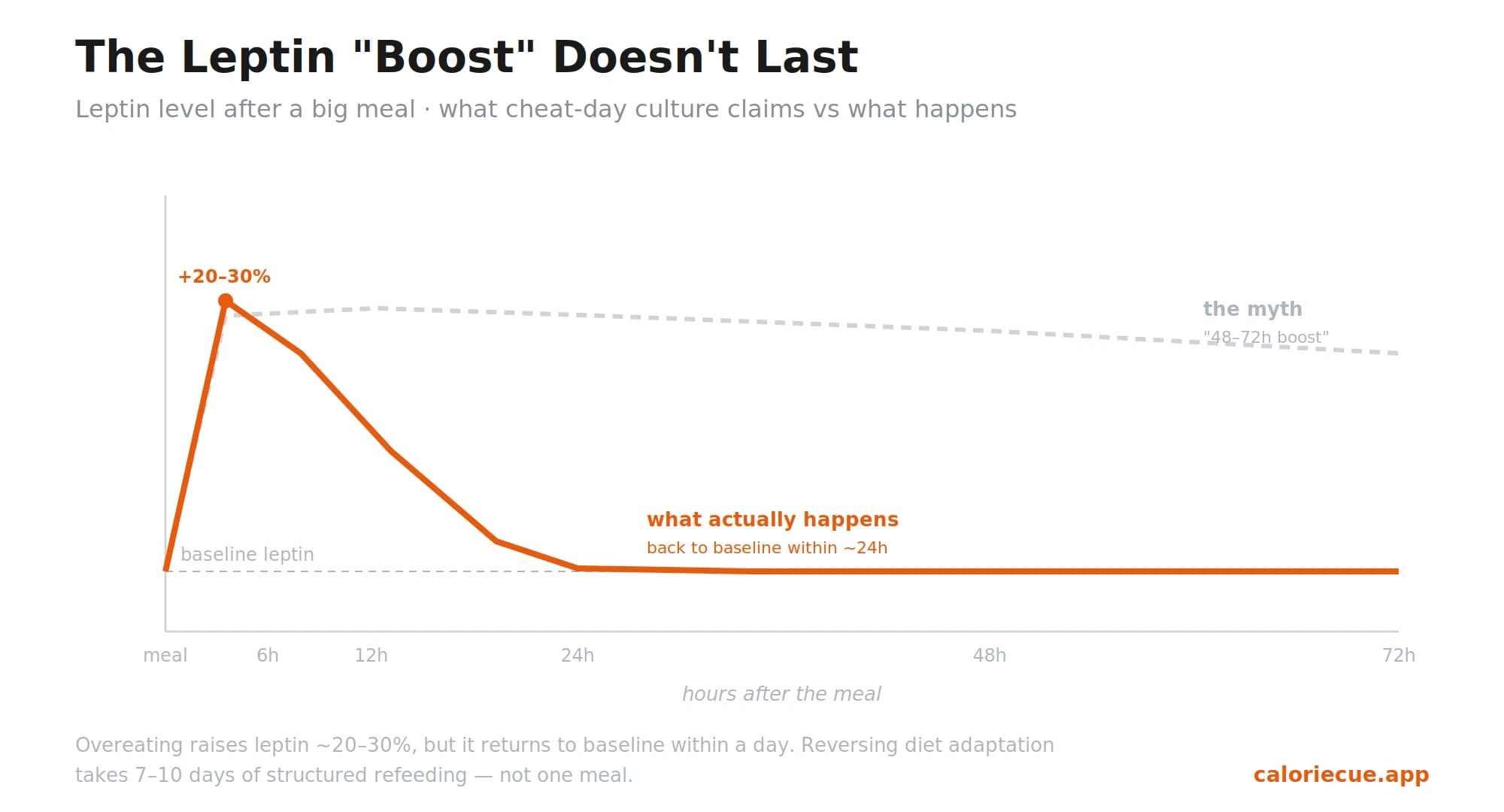
The deeper problem is what happens after. As Biolayne summarizes the research, the hormones that shift upward during a high-calorie day fall right back down as soon as you restrict intake again the next day. The boost, such as it is, evaporates. Long-term studies — primarily in people with obesity — do not support the idea that single high-calorie days meaningfully improve fat loss, precisely because the hormonal effects are so short-lived.
To actually reverse the metabolic adaptation that comes with extended dieting, the research points to 7–10 days of structured refeeding, not one pizza night. A single cheat day gives you the calorie surplus of a metabolic intervention with virtually none of the metabolic benefit. You get the downside without the upside.
So eat the cheat meal if you want it — just do it for the enjoyment and the psychological break, which are legitimate reasons. Don't do it because you think it's stoking your metabolic furnace. It isn't.
The Three Approaches (And Which to Use)
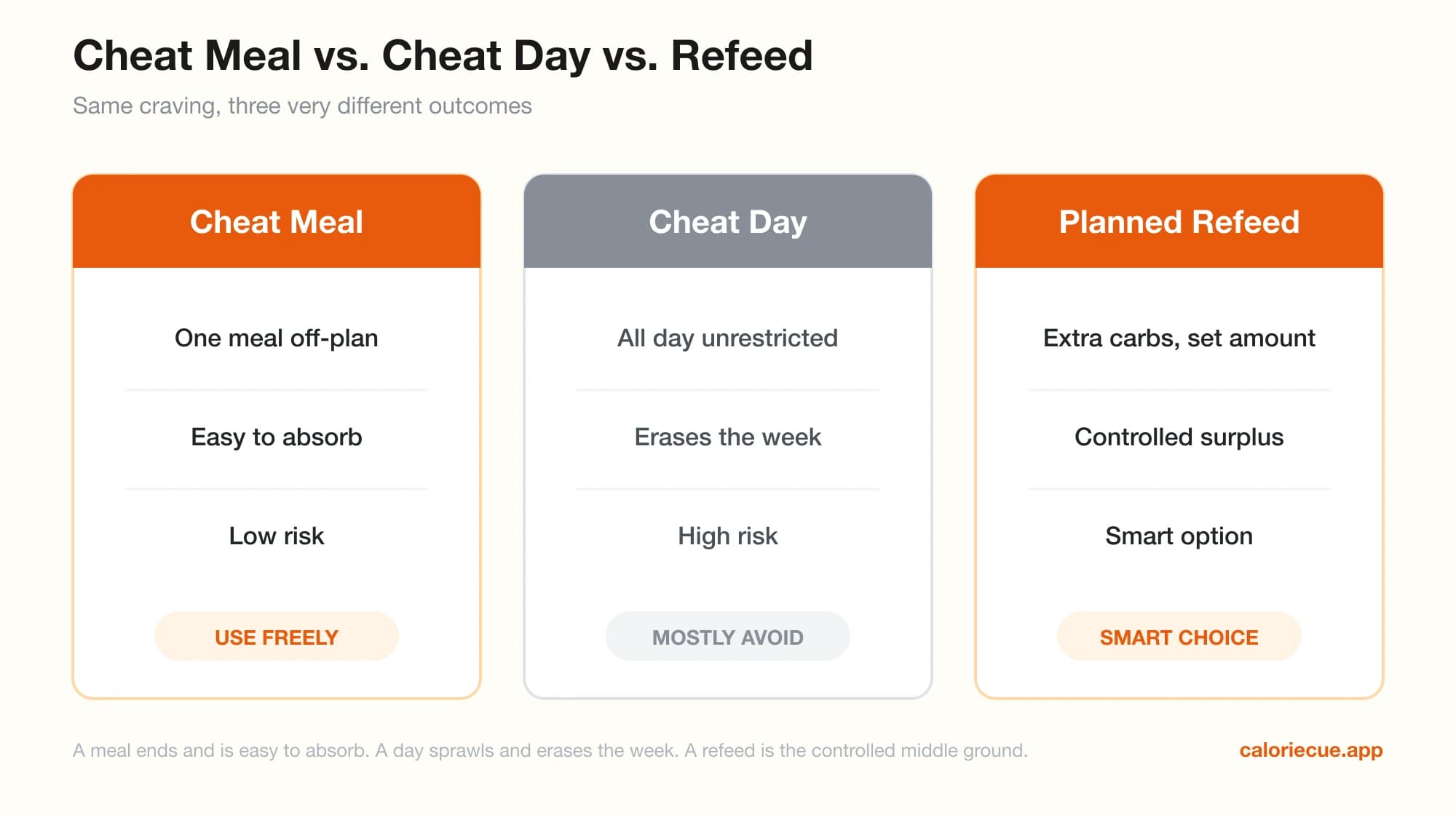
"Eating more than usual" isn't one thing. There are three distinct versions, and they produce very different results. Knowing the difference is most of the battle.
The Cheat Meal — Low Risk, Use Freely
One meal off-plan, eaten and finished. Easy to absorb into a weekly deficit, has a natural endpoint, and delivers the psychological release that keeps you sane. This is the default tool for most people. Have one once or twice a week, enjoy it fully, and move on. The damage is minimal and the benefit is real.
The Cheat Day — High Risk, Mostly Avoid
A full day of unrestricted eating. This is the one that erases weeks, as the math above shows. It has no natural brake, routinely produces 2,000–3,000+ surplus calories, and — per the research — provides essentially none of the metabolic benefit people imagine. Worse, Healthline notes that the "binge on unlimited food" framing of cheat days can encourage a distorted relationship with food. For most people, the cheat day is the worst of the three options. If you take nothing else from this article: drop the cheat day, keep the cheat meal.
The Planned Refeed — Smart, For Those Who Want Structure
A refeed is the disciplined cousin of the cheat day. Instead of unrestricted eating, you deliberately raise calories — mostly from carbohydrates — by a set amount (often to roughly maintenance, or a modest surplus) for one to three days. The difference is control: you choose the foods and the amount in advance. A refeed replenishes glycogen, gives a real leptin bump, offers a mental break, and refills you for hard training — all without the blowout surplus of a cheat day. It's the option for people who want the benefits of "eating more" without rolling the dice, and a structured refeed is one of the legitimate tools for breaking a weight loss plateau. As a simple example: if you eat 1,800 calories Monday–Friday, you might eat 2,300 (mostly extra carbs) on Saturday and Sunday — a controlled bump, not a free-for-all.
The hierarchy for most people: cheat meals freely, refeeds if you want structure, cheat days basically never.
How to Have a "Cheat" Without Wrecking Your Week
Practical rules for indulging intelligently.
Reframe It as a "Free Meal," Not a "Cheat"
The language matters more than it seems. "Cheating" implies you're breaking the rules, doing something wrong, getting away with something — which sets up a guilt-and-rebellion cycle that tends to escalate. A "free meal" or "planned indulgence" is just part of the plan. Same food, healthier psychology. You're not cheating on your diet; this is your diet, flexibility included.
Plan It in Advance
A planned indulgence is a tool. An unplanned one is a slip that tends to snowball. Decide ahead of time: which meal, roughly when, and that it's one meal. Knowing Saturday dinner is your free meal helps you stay on track Monday through Friday, because you're not depriving yourself indefinitely — you're waiting for a scheduled release.
Don't "Save Up" All Day for It
A common mistake: barely eating all day to "bank" calories for a big cheat dinner. This usually backfires — you arrive at the meal ravenous, your willpower is gone, and you overeat far more than you saved. Eat normally during the day, especially protein, then have your free meal. You'll eat less and enjoy it more. (This is the same mechanism behind overeating at night — under-eating during the day drives overeating later.)
Get Right Back to Normal — Immediately
The single most important rule. One free meal stays trivial only if the very next meal is back on plan. The danger isn't the indulgent meal; it's the "well, I already blew it, might as well make it a whole day (or weekend)" spiral that turns one meal into three days. There's nothing to recover from after one meal — so don't act like there is. Next meal, normal. Done.
Expect the Scale to Jump (And Ignore It)
After a free meal — especially a salty, carb-heavy one — the scale will likely be up a couple pounds the next morning. This is water and food weight, not fat. A 1,000-calorie surplus cannot become 2 pounds of fat overnight; that would take a ~7,000-calorie surplus. The bump is temporary and will flush within a day or two. Don't panic, don't "punish" yourself with extreme restriction — just return to normal and let it pass. Our guide on why your weight fluctuates daily explains exactly why this happens.
The whole skill is one habit: see the real number, then move on. CalorieCue lets you snap a photo of that indulgent meal and shows exactly where it lands against your week — so you know whether you're still in a deficit or need to ease back, instead of guessing. Enjoy the meal, see the number, get back to normal. Download CalorieCue free on the App Store.
Frequently Asked Questions
Are cheat days bad for weight loss?
A full day of unrestricted eating usually is, because the surplus from an entire day can erase a week's deficit and the metabolic "benefits" are largely a myth. A single cheat meal, by contrast, is fine and even helpful for sustainability. The issue is the unit: a meal ends, a day sprawls. Keep the meal, drop the day.
How often can I have a cheat meal?
For most people, once or twice a week works well without meaningfully slowing progress — assuming the rest of the week is on plan and the cheat meal is a single meal, not a gateway to a whole day. The leaner and more aggressive your goal, the more carefully you'll want to manage frequency.
Do cheat days actually boost your metabolism?
Not meaningfully. Overeating raises leptin by about 20–30%, but the effect lasts under 24 hours and the metabolic bump is small. Reversing real metabolic adaptation requires 7–10 days of structured refeeding, not a single day. The "cheat day boosts metabolism" claim is mostly fitness folklore.
What's the difference between a cheat day and a refeed?
A cheat day is unrestricted, unplanned eating. A refeed is a deliberate, controlled increase in calories — mostly carbs — by a set amount for one to three days. The refeed gives you the real benefits (glycogen replenishment, leptin bump, mental break, better training) without the blowout surplus. A refeed is planned; a cheat day is permission.
Will one cheat meal ruin my progress?
No. One indulgent meal, even a big one, is a small dent against a well-run week — you'll typically still be in a net deficit. What ruins progress is letting one meal become a whole day or weekend. The meal is fine; the spiral is the problem.
Why did I gain 2 pounds after my cheat meal?
That's water and food weight, not fat. A salty, high-carb meal causes your body to retain water (carbs store with water, and sodium drives retention), and the food itself is still in transit. It's not possible to gain 2 pounds of fat from one meal — that would require roughly a 7,000-calorie surplus. The bump flushes within a day or two.
Should I work out harder to "burn off" a cheat meal?
You don't need to, and trying to "earn back" or "punish" indulgences sets up an unhealthy exercise-as-penance dynamic. One free meal doesn't require compensation. Just return to your normal routine and normal eating. Consistency over the week matters far more than offsetting a single meal.
The Bottom Line
The whole cheat-meal-versus-cheat-day debate comes down to one insight: "day" is the wrong unit. A single meal off-plan is a rounding error against a disciplined week, and it delivers a genuine psychological break that makes dieting sustainable. A full day of unrestricted eating can erase everything you banked Monday through Friday — and it does it while feeling like "just one day off."
The metabolic justification doesn't hold up either. Yes, overeating bumps leptin 20–30%, but it's gone within a day, and meaningfully reversing diet adaptation takes 7–10 days of structured refeeding — not one blowout. So have the cheat meal for the enjoyment, which is reason enough. Don't kid yourself that it's stoking your metabolism.
The smarter framework: have planned free meals once or twice a week, use structured refeeds if you want the glycogen and training benefits, and drop the unrestricted cheat day almost entirely. Reframe "cheating" as flexibility that's built into your plan, never save up all day for one meal, and — most important — get right back to normal at the very next meal instead of spiraling.
The hardest part is knowing whether a "free meal" actually fit your week or quietly blew it. That's where tracking earns its place: CalorieCue lets you snap a photo of that indulgent meal and see exactly where it lands against your week — so you know whether you're still in a deficit or need to ease back, instead of guessing. Enjoy the meal, see the real number, move on.
Eat the burger. Enjoy it completely. Then have your next meal like normal. That's the entire skill — and it's the opposite of a cheat day.
Download CalorieCue