On this page
- Night Eating Starts in the Morning
- The Five Real Causes (In Order of Impact)
- 1. You Under-Ate During the Day
- 2. You Didn't Eat Enough Protein
- 3. You're Sleep-Deprived
- 4. You Eat in Front of Screens
- 5. It's Emotional, Not Physical
- Fix #1: Eat Earlier and Heavier
- Fix #2: Run the Hunger Test Before You Eat
- Fix #3: Break the Screen-Eating Link
- Fix #4: Address the Emotional Piece Honestly
- What Doesn't Work (And Why Everyone Recommends It Anyway)
- A Realistic 1-Week Plan
- Frequently Asked Questions
- Is it bad to eat at night?
- Why am I not hungry during the day but ravenous at night?
- Does eating at night cause weight gain specifically?
- What if I'm genuinely hungry at night?
- Could this be Night Eating Syndrome?
- How long until night eating improves?
- The Bottom Line
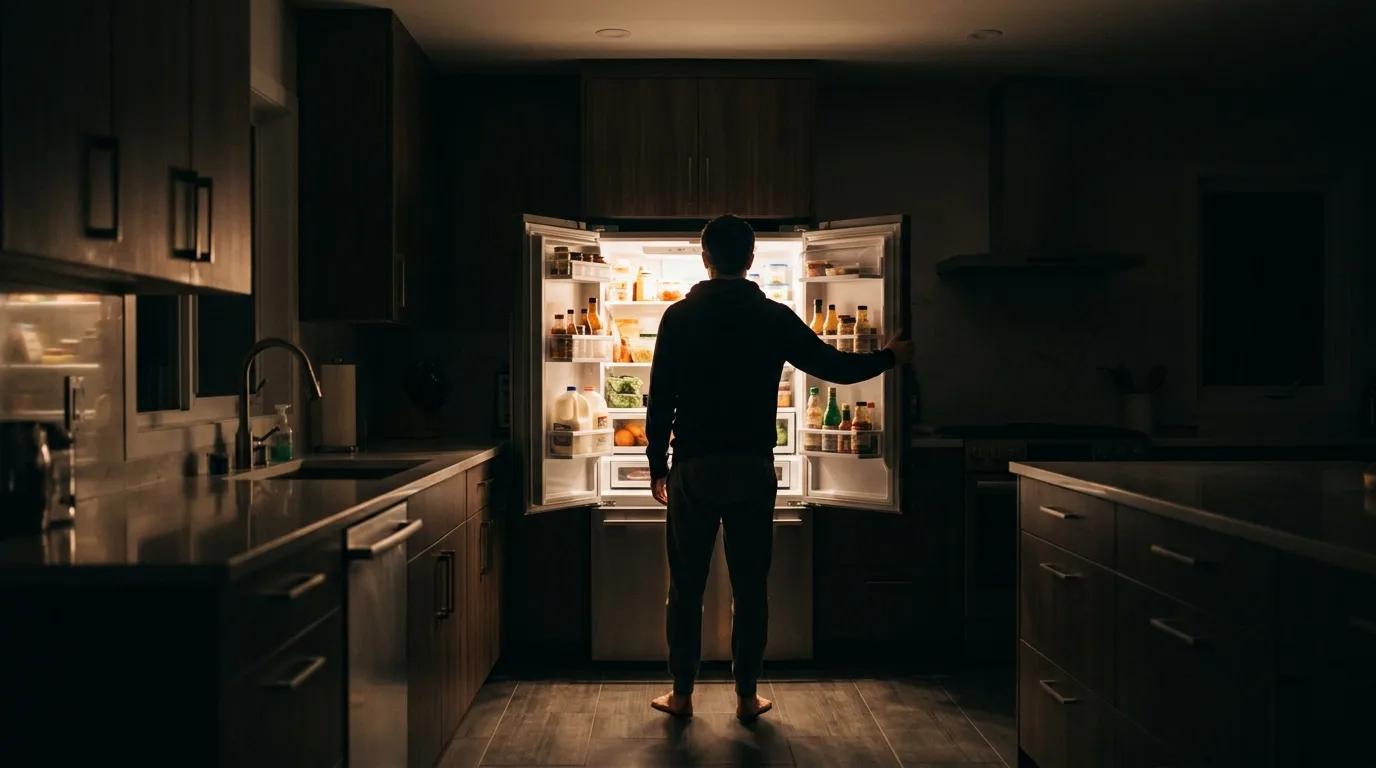
It's 9pm. Dinner was two hours ago. You weren't even hungry — and yet here you are, standing in front of the open fridge, eating something you didn't plan to eat and won't enjoy as much as you think you will.
If that scene is familiar, you've probably been told the problem is willpower. That you need more discipline, fewer snacks in the house, an earlier bedtime. Most advice on night eating treats it like a moral failing you can white-knuckle your way past.
It isn't. And that's why the white-knuckle approach keeps failing.
Night eating is almost never about night. It's about everything that happened in the twelve hours before — what you ate, what you didn't eat, how you slept, and how much of your day you spent "being good" so you could feel justified later. The 9pm binge is the symptom. The cause is upstream, in the daylight hours, where nobody's looking.
This post is about the real reasons you can't stop eating at night, and the fixes that actually work — which have very little to do with hiding the cookies.
Night Eating Starts in the Morning
Here's the single most important idea in this post, and the one almost nobody tells you: the amount you eat at night is largely determined by how you ate during the day.
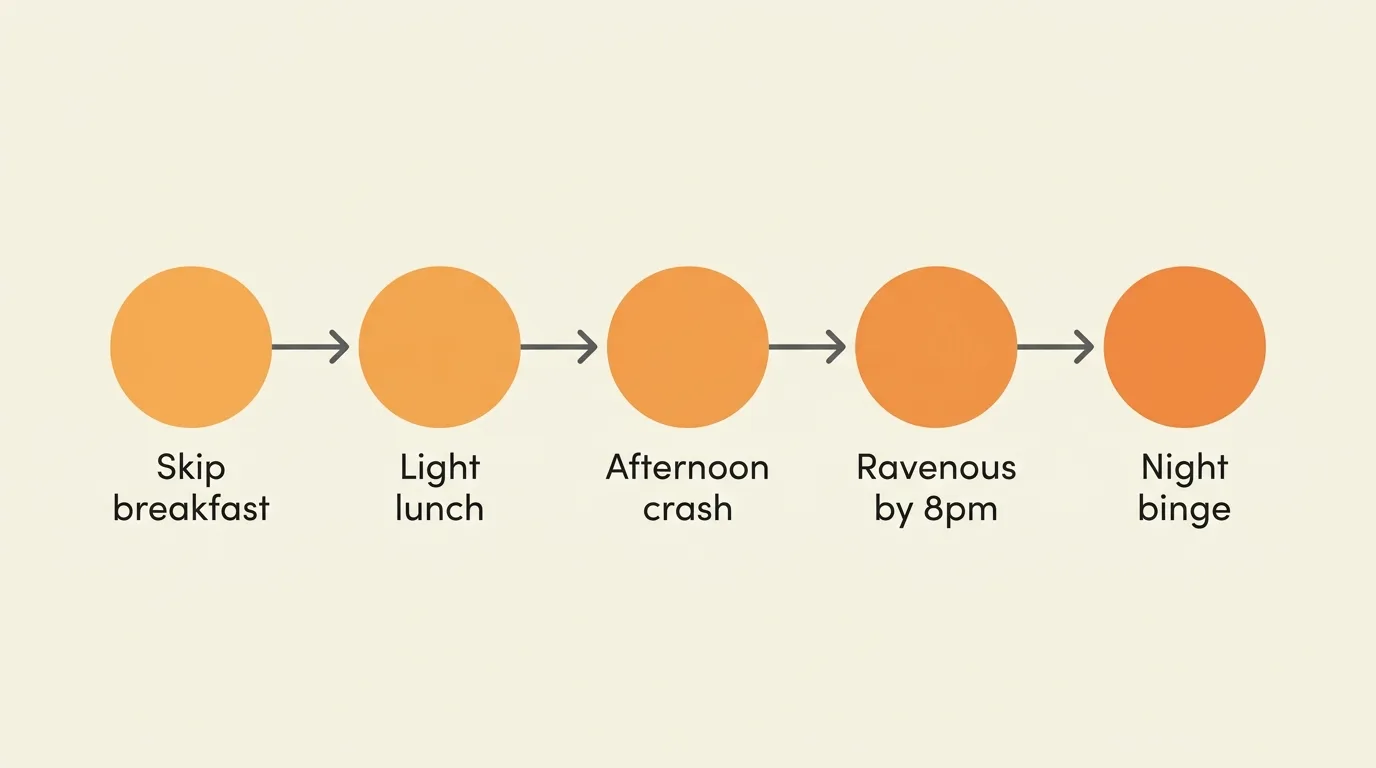
The most common pattern looks like this. You wake up, skip breakfast or have something tiny (coffee, half a banana, "I'm not really a breakfast person"). You eat a light, virtuous lunch — a salad, maybe, because you're "being good." By mid-afternoon you're running on fumes, so you grab caffeine instead of food. You make it to dinner feeling accomplished about how little you've eaten.
And then dinner happens. And then dinner doesn't stop. You eat your meal, then you keep grazing. By 9pm you're three snacks deep and you can't figure out why your "good day" turned into this.
The reason is biological, not moral. When you under-eat during the day — especially when you skip breakfast — your body responds by dysregulating the hormones that control hunger. Research reviewed in eFood (2025) found that skipping breakfast disrupts appetite-regulating hormones like leptin and ghrelin, "predisposing individuals to increased hunger and impaired glycemic control later in the day."
In plain terms: the body keeps score. Calories and protein you skipped in the morning don't just vanish — they create a debt that comes due at night, with interest. The 9pm binge isn't a failure of character. It's your body collecting what you owe it.
This reframe matters because it changes where you intervene. If night eating is a willpower problem, the fix is restriction at night — which fails, because you're fighting biology with discipline. If night eating is a daytime problem, the fix is upstream, where it's actually winnable.
The Five Real Causes (In Order of Impact)
Let's get specific about what's actually driving the night eating. These are ranked by how much damage they typically do.
1. You Under-Ate During the Day
This is the big one, covered above. If you front-load your "being good" into the morning and afternoon by eating very little, you've set a trap that springs at night. The body's hunger drive is cumulative — you can suppress it during the busy, distracted daytime, but it doesn't disappear. It waits until you're tired, home, and unoccupied, and then it hits all at once.
The tell: your night eating is worse on days you ate "really well" (read: very little) during the day. If your most disciplined days produce your worst nights, this is your cause.
2. You Didn't Eat Enough Protein
Protein is the most satiating macronutrient, and most people who struggle with night eating are under-eating it — particularly at breakfast. A protein-poor day (cereal, sandwich, pasta) leaves you technically fed but never satisfied, because carbs and fat don't trigger satiety the way protein does.
The eFood review notes that breakfasts "high in protein and fiber support stable insulin and cortisol rhythms," while sugar-dense breakfasts cause glycemic spikes and crashes. A 400-calorie protein breakfast keeps you full for hours. A 400-calorie pastry breakfast leaves you hungry by 10am and chasing that feeling all day. For specific strategies, see our guide on how to eat more protein.
3. You're Sleep-Deprived
Poor sleep is rocket fuel for night eating, through two mechanisms. First, sleep deprivation raises ghrelin (hunger) and lowers leptin (fullness) — you're simply hungrier the next day. Second, sleep deprivation impairs the prefrontal cortex, the part of your brain responsible for impulse control. So you're hungrier and worse at resisting, at exactly the time of day when temptation peaks.
There's a vicious loop here: late eating disrupts sleep, and poor sleep drives more late eating. If you're caught in it, fixing sleep and fixing night eating happen together. Our guide on how sleep affects weight loss covers the mechanism in depth.
4. You Eat in Front of Screens
Mindless eating is real and measurable. When you eat while watching TV, scrolling, or working, you don't register the food the same way — the brain's fullness signaling is partly tied to attention. You can eat an entire bag of something in front of a screen and feel like you barely ate, because you weren't paying attention to the experience.
Night is when most screen-eating happens. You're decompressing, the shows are on, the phone is in hand, and the snacks become an accessory to the entertainment rather than a response to hunger. The food is gone before your brain logs that it happened.
5. It's Emotional, Not Physical
The classic "I deserve this" pattern. You got through a hard day, and food becomes the reward — the one pleasurable, controllable thing at the end of a day where a lot felt out of your control. This isn't hunger at all. It's emotional regulation through food, and it's extremely common.
This one is the trickiest because the fix isn't dietary — it's finding other ways to decompress and reward yourself that don't route through the kitchen. But naming it is the first step. A lot of night eating evaporates the moment you ask honestly, "am I hungry, or am I just done with today?"
Fix #1: Eat Earlier and Heavier
The single highest-leverage change: front-load your calories and protein into the first two-thirds of your day.
This feels backwards to most people, who instinctively eat light early ("saving up") and heavy late. But the "saving up" strategy is exactly what creates the night eating. You're not saving calories — you're deferring hunger to the worst possible time of day.
The flip:
- Eat a real breakfast with 30+ grams of protein. Eggs, Greek yogurt, cottage cheese, a protein shake. This is the most important meal for night eating specifically, because it sets the hormonal tone for the whole day.
- Eat a substantial lunch. Not a sad desk salad. A real meal with protein, some carbs, and vegetables. Enough to carry you to dinner without an afternoon crash.
- Let dinner be moderate, not enormous. When breakfast and lunch are solid, dinner doesn't have to do all the work. The pressure comes off.
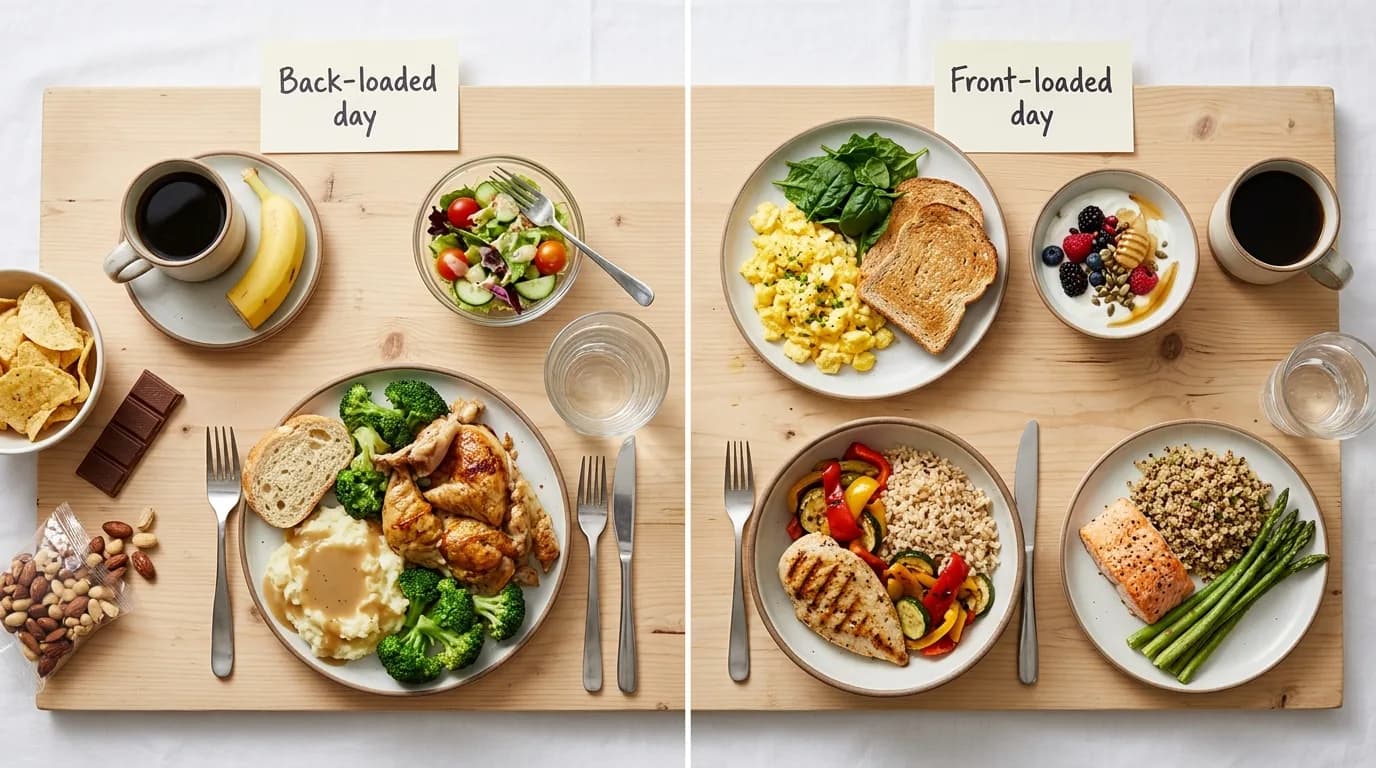
The goal is to arrive at evening already satisfied, so that night eating has to overcome actual fullness rather than ride on top of genuine hunger. You'd be surprised how much "willpower" you suddenly have at 9pm when you're not actually hungry.
This doesn't necessarily mean eating more total food — it means redistributing it. Same calories, different timing. For help figuring out your overall intake, our TDEE calculator and guide on how many calories you should eat are good starting points.
Fix #2: Run the Hunger Test Before You Eat
Before any night snack, run a quick diagnostic: is this real hunger, or head hunger?
The two feel similar in the moment but behave completely differently.
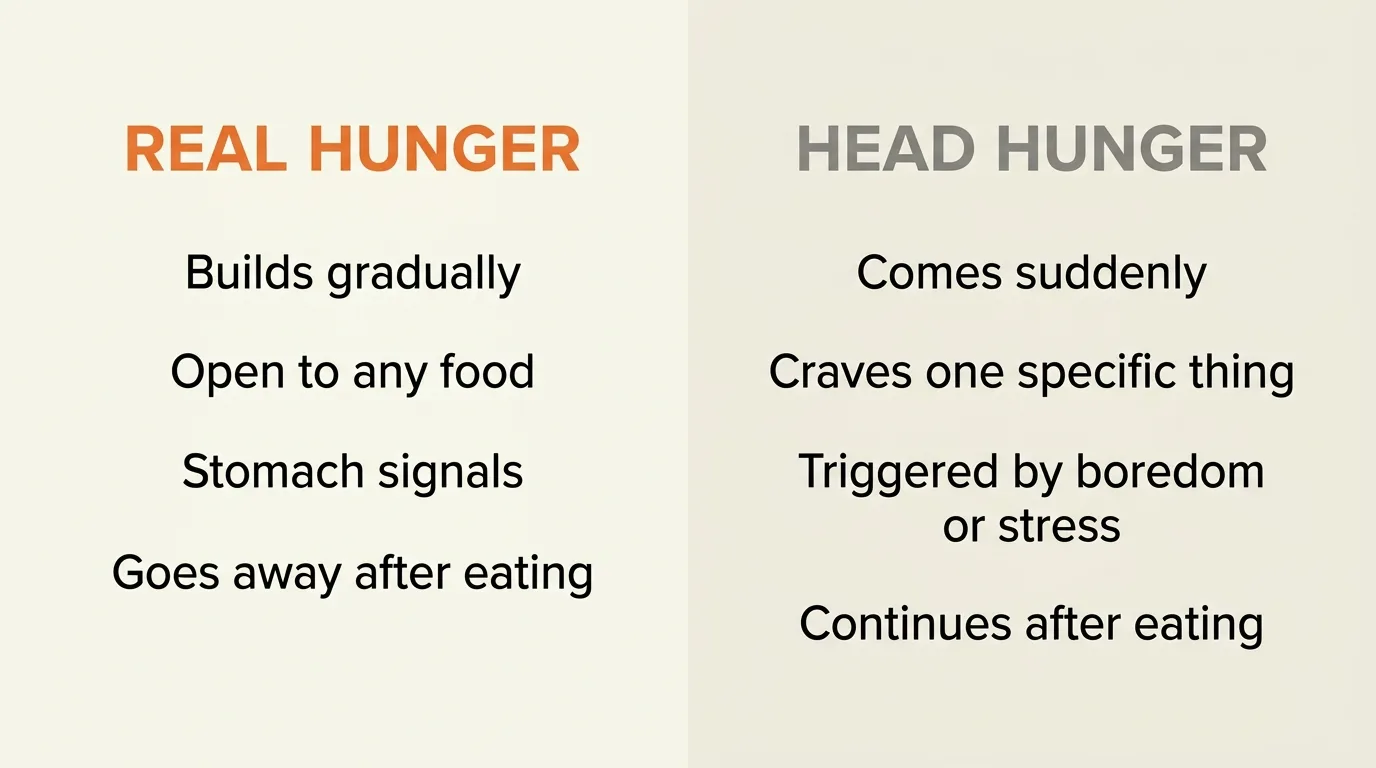
Real physical hunger builds gradually, is open to any food (if you're truly hungry, an apple sounds fine), comes with physical stomach signals, and resolves once you eat. Head hunger arrives suddenly, demands one specific thing (you don't want food, you want ice cream), is triggered by emotion or boredom or a screen, and often continues even after you've eaten.
The single most useful question: "Would I eat an apple right now?" If yes, you're probably actually hungry — eat something nutritious. If the apple sounds unappealing but the ice cream doesn't, that's not hunger. That's a craving riding on emotion or habit, and feeding it won't satisfy it.
This isn't about denying yourself. Sometimes the honest answer is "I'm not hungry, but I want this anyway, and I'm choosing it." That's fine — that's a conscious choice, which is completely different from the unconscious autopilot grazing that most night eating actually is.
Fix #3: Break the Screen-Eating Link
If a lot of your night eating happens in front of the TV or phone, the fix is mechanical, not motivational: separate eating from screens.
- Eat at a table, not on the couch. Even for snacks. The friction of having to sit somewhere specific kills a huge amount of mindless grazing.
- If you snack while watching, portion it first. Don't bring the bag. Put a serving in a bowl, then put the bag away. You can always get more — but the act of getting up creates a pause where awareness can intervene.
- Designate a kitchen close time. "The kitchen is closed after 8:30." It sounds arbitrary, but a clear rule removes the in-the-moment negotiation that you usually lose.
None of these require willpower in the moment, which is the point. They're systems that make the default behavior easier to follow. You're not relying on being strong at 9pm — you're arranging things so you don't have to be.
Fix #4: Address the Emotional Piece Honestly
If your night eating is mostly emotional — the "I survived today, I deserve this" pattern — no dietary fix will fully solve it, because the eating isn't really about food.
The honest work here is finding other ways to decompress and reward yourself at the end of a hard day. This is genuinely individual, but some things that work for people:
- A non-food ritual that signals "the day is done" — a bath, a show you actually sit and enjoy, a walk, reading, a hobby.
- Addressing the actual stress earlier in the day so you don't arrive at night depleted.
- Naming it in the moment: "I'm not hungry, I'm stressed/lonely/bored/tired." Naming the real feeling often deflates the urge to eat.
This doesn't mean emotional eating is shameful or that you can never have a treat. It means that if food is your only tool for managing difficult emotions, that's worth gently expanding — not because the eating is a moral failure, but because relying on one coping mechanism for everything tends to backfire.
If night eating feels compulsive or genuinely distressing in a way you can't control — not "I ate a few too many chips," but a real loss of control — that's worth discussing with a doctor or a therapist who specializes in eating behaviors. The strategies here are for everyday night-eating patterns, not clinical conditions.
What Doesn't Work (And Why Everyone Recommends It Anyway)
Most popular night-eating advice targets the symptom and ignores the cause. A quick tour of the greatest hits and why they underperform:
- "Brush your teeth right after dinner." The logic is that a minty mouth discourages eating. It works for about three days, then you start eating anyway and just have minty fries. It's a speed bump, not a solution.
- "Don't keep snacks in the house." Helpful at the margins, but if you're genuinely driven to eat, you'll eat whatever's there — or drive to get something. And it punishes everyone else in your household for your daytime under-eating.
- "Drink water when you feel hungry." Water can briefly blunt a craving, but if you're actually hungry (because you under-ate all day), water doesn't fix the underlying deficit. You'll be hungry again in twenty minutes.
- "Just go to bed earlier." Not bad advice — more sleep genuinely helps — but "just" is doing a lot of work in that sentence. If you could easily go to bed earlier, you probably would have.
The common thread: all of these treat night eating as a nighttime problem to be managed with nighttime tactics. They're not wrong so much as insufficient. They're trying to patch a leak at the bottom of the system when the problem is upstream. Fix the daytime, and most of these tricks become unnecessary — you won't need to trick yourself out of eating, because you won't be ravenous in the first place.
For the broader picture on overeating beyond just nighttime, see our companion guide on how to stop overeating.
A Realistic 1-Week Plan
If you want a concrete starting point, here's a week to break the pattern.
Days 1–2: Just observe. Don't change anything yet. Notice when night eating happens, what you ate earlier that day, and whether it was real hunger or head hunger. Most people discover their worst nights follow their lightest days.
Days 3–4: Fix breakfast. Add 30+ grams of protein to breakfast. That's the only change. Eggs, Greek yogurt, cottage cheese, or a shake. See if evening hunger softens.
Days 5–6: Fix lunch. Make lunch a real, substantial meal with protein. Stop "being good" at lunch. Notice the afternoon crash disappearing.
Day 7: Add the systems. Designate a kitchen close time, eat at a table, and run the hunger test before any night snack.
The order matters. Fix the food first (days 3–6), because that removes the biological driver. Then add the behavioral systems (day 7), which work far better once you're not fighting genuine hunger. Trying to add systems while still under-eating during the day is like bailing water without plugging the hole.
Frequently Asked Questions
Is it bad to eat at night?
Not inherently. The "don't eat after 7pm" rule is mostly a myth — total daily calories matter more than timing for weight loss, though, as Johns Hopkins notes, when you eat can still affect how your body processes nutrients. The bigger problem isn't the clock; it's that night eating is usually unplanned eating on top of your normal intake. A planned evening meal or snack that fits your calories is fine. Unconscious grazing is the issue.
Why am I not hungry during the day but ravenous at night?
Usually because you're distracted and busy during the day (which suppresses hunger awareness) and you under-eat without noticing. At night, you're home, unoccupied, and tired — and all the suppressed hunger arrives at once. The fix is eating enough during the day even when you don't feel ravenous.
Does eating at night cause weight gain specifically?
Calories are calories for weight purposes — a calorie at night counts the same as a calorie at noon. However, nighttime eating can impair glucose tolerance and disrupt circadian rhythms, per Harvard research. And practically, night eating tends to be extra unplanned calories, which is what drives weight gain — not the timing itself. It's also one of the most common reasons your calorie deficit isn't working: the evening grazing quietly cancels out the deficit you built during the day.
What if I'm genuinely hungry at night?
Then eat — but eat something with protein, not just carbs or sugar. Greek yogurt, cottage cheese, or a small protein-forward snack will satisfy real hunger without spiking and crashing your blood sugar. If you want something more filling for the calories, lean on volume eating — high-volume, low-calorie foods that fill you up without much damage. And if you're genuinely hungry every night, that's a strong sign you're under-eating during the day.
Could this be Night Eating Syndrome?
Night Eating Syndrome (NES) is a real, diagnosable condition involving a delayed circadian eating pattern, often with waking during the night to eat. It's distinct from the everyday "I snack too much at night" pattern this post addresses. If you're regularly waking from sleep to eat, eating a large portion of your calories after dinner, or feeling unable to control it, talk to a doctor — it may be NES or another condition that benefits from professional support.
How long until night eating improves?
Most people notice a meaningful difference within a week of fixing breakfast and lunch, because the biological driver responds quickly. The behavioral and emotional patterns take longer to fully shift — usually a few weeks of consistency. The food changes give you the fastest, most noticeable wins.
The Bottom Line
You can't stop eating at night by trying harder at night. That's been the strategy, and it hasn't worked, because night eating isn't a nighttime problem.
It's a daytime problem wearing a nighttime costume. You under-ate, under-proteined, under-slept, and "saved up" your way into an evening where biology and emotion gang up on you at exactly the moment you have the least resources to resist. The 9pm fridge raid is the last domino, not the first.
Fix the upstream causes — eat a real, protein-rich breakfast, a substantial lunch, get enough sleep — and most night eating fades on its own. Then layer in the behavioral systems (kitchen close time, eating at a table, the hunger test) to handle whatever remains. You'll find you need a lot less willpower than you thought, because you won't be fighting genuine hunger anymore.
The deeper shift is to stop treating night eating as a character flaw to be punished and start treating it as information. It's your body and mind telling you something about your day — that you didn't eat enough, didn't sleep enough, or didn't decompress in any way other than food. Listen to the message instead of fighting the symptom.
If front-loading your day is the fix, tracking helps you actually do it — making sure breakfast and lunch hit enough protein and calories that night never has to, without it taking over your life. CalorieCue makes this fast: snap a photo of each meal and see your protein and calories add up across the day, so you can spot an under-eaten morning before it becomes an over-eaten night. 7-day free trial, then paid.
Stop fighting the 9pm version of yourself. Take care of the 8am version instead. The night takes care of itself.
Download CalorieCue