On this page
- Quick Answer
- Best foods high in protein and low in calories
- Foods high in protein and low in calories
- Why Protein-to-Calorie Ratio Matters More Than Total Protein
- The 40 Best High-Protein, Low-Calorie Foods
- Tier 1: Elite Protein Density (15g+ protein per 100 cal)
- Tier 2: Excellent Protein Density (10–15g protein per 100 cal)
- Tier 3: Good Protein Density (5–10g protein per 100 cal)
- Tier 4: Decent Protein (But Watch the Calories)
- 5 High-Protein, Low-Calorie Meal Ideas
- Breakfast: Greek Yogurt Parfait (~350 cal, 30g protein)
- Lunch: Chicken Breast + Roasted Veggies + Quinoa (~450 cal, 40g protein)
- Dinner: Shrimp Stir-Fry with Cauliflower Rice (~400 cal, 35g protein)
- Snack: Cottage Cheese + Berries (~150 cal, 14g protein)
- Post-Workout: Protein Smoothie (~200 cal, 28g protein)
- How to Hit Your Protein Target Without Overthinking It
- 1. The "Protein First" Rule
- 2. The 25–30g Per Meal Target
- 3. Fix Your Snacks
- Frequently Asked Questions
- What foods are high in protein and low in calories?
- What are good high-protein, low-calorie snacks?
- How much protein do I need per day for weight loss?
- What food has the most protein for the fewest calories?
- Can you eat too much protein?
- Are plant-based proteins as good as animal proteins for weight loss?
- Do I need protein powder to hit my target?
- The Bottom Line
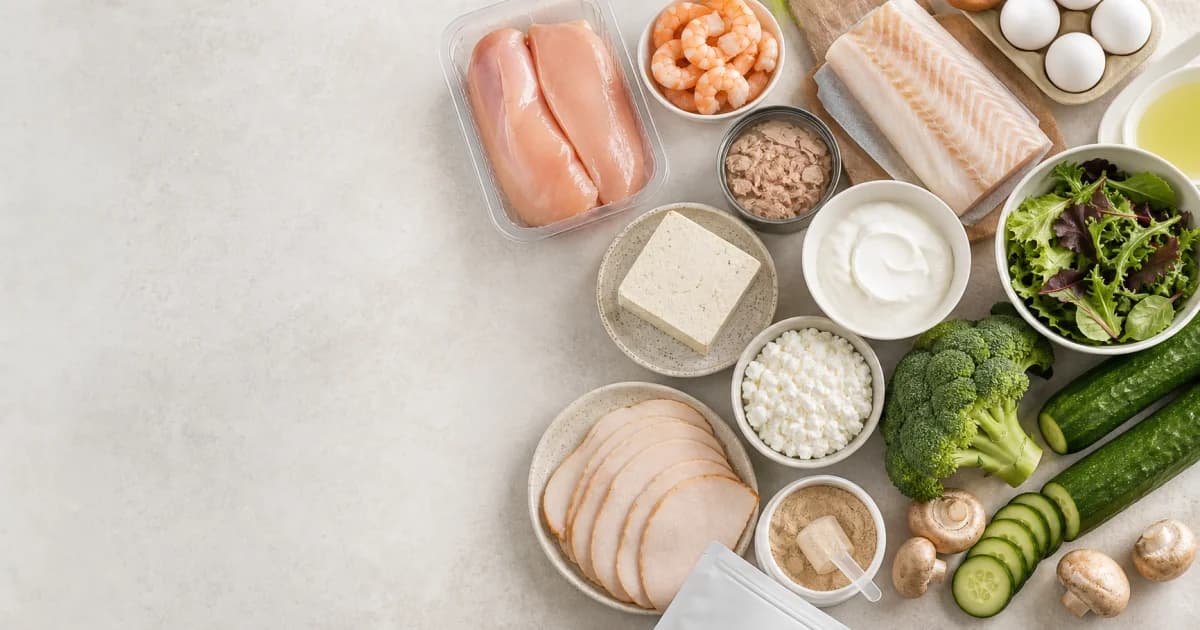
If you want foods high in protein and low in calories, start with lean seafood, egg whites, lean poultry, nonfat dairy, and a few carefully chosen plant proteins. Research shows that prioritizing protein drives more fat loss, better muscle preservation, and less hunger on a diet — but only when the foods you choose deliver that protein without a pile of calories.
Updated June 2026.
Quick Answer
The best foods high in protein and low in calories are shrimp, tuna canned in water, cod, egg whites, whey protein, chicken breast, turkey jerky, pork tenderloin, fat-free Greek yogurt, and low-fat cottage cheese.
Best foods high in protein and low in calories
| Food | Protein | Calories | Why it works |
|---|---|---|---|
| Shrimp | 20g | 85 | Highest whole-food protein density on the list |
| Tuna, canned in water | 26g | 116 | No-cook lean protein with almost no wasted calories |
| Cod / white fish | 18g | 82 | Lean, filling, and easy to build meals around |
| Egg whites | 11g | 52 | Nearly pure protein with minimal fat or carbs |
| Whey protein | 25g | 120 | Useful when food prep is the bottleneck |
| Chicken breast | 31g | 165 | The most practical everyday lean protein |
| Turkey jerky | 13g | 70 | Portable high-protein snack |
| Pork tenderloin | 26g | 143 | Leaner than most cuts people default to |
| Fat-free Greek yogurt | 18g | 100 | Easy breakfast, snack, or sauce base |
| Low-fat cottage cheese | 28g | 160 | Slow-digesting protein that keeps you full |
But not all protein sources are created equal. Some pack enormous amounts of protein for very few calories — chicken breast gives you 31g of protein for just 165 calories. Others deliver protein alongside a calorie bomb — two tablespoons of peanut butter gives you only 7g of protein for 190 calories.
When you're eating in a calorie deficit, every calorie counts. This post ranks 40 foods by protein per calorie, so you can build your plate from the most efficient sources first. If you want the ratio math on its own, use the protein per calorie chart. Prefer to shop from a list? See the high-protein, low-calorie grocery list — and if you want complete meals, jump to high-protein meals under 500 calories.
Foods high in protein and low in calories
These are the 20 most efficient high-protein, low-calorie foods, sorted by protein per 100 calories so the leanest choices come first. Scan it here, then drop to the full 40-food ranking below for serving sizes and the four density tiers.
| Food | Protein (g) | Calories | Protein per 100 cal |
|---|---|---|---|
| Shrimp (100g) | 20g | 85 | 23.5g |
| Tuna, canned in water (100g) | 26g | 116 | 22.4g |
| Cod / white fish (100g) | 18g | 82 | 22.0g |
| Egg whites (1 cup) | 11g | 52 | 21.2g |
| Whey protein (1 scoop) | 25g | 120 | 20.8g |
| Chicken breast (100g) | 31g | 165 | 18.8g |
| Turkey jerky (1 oz) | 13g | 70 | 18.6g |
| Pork tenderloin (100g) | 26g | 143 | 18.2g |
| Fat-free Greek yogurt (1 cup) | 18g | 100 | 18.0g |
| Cottage cheese, low-fat (1 cup) | 28g | 160 | 17.5g |
| Turkey breast, deli (100g) | 18g | 104 | 17.3g |
| Skyr (1 cup) | 20g | 130 | 15.4g |
| Lean ground turkey, 93% (100g) | 21g | 170 | 12.4g |
| Lean ground beef, 90% (100g) | 20g | 176 | 11.4g |
| Tofu, extra firm (100g) | 8g | 76 | 10.5g |
| Salmon, baked (100g) | 20g | 208 | 9.6g |
| Edamame (1 cup) | 18g | 188 | 9.6g |
| Eggs, whole (2 large) | 12g | 140 | 8.6g |
| Lentils, cooked (1 cup) | 18g | 230 | 7.8g |
| Black beans, cooked (1 cup) | 15g | 227 | 6.6g |
Why Protein-to-Calorie Ratio Matters More Than Total Protein
Protein density = grams of protein per 100 calories. It's the metric that tells you how efficiently a food delivers protein.
Consider the difference:
- Chicken breast delivers 18.8g protein per 100 calories — elite protein density
- Peanut butter delivers only 3.7g protein per 100 calories — low protein density
Both are commonly listed as "high protein foods." But chicken breast gives you 5x more protein per calorie. When you're in a deficit trying to hit 120g+ of protein on 1,500–1,800 calories, that difference is enormous.
Protein is the most satiating macronutrient — it keeps you fuller longer than carbs or fat. And it has a thermic effect of 20–30%, meaning your body burns 20–30% of protein calories just digesting it. So maximizing protein density does double duty: more fullness AND more calories burned through digestion.
The takeaway: when building meals in a deficit, prioritize foods with the highest protein per calorie — not just the highest total protein. Want the metric on its own — what counts as a good ratio, plus every food ranked by protein-per-calorie ratio? That's the companion guide. Learn more about how to count macros to build balanced meals around these foods.
The 40 Best High-Protein, Low-Calorie Foods
All nutrition data is based on values from the USDA FoodData Central database. Foods are ranked by protein density — grams of protein per 100 calories.
Tier 1: Elite Protein Density (15g+ protein per 100 cal)
These are the most protein-efficient foods available. Build your meals around these when you need to maximize protein on limited calories.
| Rank | Food | Serving | Calories | Protein | Protein per 100 cal |
|---|---|---|---|---|---|
| 1 | Shrimp | 100g | 85 | 20g | 23.5g |
| 2 | Tuna (canned in water) | 100g | 116 | 26g | 22.4g |
| 3 | Cod / white fish | 100g | 82 | 18g | 22.0g |
| 4 | Egg whites | 1 cup (243g) | 52 | 11g | 21.2g |
| 5 | Protein powder (whey) | 1 scoop | 120 | 25g | 20.8g |
| 6 | Chicken breast (grilled) | 100g | 165 | 31g | 18.8g |
| 7 | Turkey jerky | 1 oz | 70 | 13g | 18.6g |
| 8 | Pork tenderloin | 100g | 143 | 26g | 18.2g |
| 9 | Fat-free Greek yogurt | 1 cup | 100 | 18g | 18.0g |
| 10 | Cottage cheese (low-fat) | 1 cup | 160 | 28g | 17.5g |
Shrimp is the undisputed protein density champion — 23.5g of protein per 100 calories. A 200-calorie serving of shrimp delivers 47g of protein. You'd need 500+ calories of peanut butter to match that.
Tier 2: Excellent Protein Density (10–15g protein per 100 cal)
Excellent protein sources that also bring additional nutrients. These form the backbone of a high-protein meal plan.
| Rank | Food | Serving | Calories | Protein | Protein per 100 cal |
|---|---|---|---|---|---|
| 11 | Turkey breast (deli) | 100g | 104 | 18g | 17.3g |
| 12 | Skyr (Icelandic yogurt) | 1 cup | 130 | 20g | 15.4g |
| 13 | Lean ground turkey (93%) | 100g | 170 | 21g | 12.4g |
| 14 | Lean ground beef (90%) | 100g | 176 | 20g | 11.4g |
| 15 | Tofu (extra firm) | 100g | 76 | 8g | 10.5g |
| 16 | Salmon (baked) | 100g | 208 | 20g | 9.6g |
| 17 | Edamame | 1 cup | 188 | 18g | 9.6g |
| 18 | Eggs (whole) | 2 large | 140 | 12g | 8.6g |
| 19 | Lentils (cooked) | 1 cup | 230 | 18g | 7.8g |
| 20 | Black beans (cooked) | 1 cup | 227 | 15g | 6.6g |
Tier 3: Good Protein Density (5–10g protein per 100 cal)
Solid protein contributors that work well as meal components alongside Tier 1 and 2 foods.
| Rank | Food | Serving | Calories | Protein | Protein per 100 cal |
|---|---|---|---|---|---|
| 21 | Seitan | 100g | 130 | 12g | 9.2g |
| 22 | Venison | 100g | 158 | 30g | 9.0g |
| 23 | Bison | 100g | 143 | 28g | 8.5g |
| 24 | Crab meat | 100g | 97 | 19g | 8.2g |
| 25 | Lobster | 100g | 89 | 19g | 7.9g |
| 26 | Tempeh | 100g | 192 | 20g | 7.6g |
| 27 | Low-fat cheese (mozzarella) | 1 oz | 72 | 7g | 7.0g |
| 28 | Chickpeas (cooked) | 1 cup | 269 | 15g | 5.6g |
| 29 | Quinoa (cooked) | 1 cup | 222 | 8g | 3.6g |
| 30 | Milk (1% low-fat) | 1 cup | 102 | 8g | 7.8g |
Tier 4: Decent Protein (But Watch the Calories)
These foods contain protein but come with significantly more calories per gram of protein. Use them in moderation when you're in a deficit.
| Rank | Food | Serving | Calories | Protein | Protein per 100 cal |
|---|---|---|---|---|---|
| 31 | Oats (cooked) | 1 cup | 158 | 6g | 3.8g |
| 32 | Peanut butter | 2 tbsp | 190 | 7g | 3.7g |
| 33 | Almonds | 1 oz (23 almonds) | 164 | 6g | 3.7g |
| 34 | Cheese (cheddar) | 1 oz | 113 | 7g | 3.5g |
| 35 | Whole milk | 1 cup | 149 | 8g | 5.4g |
| 36 | Hummus | 2 tbsp | 70 | 2g | 2.9g |
| 37 | Avocado | 1/2 medium | 120 | 1.5g | 1.3g |
| 38 | Granola | 1/2 cup | 210 | 5g | 2.4g |
| 39 | Dark chocolate (70%) | 1 oz | 170 | 2g | 1.2g |
| 40 | Trail mix | 1/4 cup | 175 | 5g | 2.9g |
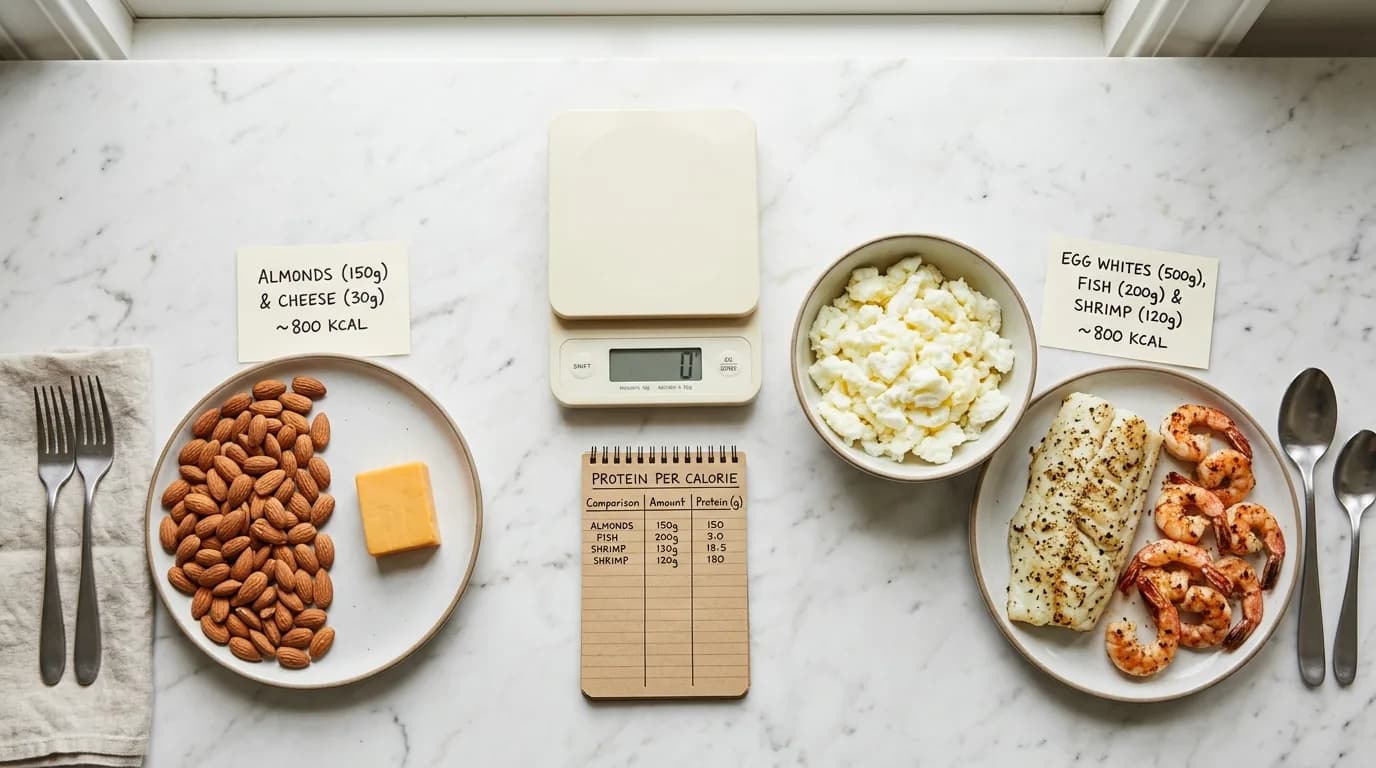
Notice how peanut butter (3.7g protein per 100 cal) is in Tier 4 while chicken breast (18.8g per 100 cal) is in Tier 1? Both are commonly called "high protein" foods, but one gives you 5x more protein per calorie. When you're in a deficit, this difference matters enormously. Tier 4 foods aren't bad — they're just not efficient protein sources.
For the inverse view, the high-calorie, low-protein foods ranking and swap tool shows what these choices cost at equal calories and which alternatives provide more protein.
5 High-Protein, Low-Calorie Meal Ideas
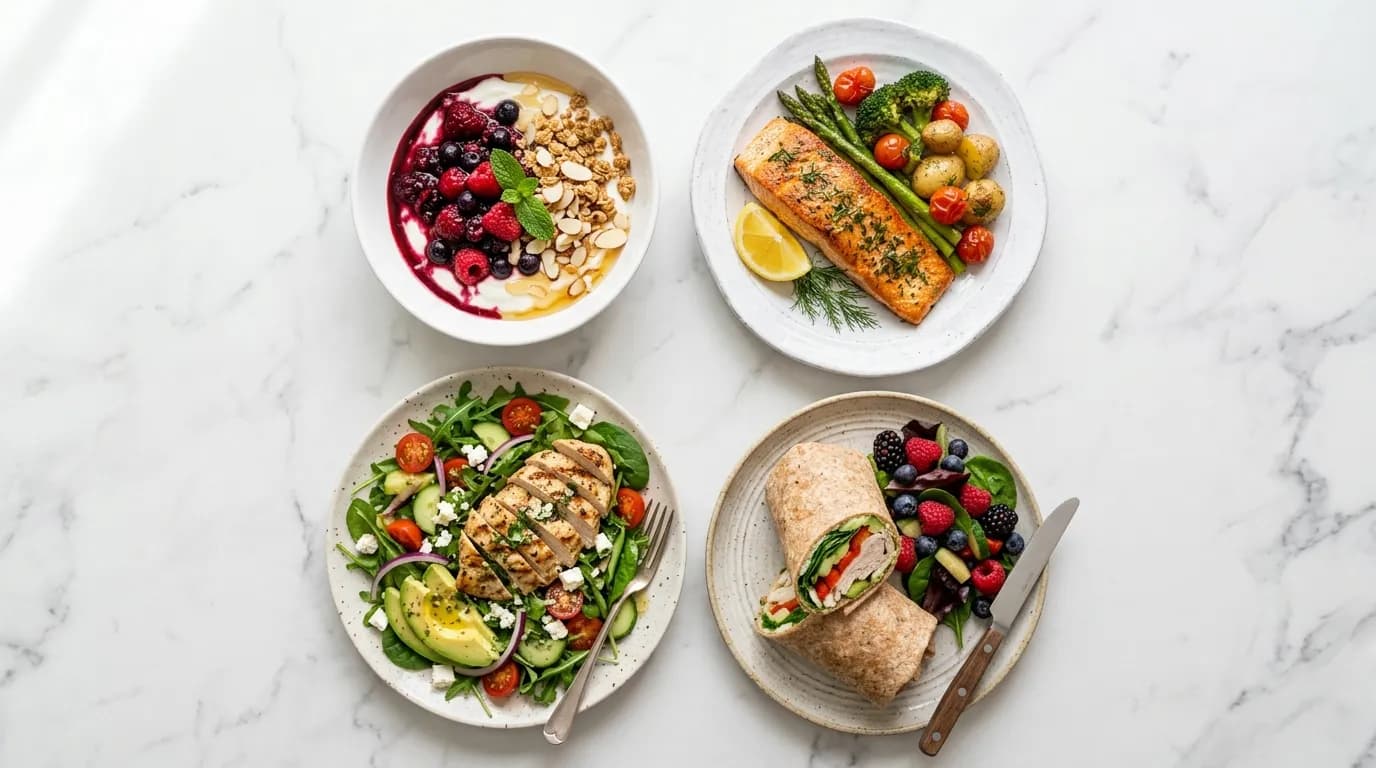
Here's what a full day of high-protein eating looks like — hitting nearly 150g of protein on moderate calories.
Looking for complete meals instead of individual foods? See our guide to 20 high protein meals under 500 calories — with full macros for every meal.
Breakfast: Greek Yogurt Parfait (~350 cal, 30g protein)
- 1 cup fat-free Greek yogurt (18g protein)
- 1/2 cup mixed berries
- 1 tablespoon granola
- 1 hard-boiled egg on the side (6g protein)
Greek yogurt is a protein powerhouse — 18g per cup at just 100 calories. The berries add sweetness and fiber, and the granola adds crunch without a calorie bomb (keep it to a tablespoon).
Lunch: Chicken Breast + Roasted Veggies + Quinoa (~450 cal, 40g protein)
- 150g grilled chicken breast (46.5g → ~40g after cooking)
- 1 cup roasted broccoli and bell peppers
- 1/2 cup cooked quinoa
The classic high-protein lunch. Chicken breast is the gold standard for a reason — unbeatable protein density from a whole food. The quinoa adds a complete plant protein boost, and the roasted vegetables add volume without many calories.
Dinner: Shrimp Stir-Fry with Cauliflower Rice (~400 cal, 35g protein)
- 200g shrimp (40g protein)
- 2 cups cauliflower rice
- Mixed vegetables (snap peas, bell peppers, broccoli)
- Light soy sauce + ginger + garlic
Shrimp is the highest protein-density whole food on this list. Paired with cauliflower rice instead of regular rice, you save hundreds of calories while keeping the meal enormous and satisfying.
Snack: Cottage Cheese + Berries (~150 cal, 14g protein)
- 1/2 cup low-fat cottage cheese (14g protein)
- 1/2 cup fresh strawberries
Most people snack on zero-protein foods — chips, crackers, fruit alone. Swapping in cottage cheese turns your snack into a protein hit that actually keeps you full until your next meal.
Post-Workout: Protein Smoothie (~200 cal, 28g protein)
- 1 scoop whey protein (25g protein)
- 1/2 banana
- 1 cup unsweetened almond milk
- Ice
Quick, efficient, and hits 28g of protein for just 200 calories. Protein powder isn't mandatory, but it's the most protein-dense option available — 20.8g per 100 calories.
Full day total: ~1,550 calories, ~147g protein. That's a high-protein day on a moderate deficit — and you're eating five times. No starvation, no chicken-and-broccoli monotony. Just smart food choices based on protein density.
Snap each meal with CalorieCue to verify your protein and calorie totals — the AI breakdown shows you exactly how much protein is on your plate.
Download CalorieCueHow to Hit Your Protein Target Without Overthinking It
You don't need a spreadsheet or a meal prep empire. Here are three rules that get most people to 100–130g of protein per day:
1. The "Protein First" Rule
Build every meal around a protein source. Pick your protein, then add carbs and fat around it. This simple order of operations guarantees you're never left scrambling for protein at the end of the day. Need ideas beyond this list? Our guide to the best sources of protein covers animal and plant options for every meal.
- Breakfast → eggs, Greek yogurt, or cottage cheese
- Lunch → chicken, turkey, tuna, or tofu
- Dinner → salmon, shrimp, lean ground beef, or lentils
2. The 25–30g Per Meal Target
Aim for 25–30g of protein at each of your 3–4 meals. This is backed by research from the International Society of Sports Nutrition — spreading protein across meals optimizes muscle protein synthesis better than loading all your protein into one meal.
- 4 meals × 30g = 120g protein — enough for most people in a deficit
- Add a protein-rich snack and you're at 140–150g without trying
3. Fix Your Snacks
Most people hit decent protein at meals but eat zero-protein snacks — chips, fruit, crackers, granola bars. These snacks fill you up momentarily but leave you hungry within an hour.
Swap in protein snacks:
- Cottage cheese + berries (14g protein, 150 cal)
- Turkey jerky (13g protein, 70 cal)
- Hard-boiled eggs (12g protein, 140 cal)
- Greek yogurt (18g protein, 100 cal)
CalorieCue shows your protein breakdown per meal — one glance at your daily summary tells you if you're on track or falling short. Learn more about tracking your food intake.
To turn these foods into a repeatable cooking routine, use the four-week beginner meal-prep plan, including how to store later portions safely.
Frequently Asked Questions
What foods are high in protein and low in calories?
The most protein-dense, low-calorie foods are shrimp, white fish (cod, tilapia), tuna canned in water, egg whites, chicken and turkey breast, fat-free Greek yogurt, and low-fat cottage cheese. Each delivers roughly 17–24g of protein per 100 calories, so you hit your protein target while keeping calories low. Build your meals around these when you're eating in a deficit.
What are good high-protein, low-calorie snacks?
Swap zero-protein snacks like chips, crackers, and granola bars for protein-dense ones: fat-free Greek yogurt (18g protein, 100 cal), turkey jerky (13g, 70 cal), a hard-boiled egg or two (6–12g), low-fat cottage cheese with berries (14g, 150 cal), or a scoop of whey in water (25g, ~120 cal). Each keeps you full far longer than a carb-only snack.
How much protein do I need per day for weight loss?
Most research recommends 0.7–1g of protein per pound of body weight when you're trying to lose fat while preserving muscle. For a 160-pound person, that's 112–160g per day. The International Society of Sports Nutrition recommends 1.4–2.0 g/kg/day for active individuals, with even higher intakes during caloric restriction. Spreading your protein across 3–4 meals (25–40g each) optimizes muscle protein synthesis throughout the day.
What food has the most protein for the fewest calories?
Among whole foods, shrimp leads at 23.5g of protein per 100 calories, followed by tuna canned in water (22.4g), cod and white fish (22.0g), and egg whites (21.2g). If you include supplements, whey protein powder (20.8g per 100 cal) ranks among the top options. All nutrition values can be verified at the USDA FoodData Central database.
Can you eat too much protein?
For healthy adults, high protein intake is not harmful. A 2018 meta-analysis in the Journal of Nutrition analyzed 28 studies and concluded that higher-protein diets do not adversely affect kidney function in healthy people. That said, extremely high intakes (above 2g per pound of body weight) offer no additional benefit for most people. Stick to the 0.7–1g per pound range for optimal fat loss and muscle preservation.
Are plant-based proteins as good as animal proteins for weight loss?
For weight loss specifically, total protein intake matters more than the source. A 2021 systematic review in Nutrients found that animal protein tends to be slightly more beneficial for lean mass preservation in younger adults, but no significant difference was found for muscle strength. Plant proteins like tofu, lentils, edamame, and tempeh are excellent choices — you may just need slightly higher total intake since most plant proteins have lower digestibility and incomplete amino acid profiles individually. Combining different plant proteins throughout the day solves this.
Do I need protein powder to hit my target?
No. Protein powder is a convenient supplement, not a necessity. You can hit 100–150g of protein per day through whole foods alone — a chicken breast at lunch (31g), Greek yogurt as a snack (18g), salmon at dinner (20g), eggs at breakfast (12g), and cottage cheese before bed (28g) gets you to 109g without any powder. That said, whey protein is one of the most protein-dense options available (20.8g per 100 cal) and is useful when you're short on time or need a quick post-workout option.
The Bottom Line
Protein density — grams of protein per 100 calories — is the key metric when building a weight loss diet. Not total protein, not protein per serving, but protein per calorie. This is what determines whether you can hit your protein target while staying in a deficit.
Prioritize Tier 1 and Tier 2 foods to maximize satiety and muscle preservation during weight loss. Build every meal around a lean protein source. Fix your snacks. And use the protein-to-calorie ratio to make smarter food choices — not just more restrictive ones.
High-protein diets reduce hunger, preserve muscle, and burn more calories through digestion. When you combine that with choosing the most protein-dense foods, you're stacking every advantage in your favor.
See your protein breakdown instantly — download CalorieCue free and snap your next meal.
Download CalorieCue