On this page
- Why Protein Is the Single Most Important Nutrient for Weight Loss
- Protein Is Metabolically Expensive
- Protein Is the Most Filling Macronutrient
- Protein Preserves Muscle During Weight Loss
- How Much Protein Do You Actually Need?
- Quick Formula
- The Single Biggest Mistake — Eating Most of Your Protein at Dinner
- The Fix — The Front-Loading Strategy
- 14 Specific Ways to Eat More Protein (Without Forcing It)
- Breakfast Swaps
- Lunch and Dinner Swaps
- Snack Strategy
- The Universal Strategy
- A Sample Day Hitting 120g of Protein
- Best Low-Calorie Protein Sources (Ranked)
- What About Plant-Based Protein?
- Common Mistakes That Kill Your Protein Intake
- Mistake 1 — Counting "Protein-Marketed" Foods That Aren't Actually High in Protein
- Mistake 2 — Forgetting That Cooking Method Affects Protein-to-Calorie Ratio
- Mistake 3 — Eating Protein Without Adequate Fiber
- Mistake 4 — Relying Too Much on Powders and Bars
- Mistake 5 — Underestimating How Much Protein You're Already Eating
- Frequently Asked Questions
- The Bottom Line
How to Eat More Protein: A Practical Guide for Weight Loss (Without Forcing It)
Most articles about eating more protein assume you're a bodybuilder who's happy to choke down chicken breast and broccoli at every meal. This isn't that article.
The truth is, hitting 100+ grams of protein per day for weight loss isn't about willpower or chicken-and-rice meal prep — it's about understanding three things: how much you actually need, when to eat it, and how to swap small choices throughout the day to add 30–40 grams without feeling like you're on a diet.
This guide will walk you through all three. By the end, you'll have a clear daily protein target, a list of high-leverage food swaps, and 14 specific strategies to hit your goal effortlessly. No bro-diet required.
Why Protein Is the Single Most Important Nutrient for Weight Loss
Before getting into how to eat more, it helps to understand why protein matters so much more than carbs or fat when you're trying to lose weight.
Three reasons stand out:
Protein Is Metabolically Expensive
Your body burns calories digesting every nutrient, but protein burns the most by far. According to research cited by WeightWatchers, your body burns 20–30% of the calories in protein during digestion, compared to just 5–10% for carbohydrates and 0–3% for fats.
In practical terms: a 200-calorie protein source nets you only 140–160 absorbed calories. A 200-calorie carb source nets you 180–190. This effect — called the thermic effect of food — adds up over weeks and months.
Protein Is the Most Filling Macronutrient
Research consistently shows that high-protein meals reduce hunger hormones like ghrelin and increase satiety hormones like PYY. People eating 30% of their calories from protein report 34% greater satisfaction than those eating 18% from protein.
In practice, this means you naturally eat less without feeling deprived. Protein doesn't require willpower the way calorie counting alone does — your body simply stops being hungry sooner.
Protein Preserves Muscle During Weight Loss
When you lose weight, your body draws from both fat and muscle stores. Without adequate protein, the muscle loss can be substantial — which is bad for two reasons. First, muscle burns more calories at rest than fat does, so losing it slows your metabolism. Second, the body composition you want isn't just lower on the scale; it's leaner-looking, which requires keeping the muscle.
Eating sufficient protein during a calorie deficit signals your body to preserve muscle and burn fat preferentially. The Mayo Clinic recommends spreading protein evenly across the day specifically because it supports lean mass retention during weight loss.
How Much Protein Do You Actually Need?
The default recommended dietary allowance (RDA) of 0.8 grams per kilogram of body weight is a minimum to prevent deficiency — not an optimal target for someone trying to lose weight.
Here's the practical breakdown for active adults:
| Goal | Protein Target | For 165 lb / 75 kg person |
|---|---|---|
| Sedentary maintenance (RDA minimum) | 0.8 g/kg | 60g/day |
| Active adult, general health | 1.0–1.2 g/kg | 75–90g/day |
| Weight loss with muscle preservation | 1.2–1.6 g/kg | 90–120g/day |
| Resistance training in calorie deficit | 1.6–2.2 g/kg | 120–165g/day |
| Athletes / bodybuilders | 1.8–2.4 g/kg | 135–180g/day |
For most people reading this — someone trying to lose weight while staying active — 1.2 to 1.6 grams per kilogram of body weight is the practical target. That works out to roughly 0.7 grams per pound for an easy mental shortcut.
Quick Formula
Take your body weight in pounds, multiply by 0.7. That's your daily protein target in grams.
- 130 lbs = ~90g protein
- 165 lbs = ~115g protein
- 200 lbs = ~140g protein
- 250 lbs = ~175g protein
If you're significantly overweight, use your "goal weight" rather than current weight to avoid overestimating. A 250-pound person aiming for 180 lbs should target ~125g protein, not 175g.
For more on calculating your full nutrition targets, see our TDEE calculator and how to count macros guide.
The Single Biggest Mistake — Eating Most of Your Protein at Dinner
Here's the pattern that breaks most people's protein goals:
- Breakfast: cereal, toast, or skipped entirely → 5–10g protein
- Lunch: sandwich, salad, or rice bowl → 20–25g protein
- Snacks: chips, granola bar, fruit → 2–5g protein
- Dinner: large protein portion → 50–60g protein
Total: 80–100g, mostly concentrated in one meal.
The Mayo Clinic explicitly notes that on average, people get most of their protein from evening meals and the least from breakfast. The problem isn't just the total — it's the distribution.
Research consistently shows that the body uses protein most effectively when it's distributed across 3–5 meals of 25–40g each. A single 60-gram dinner doesn't build more muscle or satiety than two 30-gram meals; in fact, the body may use it less efficiently because muscle protein synthesis is maximized at roughly 25–40g per meal.
The Fix — The Front-Loading Strategy
Move protein earlier in your day. The aim is at least 25–30g of protein at breakfast and another 25–30g at lunch.
Why this works:
- It captures the morning's high muscle protein synthesis window
- It reduces afternoon hunger that drives overeating at dinner
- It's psychologically easier — you "bank" protein early instead of cramming it at night
Front-loading is the single biggest behavioral change you can make to improve your protein intake without eating more food overall.
14 Specific Ways to Eat More Protein (Without Forcing It)
These aren't general tips — each one is a specific swap or addition that adds at least 10 grams of protein per use.
Breakfast Swaps
1. Switch from cereal to Greek yogurt + berries. A 200g serving of plain Greek yogurt has 24g of protein vs. 4–7g in most cereals. Add a tablespoon of chia seeds for fiber, top with berries for flavor.
Protein gain: +18g
2. Replace toast with eggs. Two whole eggs have 12g of protein. Add cottage cheese on the side for another 14g. Eggs cook in 3 minutes; this isn't more work than toast.
Protein gain: +20g
3. Add protein powder to oatmeal or smoothies. A scoop of whey or plant protein adds 20–25g. Mix into hot oats with cinnamon and banana, or blend into a smoothie with milk and frozen fruit.
Protein gain: +24g
4. Try cottage cheese as your morning base. A cup (220g) of low-fat cottage cheese has 24g of protein and feels like a treat with fresh fruit, honey, and nuts on top. Cottage cheese has had a quiet renaissance for a reason.
Protein gain: +24g
Lunch and Dinner Swaps
5. Choose Greek yogurt over sour cream/mayo. Use plain Greek yogurt as a 1:1 swap in dressings, dips, sauces, and on top of soups and chilis. Same texture, 5x the protein.
Protein gain: +6–8g per meal
6. Add cottage cheese to pasta sauce. Blend it in. The result is a creamy, high-protein sauce that tastes like alfredo without the dairy fat. Adds 12–15g protein per cup of sauce.
Protein gain: +12g
7. Top salads with grilled chicken, tuna, or chickpeas. A salad alone is rarely a real meal. Adding 100g of grilled chicken (31g protein) or a can of tuna (39g protein) or a cup of chickpeas (15g protein) turns it into one.
Protein gain: +20–40g
8. Use turkey or lean beef instead of regular ground beef. 93% lean ground turkey has 27g of protein per 100g, compared to 25g in 80/20 ground beef but with significantly fewer calories. Same recipes — better protein-to-calorie ratio.
Protein gain: net 30–50 calories saved at same protein level
9. Choose edamame or roasted chickpeas as your "snacky" food at meals. Instead of bread or chips on the side, a half-cup of edamame (9g protein) or roasted chickpeas (8g protein) adds protein where there usually is none.
Protein gain: +8–9g
Snack Strategy
10. Keep hard-boiled eggs ready. Boil a dozen on Sunday. Each one is 6g of protein and zero prep at snack time. Two with a sprinkle of salt = 12g of protein in 30 seconds.
Protein gain: +12g
11. Replace chips with Greek yogurt + nuts. A 100g cup of Greek yogurt with 15g of mixed nuts is 14g of protein and similar calories to a small bag of chips (which has 2g protein). Same convenience, dramatically better nutrition.
Protein gain: +12g
12. Try string cheese, jerky, or protein bars for portable snacks. A piece of string cheese is 7g of protein, jerky is roughly 12g per ounce, and a quality protein bar is 20–25g. Keep these in your bag, your desk, your car.
Protein gain: +7–25g per snack
13. Drink milk or a protein shake between meals. A glass of milk (8g) or a simple protein shake (whey + water = 24g) is the fastest way to add protein without "eating" more. Especially useful during high-activity days.
Protein gain: +8–24g
The Universal Strategy
14. Add, don't replace. This is the most important principle in this entire post. Don't try to "swap" rice for chicken or "cut" carbs to add protein. Just add a protein source to whatever you're already eating.
Already having pasta? Add chicken or shrimp. Already having a sandwich? Add a hard-boiled egg on the side. Already having soup? Stir in cooked beans or shredded chicken. Already having toast? Top it with cottage cheese.
Most people fail at adding protein because they think it requires changing what they eat. It doesn't — it requires adding to what they eat. Your existing meals are the foundation; protein layers on top.
A Sample Day Hitting 120g of Protein
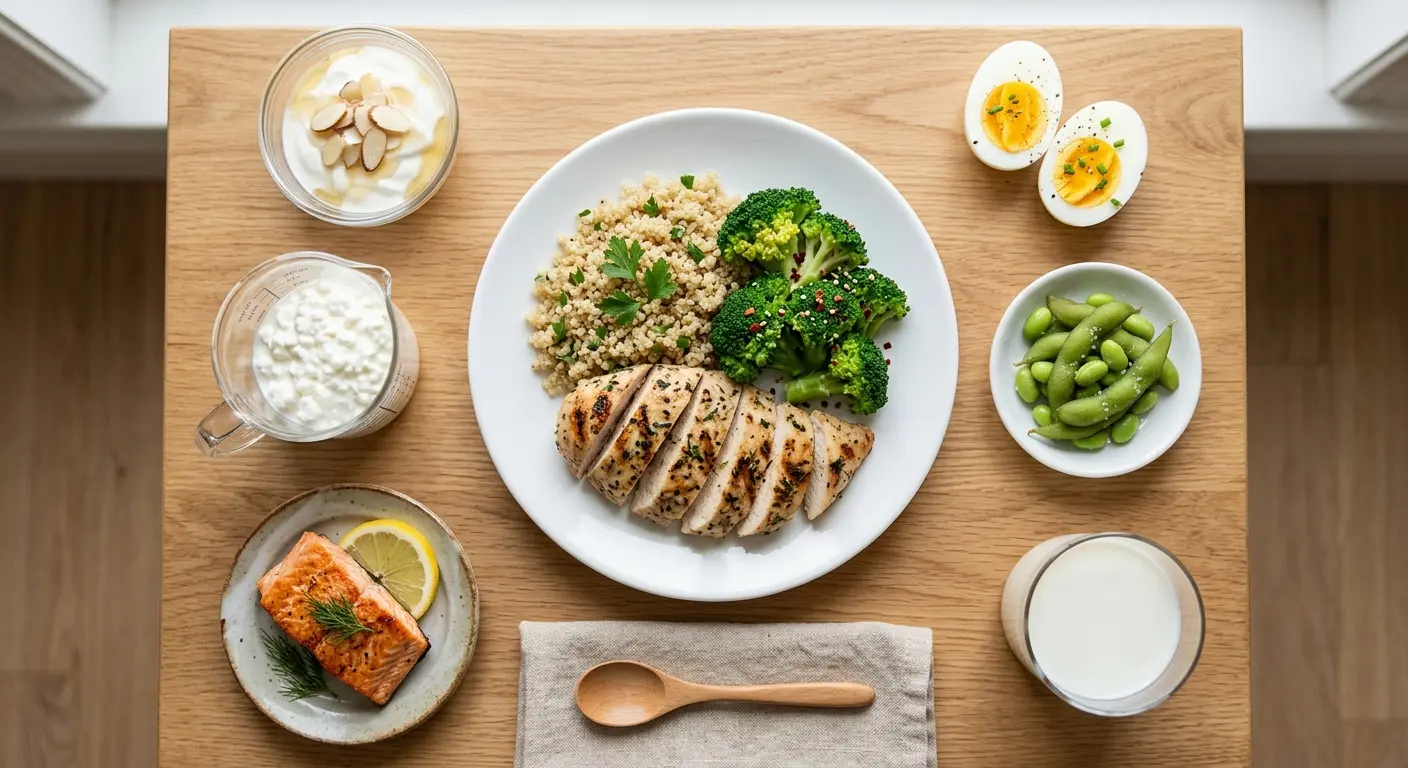
Here's what a real day looks like for someone targeting 120g of protein, eating roughly 1,800 calories total:
Breakfast (~30g protein, ~430 cal)
- 200g Greek yogurt with berries and 2 tbsp granola = 24g protein, 280 cal
- 1 hard-boiled egg = 6g protein, 78 cal
- Black coffee
- Subtotal: ~30g protein
Mid-morning snack (12g protein, ~180 cal)
- 1 string cheese + 1 apple = 8g protein, 130 cal
- Subtotal: ~38g protein running total
Lunch (35g protein, ~500 cal)
- Large salad with 120g grilled chicken, mixed greens, cherry tomatoes, cucumber, 1/2 avocado, lemon-olive oil dressing
- Subtotal: ~73g protein running total
Afternoon snack (15g protein, ~150 cal)
- 1/2 cup edamame (9g) + 1 oz almonds (6g)
- Subtotal: ~88g protein running total
Dinner (35g protein, ~550 cal)
- 130g baked salmon with sweet potato and roasted vegetables
- Subtotal: ~123g protein
Total: ~123g protein, ~1,810 calories
Notice that no single meal contains more than 35g of protein. The total is built up through consistent moderate-protein meals plus two protein-conscious snacks. This is much easier to sustain than trying to cram 60g into dinner.
For more sample meals like these, see our high protein meals under 500 calories guide.
Download CalorieCueBest Low-Calorie Protein Sources (Ranked)
If you're trying to maximize protein per calorie — what nutrition researchers call "protein density" — these are the highest-leverage choices:
| Food | Serving | Protein | Calories | Protein per 100 cal |
|---|---|---|---|---|
| Egg whites | 100g | 11g | 52 | 21g |
| Plain nonfat Greek yogurt | 200g | 24g | 130 | 18g |
| Cod, baked | 150g | 31g | 140 | 22g |
| Chicken breast, grilled | 150g | 46g | 248 | 19g |
| Tuna, canned in water | 1 can (142g) | 39g | 179 | 22g |
| Cottage cheese, low-fat | 1 cup | 24g | 183 | 13g |
| Shrimp, cooked | 150g | 33g | 149 | 22g |
| Tofu, firm | 150g | 15g | 126 | 12g |
| Edamame, shelled | 1 cup | 18g | 188 | 10g |
| Whey protein powder | 30g | 24g | 120 | 20g |
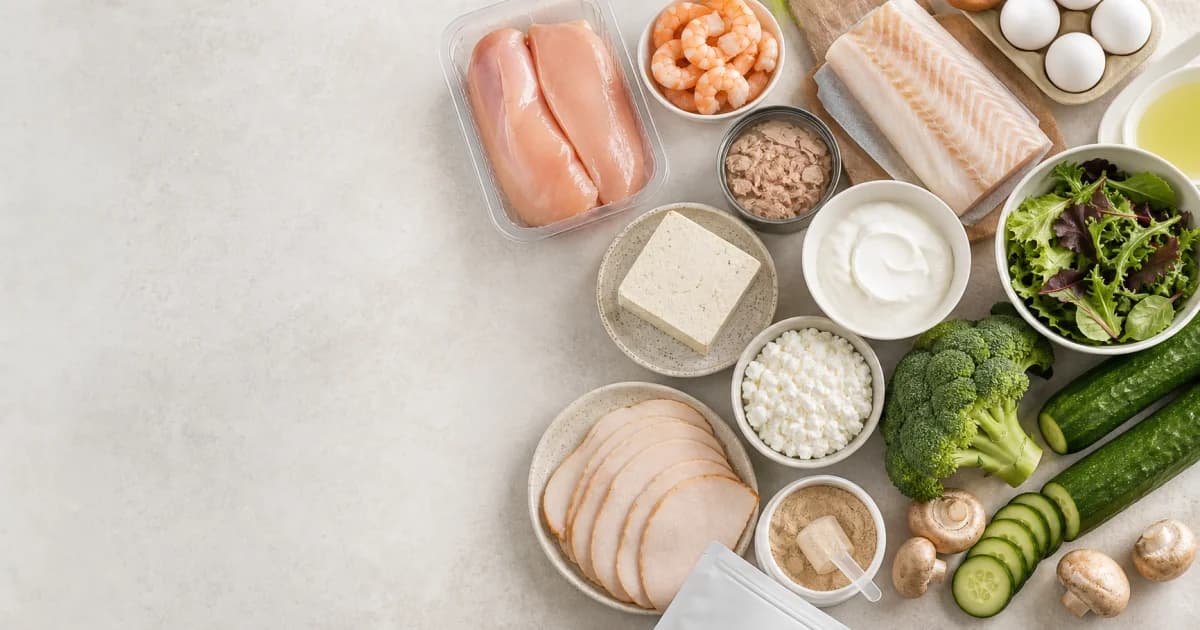
The clear winners by protein density are egg whites, white fish (cod, tilapia), shrimp, and Greek yogurt — these give you the most protein for the fewest calories.
If you want a more comprehensive list of high-protein foods, including animal and plant sources, see our guide on high protein low calorie foods.
What About Plant-Based Protein?
Plant-based protein works for weight loss — but requires more intentionality.
The challenges:
- Most plant proteins are "incomplete" (don't contain all 9 essential amino acids)
- Calorie density is often higher relative to protein content (e.g., nuts and beans bring fats and carbs along)
- Total volume needed to hit 100g+ daily is significant
The solutions:
- Combine sources within a day — beans + grains, tofu + nuts, lentils + quinoa — to cover all amino acids
- Lean on highest-density options — tofu, tempeh, edamame, seitan, plant-based protein powder
- Use plant-based protein powders — pea, brown rice, soy, or blended formulas — to fill gaps efficiently
A practical day for a vegetarian targeting 100g of protein:
- Breakfast: oats + plant protein powder + chia seeds (30g)
- Lunch: tofu stir-fry with quinoa and edamame (28g)
- Snack: Greek-style soy yogurt with nuts (15g)
- Dinner: lentil curry with brown rice (28g)
This is doable — just less automatic than the omnivore's "add chicken to it" default.
Common Mistakes That Kill Your Protein Intake
Even well-intentioned trackers fall into these:
Mistake 1 — Counting "Protein-Marketed" Foods That Aren't Actually High in Protein
Protein bars vary wildly. Some have 20g, others have 7g with 30g of sugar. Granola "with extra protein" might have 5g per serving. Always check the label, not the marketing.
A quick rule: if a food labeled "high protein" has less than 10g of protein per serving, it's marketing, not nutrition.
Mistake 2 — Forgetting That Cooking Method Affects Protein-to-Calorie Ratio
Fried chicken thigh has the same protein as grilled chicken breast — but 60% more calories. If protein density matters to you (it should during weight loss), prioritize grilling, baking, steaming, and air-frying over deep-frying.
Mistake 3 — Eating Protein Without Adequate Fiber
Protein is filling, but the satiety effect is dramatically amplified when paired with fiber. A chicken breast alone keeps you full for 2 hours. Chicken + vegetables + whole grain keeps you full for 4–5 hours. If you find yourself hungry between high-protein meals, you probably need more fiber, not more protein.
Mistake 4 — Relying Too Much on Powders and Bars
Whole foods should be your main source of protein. Powders and bars are supplements — useful for gaps and convenience, not for foundation. Aim for at least 70% of your protein from whole foods.
Mistake 5 — Underestimating How Much Protein You're Already Eating
Some people are already hitting their target without realizing it. Before adding more, track what you're actually eating for 3 days. You may find you're at 90g already and just need to redistribute, not add. Our guide on calories in food can help you build a more accurate picture of your current intake.
Frequently Asked Questions
Will eating more protein make me bulky?
No. Building visible muscle requires consistent resistance training plus a calorie surplus — not just protein. Eating more protein during weight loss helps you keep the muscle you have while losing fat. The result is a leaner, more defined appearance, not a bulkier one.
Is it safe to eat 150g+ of protein per day?
For healthy adults with normal kidney function, yes. The Mayo Clinic notes that excessive protein (more than 2g per kg of body weight daily) may add unnecessary calories, but the upper safe limit is well above the targets in this article. People with chronic kidney disease should consult a clinician before significantly increasing protein.
Can I eat all my protein at one meal?
You can, but it's not optimal. Research suggests that 25–40g per meal is the most efficient dose for muscle protein synthesis — anything beyond that is metabolized for energy rather than muscle preservation. Spreading protein across 3–5 meals per day produces better results than one massive meal.
Are protein shakes necessary?
No, but they're useful for convenience. If you can hit your protein target with whole foods, you don't need shakes. If you struggle to fit enough whole-food protein into your day (busy schedule, smaller appetite, traveling), shakes are an efficient gap-filler.
Does plant protein work as well as animal protein for weight loss?
For total protein quantity and weight loss outcomes — yes, when total intake matches. For per-meal muscle protein synthesis efficiency, animal protein has a slight edge due to higher leucine content and complete amino acid profiles. Plant-based eaters can compensate by eating slightly more total protein and combining sources.
How long until I notice the difference from eating more protein?
Most people report feeling less hungry within 3–7 days of consistently hitting their protein target. Visible body composition changes (more muscle definition, less stubborn fat) take 6–12 weeks of consistent protein intake combined with a calorie deficit and resistance training.
The Bottom Line
Eating more protein for weight loss isn't about willpower or extreme bro-diet meal prep. It's about:
- Knowing your target — roughly 0.7g per pound of body weight for active weight loss
- Front-loading breakfast and lunch — instead of cramming 60g into dinner
- Adding, not replacing — layer protein on top of meals you already eat
- Choosing the higher-protein swap — Greek yogurt over regular, cottage cheese over cream cheese, edamame over chips
- Using whole-food protein density — egg whites, white fish, Greek yogurt, lean poultry give you the most protein per calorie
Hit those five principles and you'll add 30–50g of daily protein without changing your lifestyle dramatically. The cumulative effect over weeks: more muscle preserved, less hunger, more satisfying meals, faster fat loss.
Tracking helps. If you don't currently know how much protein you're eating, start by logging your meals for a week. CalorieCue makes this easy — snap a photo of your meal and get instant protein, calorie, and macro breakdowns. The friction of manual logging is what causes most people to quit tracking before they ever see results.
Whatever tool you use, the goal is the same: make protein the foundation of your weight loss approach, not an afterthought. And if you're looking for inspiration to stay on track with your meals, our guides on meal prep for beginners and volume eating pair well with a high-protein strategy. The math is on your side.
Download CalorieCue