On this page
- Quick answer: which foods have the highest Protein Cost?
- How we ranked the foods
- High-calorie, low-protein foods by category
- Nuts, nut butters, and seeds
- Cheese and full-fat dairy
- Granola and breakfast foods
- Plant foods marketed as protein
- Convenience foods and restaurant add-ons
- Five practical protein swaps
- A one-day worked example
- When these foods are still the right choice
- Protein helps, but it is not the whole diet
- A medical note about low-protein diets
- Frequently asked questions
- What foods are high in calories but low in protein?
- Is peanut butter a high-protein food?
- Are nuts and cheese bad for weight loss?
- How is Protein Cost calculated?
- What is the easiest high-protein swap for peanut butter?
- When are high-calorie, low-protein foods useful?
- Does this guide apply to a prescribed low-protein diet?
- The bottom line
High-calorie, low-protein foods use a large share of your calorie budget while contributing relatively little protein. Peanut butter, cheddar, and granola are familiar examples: each can add flavor, energy, and useful nutrients, but none is an efficient protein anchor when calories are limited.
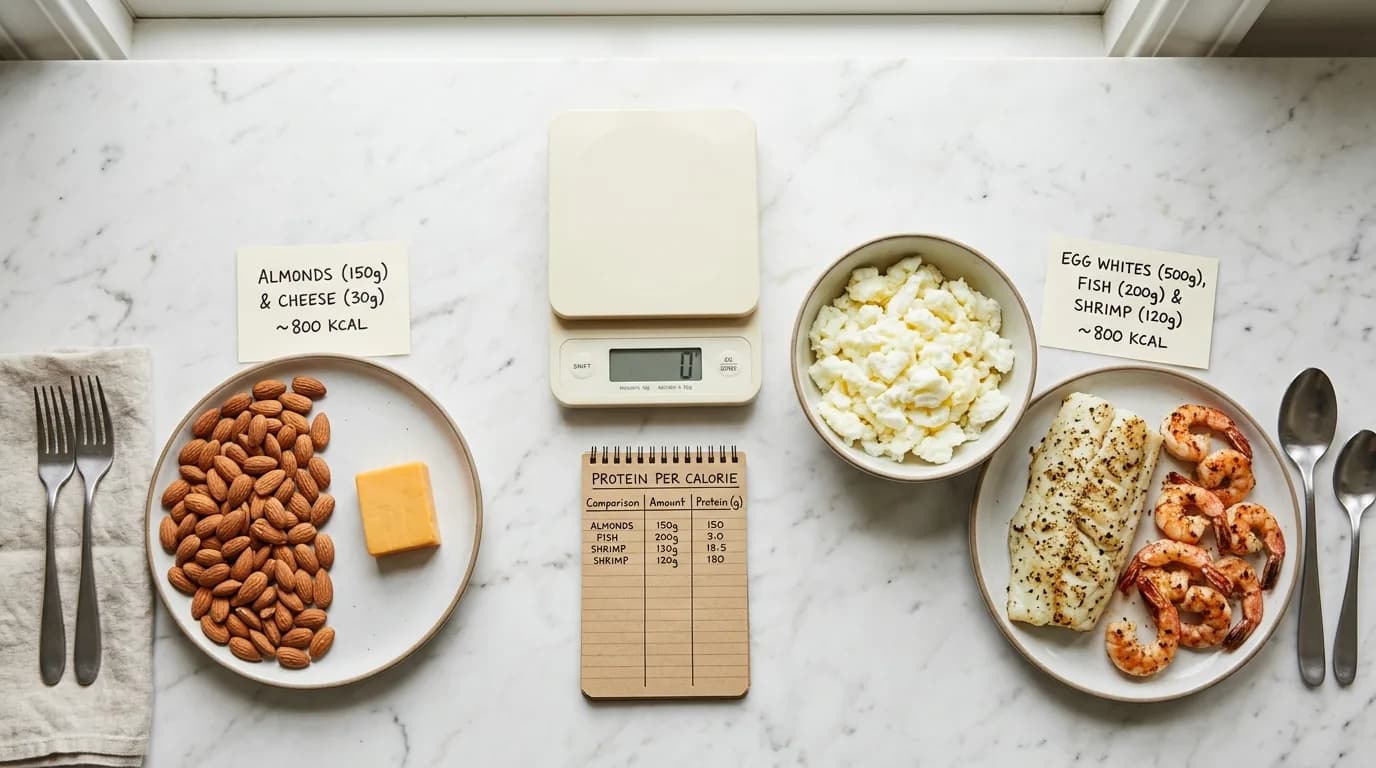
That distinction matters more than a simple “high protein” label. A food can contain several grams of protein and still require hundreds of calories to reach a meaningful protein amount. It can also be perfectly appropriate for maintenance, weight gain, endurance fuel, or enjoyment. The question here is narrower: if protein is the job, how many calories does the food charge?
The ranking below uses representative USDA values and a metric we call Protein Cost—the calories required to obtain 10 grams of protein. The interactive tool lets you compare foods at the same calories or the same protein, filter the complete 30-food table, and download the underlying CSV.
Quick answer: which foods have the highest Protein Cost?
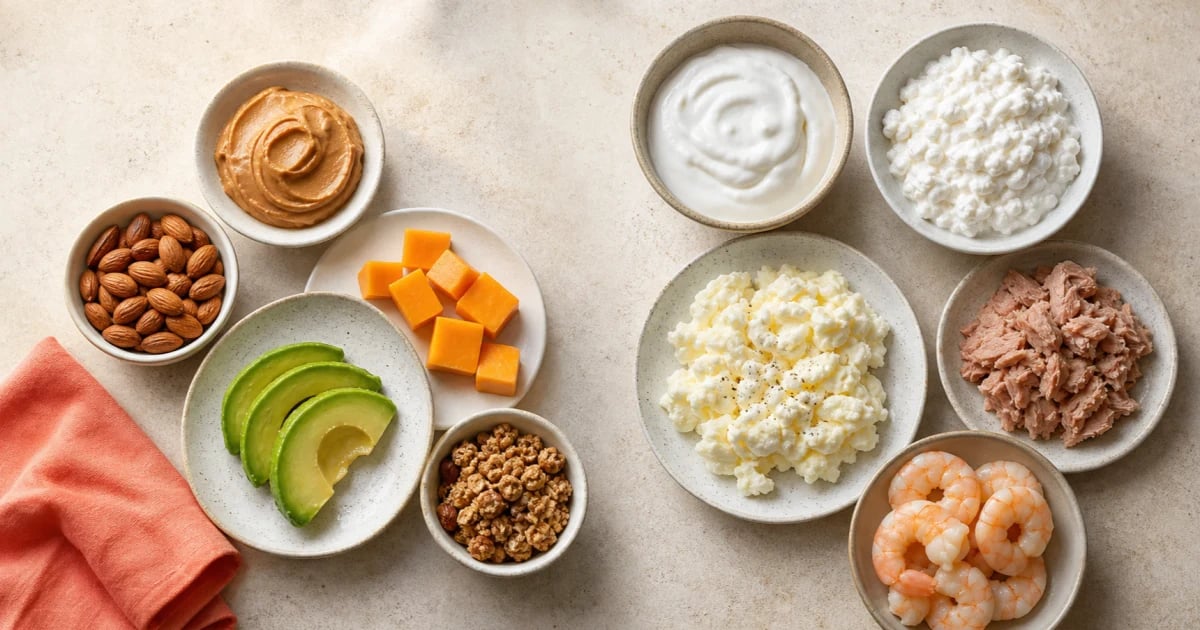
The least protein-efficient choices in this comparison tend to fall into six groups:
- Nuts and nut butters: peanut butter, almonds, walnuts, and sunflower seeds are primarily fat sources that contain some protein.
- Cheese and full-fat dairy: cheddar, cream cheese, and whole milk spend more calories per gram of protein than nonfat Greek yogurt or low-fat cottage cheese.
- Granola and breakfast add-ons: granola and seeds can make breakfast more energy-dense without turning it into a protein-centered meal.
- Plant foods marketed as protein: hummus, falafel, black beans, quinoa, and avocado play mixed nutritional roles; their calories also come from carbohydrate or fat.
- Fried snacks and add-ons: chips and fries contribute very little protein relative to their calorie load.
- Fatty processed meats: bacon and pork sausage contain protein, but much of their energy comes with fat.
Pure oils, sugary drinks, and many sweets contain essentially no protein at all. This table focuses instead on foods people might plausibly count toward protein or compare with a protein source.
Interactive nutrition lab
Protein Swap Explorer
Compare representative USDA values at the same calories or the same protein. Protein Cost means calories needed to obtain 10 g of protein—not overall food quality.
Serving snapshot
Peanut butter, smooth
2 tbsp (32 g)
- Calories
- 188
- Protein
- 8.0 g
- Per 100 cal
- 4.3 g
- Protein Cost
- 235 cal
Serving snapshot
Greek yogurt, plain, nonfat
170 g single-serve cup
- Calories
- 100
- Protein
- 17.3 g
- Per 100 cal
- 17.3 g
- Protein Cost
- 58 cal
At 188 calories, Greek yogurt, plain, nonfat provides 32.5 g of protein versus 8.0 g from Peanut butter, smooth — 24.5 g more protein.
At a glance
Longer means more protein at equal calories.
| Food | Serving | Calories | Protein | Protein / 100 cal | Protein Cost | Source |
|---|---|---|---|---|---|---|
| Restaurant-style french fries | 100 g | 312 | 3.4 g | 1.1 g | 918 cal | Fast foods, potato, french fried in vegetable oil |
| Plain potato chips | 1 oz (28 g) | 152 | 1.8 g | 1.2 g | 850 cal | Snacks, potato chips, plain, salted |
| Avocado | 1/2 large (100 g) | 160 | 2.0 g | 1.3 g | 800 cal | Avocados, raw, all commercial varieties |
| Plain tortilla chips | 1 oz (28 g) | 139 | 2.0 g | 1.4 g | 699 cal | Snacks, tortilla chips, plain, white corn, salted |
| Cream cheese | 2 tbsp (29 g) | 100 | 1.7 g | 1.7 g | 596 cal | Cream cheese, full fat, block |
| Walnuts | 1 oz (28 g) | 185 | 4.3 g | 2.3 g | 430 cal | Nuts, walnuts, English |
| Prepared hummus | 1/4 cup (60 g) | 106 | 2.9 g | 2.7 g | 364 cal | Hummus, home prepared |
| Plain granola | 1/2 cup (50 g) | 235 | 6.9 g | 2.9 g | 343 cal | Cereals ready-to-eat, granola, homemade |
| Chia seeds | 1 oz (28 g) | 138 | 4.7 g | 3.4 g | 294 cal | Seeds, chia seeds |
| Sunflower seed kernels | 1 oz (28 g) | 165 | 5.9 g | 3.6 g | 280 cal | Seeds, sunflower seed kernels |
| Quinoa, cooked | 1 cup (185 g) | 222 | 8.1 g | 3.6 g | 274 cal | Quinoa, cooked |
| Almonds | 1 oz (28 g) | 164 | 6.0 g | 3.7 g | 273 cal | Nuts, almonds |
| Falafel | 3 patties (75 g) | 250 | 10.0 g | 4.0 g | 250 cal | Falafel, home-prepared |
| Peanut butter, smooth | 2 tbsp (32 g) | 188 | 8.0 g | 4.3 g | 235 cal | Peanut butter, creamy |
| Whole milk | 1 cup (244 g) | 149 | 7.7 g | 5.2 g | 194 cal | Milk, whole, 3.25% milkfat |
| Whole-wheat bread | 2 slices (56 g) | 138 | 7.3 g | 5.3 g | 189 cal | Bread, whole-wheat, commercially prepared |
| Cooked pork sausage | 2 links (90 g) | 305 | 17.5 g | 5.7 g | 174 cal | Pork sausage, link/patty, cooked, pan-fried |
| Cheddar cheese | 1 oz (28 g) | 113 | 6.5 g | 5.8 g | 173 cal | Cheese, cheddar |
| Black beans, cooked | 1 cup (172 g) | 227 | 15.2 g | 6.7 g | 149 cal | Beans, black, cooked |
| Cooked bacon | 3 slices (24 g) | 112 | 8.1 g | 7.2 g | 138 cal | Pork, cured, bacon, pre-sliced, cooked, pan-fried |
| Edamame, prepared | 1 cup shelled (155 g) | 188 | 18.4 g | 9.8 g | 102 cal | Edamame, frozen, prepared |
| Firm tofu | 100 g | 144 | 17.3 g | 12.0 g | 83 cal | Tofu, raw, firm, prepared with calcium sulfate |
| Cottage cheese, 1% | 1 cup (226 g) | 163 | 28.0 g | 17.2 g | 58 cal | Cheese, cottage, lowfat, 1% milkfat |
| Greek yogurt, plain, nonfat | 170 g single-serve cup | 100 | 17.3 g | 17.3 g | 58 cal | Greek yogurt, plain, nonfat |
| Chicken breast, roasted | 100 g | 165 | 31.0 g | 18.8 g | 53 cal | Chicken, broilers or fryers, breast, meat only, cooked, roasted |
| Turkey breast, roasted | 100 g | 147 | 30.1 g | 20.5 g | 49 cal | Turkey, whole, breast, meat only, cooked, roasted |
| Egg whites | 100 g | 52 | 10.9 g | 21.0 g | 48 cal | Egg, white, raw, fresh |
| Tuna, canned in water | 100 g drained | 116 | 25.5 g | 22.0 g | 45 cal | Fish, tuna, light, canned in water, without salt, drained solids |
| Pacific cod, cooked | 100 g | 85 | 18.7 g | 22.0 g | 45 cal | Fish, cod, Pacific, cooked, dry heat (may contain additives to retain moisture) |
| Shrimp, cooked | 100 g | 99 | 24.0 g | 24.2 g | 41 cal | Crustaceans, shrimp, cooked |
Representative values vary by brand, preparation, and serving. Use the linked USDA descriptions to inspect the source assumptions.
How we ranked the foods
The food descriptions, energy values, and protein values come from USDA FoodData Central. Each row names the representative serving used and links to the relevant USDA search so you can inspect the underlying description. Values vary by brand, recipe, preparation, moisture, and serving size, so treat the numbers as comparison anchors rather than universal labels.
Protein Cost uses one calculation:
Protein Cost = calories ÷ protein grams × 10
Peanut butter at 188 calories and 8 grams of protein has a Protein Cost of 235 calories. In other words, at that ratio it takes about 235 calories to obtain 10 grams of protein. Plain nonfat Greek yogurt at 100 calories and 17.3 grams of protein has a Protein Cost of about 58 calories. Lower is more protein-efficient.
The tool also expresses protein per 100 calories. That is the inverse view used in our protein-per-calorie chart. This article owns the practical inverse question—which foods cost the most calories for their protein, and what could you use instead—while the companion guide explains the ratio and ranks the most efficient foods. If you want the basic energy math behind protein, carbohydrate, and fat, start with calories per gram.
Calculations use the stored values at full precision and round only for display. A food with zero protein would show “Not a meaningful protein source” rather than infinity. Protein Cost is a CalorieCue comparison framework, not a recognized medical score. It says nothing by itself about fiber, vitamins, minerals, fatty-acid profile, affordability, convenience, cultural value, or how satisfying you personally find a food.
High-calorie, low-protein foods by category
Nuts, nut butters, and seeds
Peanut butter, almonds, walnuts, sunflower seeds, and chia seeds all contain protein. The problem appears when they are asked to serve as the main protein in a calorie-limited meal. Their fat content makes them energy-dense, so the calories rise much faster than the protein.
A two-tablespoon serving of peanut butter has about 188 calories and 8 grams of protein. That can fit easily when it is measured. But reaching 20 or 30 grams of protein primarily from peanut butter would consume a large part of many people's meal budget. Walnuts are even less efficient in protein terms, though they contribute a different mix of fats and other nutrients.
Use these foods as measured fat sources, toppings, texture, and flavor. If you enjoy peanut butter, there is no need to remove it. Pair a smaller amount with Greek yogurt, cottage cheese, or another real protein anchor instead of expecting the jar to do both jobs.
Cheese and full-fat dairy
Cheddar contains meaningful protein, but it also carries enough fat to produce a much higher Protein Cost than low-fat cottage cheese. Cream cheese is mostly a spread, not a protein source. Whole milk contributes protein, carbohydrate, and fat together, which can be useful but is less efficient than cultured nonfat or low-fat dairy when calories are tight.
Use cheddar and cream cheese as flavor and fat, then let Greek yogurt, cottage cheese, or a lean entrée carry the protein target. This framing avoids an all-or-nothing choice: an ounce of cheese can improve a meal while a separate anchor supplies the bulk of the protein.
Granola and breakfast foods
Granola often looks like a protein food because it may include oats, nuts, and seeds. In practice, a half-cup serving in this dataset provides 6.9 grams of protein for 235 calories. It is better understood as a concentrated carbohydrate-and-fat topping.
Whole-wheat bread is more efficient than granola in this comparison, but it still plays primarily a carbohydrate role. Chia seeds add fiber, texture, and fat; they do not turn a low-protein breakfast into a high-protein one on their own.
Use granola, bread, and seeds as carbohydrate, crunch, or topping. Start breakfast with egg whites, Greek yogurt, cottage cheese, or another anchor, then add the amount of granola or bread that fits your appetite and calorie target.
Plant foods marketed as protein
Plant foods need more nuance. Hummus, falafel, black beans, quinoa, and avocado are not nutritionally interchangeable. Beans provide fiber and protein, falafel combines legumes with added cooking fat, quinoa is mostly carbohydrate with some protein, hummus is a mixed spread, and avocado is predominantly a fat-rich fruit.
Their Protein Cost simply describes efficiency. It does not erase fiber, minerals, unsaturated fats, or the role these foods play in a satisfying plant-forward diet. Firm tofu and edamame rank better within the plant group because they provide more protein for their calories.
Use the lower-efficiency choices as a mixed carbohydrate/fat component or moderate protein contributor, then combine them with tofu, edamame, seitan, a protein isolate, or another protein source appropriate to your diet. A bowl with beans and quinoa may still deliver substantial total protein; it just uses more calories than an equal-protein portion of a leaner source.
Convenience foods and restaurant add-ons
Potato chips, tortilla chips, and restaurant-style fries supply very little protein. They are included because they can occupy the calorie space where people expected a snack or side to help with fullness. Bacon and pork sausage do supply protein, but their fat raises the calorie cost compared with roasted chicken or turkey breast.
Use these foods for convenience, flavor, or enjoyment, not because their menu position makes them protein-efficient. A restaurant meal can keep the fries and still improve its balance by choosing a clear protein anchor and ordering a portion that matches your appetite.
Five practical protein swaps
The word “swap” describes an option, not a ban. Sometimes the most satisfying choice is to keep a smaller portion of the original food and add the comparison food beside it.
| Current food | Higher-protein comparison | At the current food's calories | Calories to match the current food's protein |
|---|---|---|---|
| Peanut butter: 188 cal, 8 g | Nonfat Greek yogurt | About 32.5 g protein | About 46 cal for 8 g protein |
| Granola: 235 cal, 6.9 g | Nonfat Greek yogurt | About 40.7 g protein | About 40 cal for 6.9 g protein |
| Cheddar: 113 cal, 6.5 g | 1% cottage cheese | About 19.4 g protein | About 38 cal for 6.5 g protein |
| Restaurant fries: 312 cal, 3.4 g | Cooked shrimp | About 75.6 g protein | About 14 cal for 3.4 g protein |
| Pork sausage: 305 cal, 17.5 g | Roasted chicken breast | About 57.3 g protein | About 93 cal for 17.5 g protein |
The same-calorie column asks how much protein the comparison food would provide if you spent the original food's calorie amount. It is a mathematical normalization, not a serving recommendation—312 calories of shrimp is a large portion, and 14 calories of shrimp is not a useful meal.
The same-protein column asks the reverse: how many calories of the comparison food would be required to match the original serving's protein. That view is useful when the protein target is fixed and you want to see how much calorie room remains for vegetables, grains, sauces, fats, or dessert.
A one-day worked example
Suppose a day already contains the foods you enjoy, but protein is low and the calorie total is tight. Three bounded changes can shift the ratio without rebuilding the entire menu.
1. Measure the peanut butter. An unmeasured three-tablespoon spoonful is about 282 calories and 12 grams of protein when scaled from the dataset. Measuring two tablespoons brings it to 188 calories and 8 grams. That saves about 94 calories while keeping peanut butter in the meal.
2. Make yogurt the snack anchor. A half-cup serving of granola is 235 calories and 6.9 grams of protein. Replace it with one 170-gram cup of nonfat Greek yogurt and keep one-quarter of the granola serving as a topping. The new snack is about 159 calories and 19.0 grams of protein—saving about 76 calories and adding 12.2 grams of protein.
3. Split the sausage portion. Replace half of the two-link pork sausage serving with 50 grams of roasted chicken breast. The mixed serving is about 235 calories and 24.3 grams of protein, compared with 305 calories and 17.5 grams for the full sausage portion. That saves 70 calories and adds 6.8 grams of protein while preserving some sausage flavor.
Across the illustrative day, those three decisions save about 240 calories and add 14.9 grams of protein. The exact result will change with the product, recipe, and portion. This is a worked comparison, not a meal prescription. You could spend the remaining calories on a larger meal, fruit, vegetables, a dessert, or simply a smaller deficit.
When these foods are still the right choice
Protein efficiency matters most when two constraints collide: calories are limited and a protein target is hard to reach. Outside that situation, a higher Protein Cost may not be a meaningful disadvantage.
Energy-dense foods can help during intentional weight gain, high-volume endurance training, maintenance with a high energy need, or periods of reduced appetite when eating enough is difficult. Nuts, avocado, oils, granola, and full-fat dairy can add energy without requiring a huge volume of food. They can also make meals taste better, improve satisfaction, preserve cultural fit, and add dietary variety.
A higher Protein Cost does not make a food nutritionally empty. It tells you only that protein is not the food's most calorie-efficient role. Choose it because you want the role it actually plays.
Protein helps, but it is not the whole diet
Higher-protein eating patterns can support fullness and body-weight management for some people, but the evidence does not turn protein into a magic lever. A review by Leidy and colleagues describes benefits and important limits: total diet quality, energy intake, adherence, food preferences, and the rest of the meal still matter.
If you need a target, use the separate guide to how much protein per day for weight loss. If you want a positive list rather than the inverse ranking, use foods high in protein and low in calories. And if your calorie target is unknown, calculate a starting estimate with the TDEE calculator, then adjust from your real trend.
A medical note about low-protein diets
This article is for readers trying to obtain more protein efficiently within a calorie budget. It does not apply to a medically prescribed low-protein diet.
Some people with chronic kidney disease or other conditions may be told to limit protein, change protein sources, or coordinate protein with dialysis and other treatment. That is a different goal. The National Kidney Foundation's guidance on protein and chronic kidney disease explains why the right amount depends on the person and treatment stage. Follow the amount and food guidance provided by your physician or renal dietitian rather than using this ranking to increase protein.
Frequently asked questions
What foods are high in calories but low in protein?
Common examples include oils and dressings, avocado, nuts, nut butter, seeds, cheese, cream cheese, granola, chips, fries, and many pastries. Some contain useful nutrients, but they deliver relatively little protein for their calories and should not be treated as lean protein anchors.
Is peanut butter a high-protein food?
Peanut butter contains protein, but most of its calories come from fat. A two-tablespoon serving has about 188 calories and 8 grams of protein, so it is better treated as a measured fat source than as the main protein in a calorie-limited meal.
Are nuts and cheese bad for weight loss?
No. Nuts and cheese can fit a weight-loss diet, but their portions matter because they are calorie-dense. Use them for flavor, texture, fats, and micronutrients while getting most of your protein from more calorie-efficient foods.
How is Protein Cost calculated?
Protein Cost is calories divided by protein grams, multiplied by 10. It estimates how many calories a food requires to provide 10 grams of protein. A lower number is more protein-efficient, but the metric does not measure fiber, vitamins, minerals, fat quality, cost, or overall food quality.
What is the easiest high-protein swap for peanut butter?
If the goal is protein rather than fat, plain nonfat Greek yogurt is an easy comparison: at the same calories it provides substantially more protein. The foods play different roles, so you can also keep a smaller measured amount of peanut butter and pair it with yogurt.
When are high-calorie, low-protein foods useful?
They can be useful for weight gain, maintenance, endurance fueling, reduced appetite, or simply adding dietary variety and enjoyment. Protein efficiency matters most when calories are constrained and reaching a protein target is difficult.
Does this guide apply to a prescribed low-protein diet?
No. A clinician-directed low-protein diet, including some diets used for chronic kidney disease, has a different medical purpose. Follow the protein amount and food guidance provided by your physician or renal dietitian rather than using this ranking to increase protein.
The bottom line
Think in terms of food role, not food morality. Peanut butter can be a measured fat source. Granola can be a topping. Cheddar can provide flavor. Avocado can bring texture and unsaturated fat. None has to disappear simply because it has a high Protein Cost.
When protein is the goal, choose an efficient anchor first—Greek yogurt, cottage cheese, egg whites, tofu, edamame, chicken, turkey, tuna, shrimp, or cod—then add the fats, carbohydrates, and flavors you actually want in portions that fit the day.
CalorieCue shows calories and protein side by side when you log a meal, which makes this tradeoff easier to see without doing the division every time.
Download CalorieCue