On this page
- Why the RDA Is the Wrong Number
- The Four Numbers (And Which One Is Yours)
- 0.8 g/kg — The RDA (Deficiency Floor)
- 1.2–1.6 g/kg — General Weight Loss
- 1.6–2.2 g/kg — Fat Loss + Muscle Preservation (The Sweet Spot)
- 2.2–2.4 g/kg — Lean Athletes in an Aggressive Cut
- The Simple Shortcut (For People Who Hate Math)
- The Adjustment Nobody Tells You About (If You're Overweight)
- Why Protein Matters More in a Deficit Than Anywhere Else
- It Decides Whether You Lose Fat or Muscle
- It Keeps You Full (So You Actually Stick to the Diet)
- It Costs You Calories to Digest
- How to Actually Hit Your Number
- Spread It Across the Day
- Anchor Every Meal With a Protein First
- Use Efficient Protein Sources
- Supplement Strategically
- Track It (At Least Until You Have a Feel for It)
- Can You Eat Too Much Protein?
- A Note on Older Adults
- Frequently Asked Questions
- How much protein do I need per day to lose weight?
- Is 100 grams of protein a day enough to lose weight?
- Should I count protein by current weight or goal weight?
- Can I lose weight on a high-protein diet without counting calories?
- What's the best source of protein for weight loss?
- Do I need protein powder to hit my target?
- How much protein per meal should I aim for?
- The Bottom Line
Here's the number you've probably been told: 0.8 grams of protein per kilogram of body weight. It's the official RDA. It's on every government chart. And for losing weight, it's almost certainly wrong for you.
Not because the science behind it is bad — but because you're using a number that was built to answer a completely different question.
The RDA exists to answer: "What's the minimum protein a sedentary adult needs to avoid a deficiency?" That's it. It's the nutritional equivalent of asking how little you can eat without getting sick. It is a floor, not a target. And almost everyone who quotes it as a protein "goal" — including a lot of doctors and dietitians who should know better — is accidentally telling you to aim at the floor.
If your actual question is "how much protein do I need to lose fat while keeping my muscle?" — which is what you really mean when you ask how much protein to eat for weight loss — the answer is roughly double the RDA. This post explains exactly how much, why, and how to hit it without choking down chicken breast all day.
Let me give you the short answer up front, then earn it: aim for about 1 gram of protein per pound of your goal body weight. For most people losing weight, that lands between 1.6 and 2.2 grams per kilogram. Now here's why.
Why the RDA Is the Wrong Number
The Recommended Dietary Allowance for protein — 0.8 g/kg of body weight — is one of the most misunderstood numbers in nutrition.
It was established as the amount needed to meet the basic requirements of 97.5% of healthy, sedentary adults — meaning the amount that prevents deficiency symptoms like muscle wasting and immune problems in almost everyone who isn't very active. It assumes you're not exercising hard, not dieting, and not trying to change your body composition.
The moment any of those things change, the number is too low. And weight loss changes all of them at once.
Think about what a diet actually is: you're deliberately eating fewer calories than you burn, which puts your body under stress and forces it to pull energy from its own tissues. Your body doesn't only pull from fat. Without enough protein, it happily breaks down muscle for energy too. The RDA — designed for someone not under this stress — provides nowhere near enough protein to protect against that.
According to Ro's review of the research, the weight-loss range is 1.2–1.6 g/kg — already 50–100% above the RDA. And for preserving muscle during a deficit, the evidence supports going higher still. The RDA isn't just a little low for weight loss. It's the wrong tool entirely.
A useful analogy: the RDA is like the minimum amount of water you need to not die of dehydration. Technically true, completely useless if your actual goal is to perform well, feel good, and not be thirsty all day. You don't aim for the survival minimum. You aim for the amount that gets you what you want.
The Four Numbers (And Which One Is Yours)
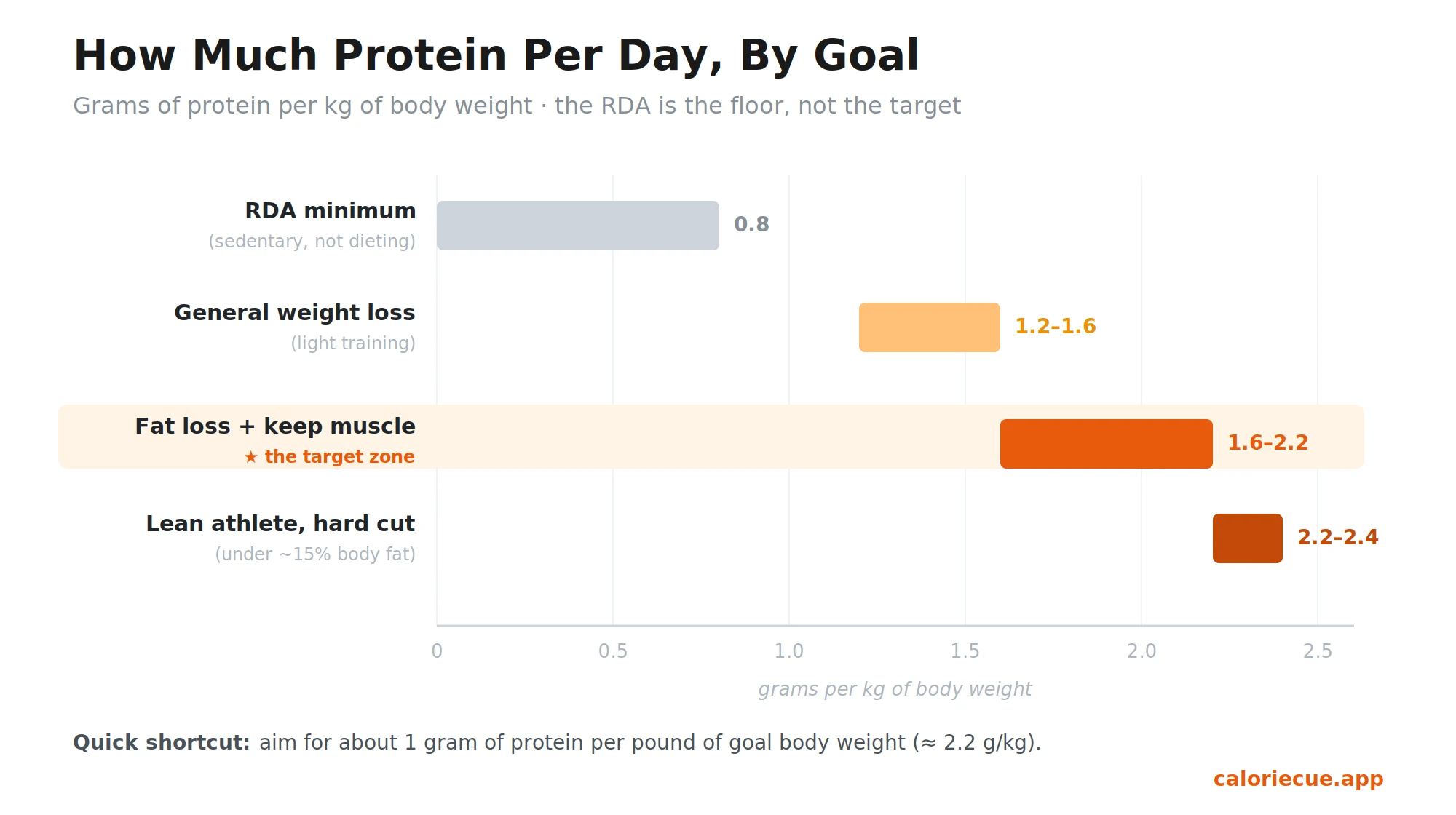
Protein recommendations get confusing because different sources quote different ranges — and they're all technically right, because they're answering different questions. Here are the four ranges that matter, from lowest to highest.
0.8 g/kg — The RDA (Deficiency Floor)
This is the "don't get sick" minimum for a sedentary person who isn't dieting. If you're reading an article about protein for weight loss, this number is not for you. It's the baseline the other numbers are measured against. (For a 150 lb person, that's about 55 grams per day.)
1.2–1.6 g/kg — General Weight Loss
This is the entry-level weight-loss range. It's appropriate if you're losing weight gradually, aren't doing much resistance training, and mostly want the satiety and muscle-protection benefits without maximizing them. It's a solid, sustainable target for someone easing into a more intentional diet. (For a 150 lb person: roughly 82–109 grams per day.)
1.6–2.2 g/kg — Fat Loss + Muscle Preservation (The Sweet Spot)
This is the range most people losing weight should target. It's the level the research consistently supports for preserving lean muscle mass during a calorie deficit, maximizing satiety, and getting the full metabolic benefit of protein. Examine's analysis puts the fat-loss-with-muscle range at 1.6–2.4 g/kg. If you're doing any resistance training while dieting — which you should be — this is your zone. (For a 150 lb person: roughly 109–150 grams per day.)
2.2–2.4 g/kg — Lean Athletes in an Aggressive Cut
This is the top end, relevant mainly for already-lean people (think under ~15% body fat for men) trying to get leaner while holding onto every ounce of muscle, often in a steep deficit. Most people don't need this much, and there's little benefit to going higher for the average person losing weight. But it's not harmful, and athletes in a hard cut genuinely benefit. (For a 150 lb person: roughly 150–164 grams per day.)
Which one is yours? For the overwhelming majority of people reading this — someone who wants to lose fat, keep their muscle, and not feel starving — the answer is the third range, 1.6–2.2 g/kg. That's where the simple "1 gram per pound" shortcut comes from, and it's where you should aim.
The Simple Shortcut (For People Who Hate Math)
You don't need to do kilogram conversions every day. Here's the rule that covers almost everyone:
Aim for about 1 gram of protein per pound of your goal body weight.
That's it. If your goal weight is 150 pounds, aim for about 150 grams of protein a day. If it's 130, aim for 130. This shortcut lands you neatly inside the 1.6–2.2 g/kg sweet spot, and it's easy to remember and easy to track.
A slightly more relaxed version, if 1 gram per pound feels like a lot to hit at first: aim for 0.7–0.8 grams per pound, and work up from there. You'll still get most of the muscle-preservation and satiety benefits, and it's more achievable when you're starting out. Hitting 0.7 g/lb consistently beats aiming for 1 g/lb and giving up.
The key word in the shortcut is goal weight, not current weight — which matters a lot if you have significant weight to lose. More on that next.
The Adjustment Nobody Tells You About (If You're Overweight)
Here's a critical detail most protein advice skips: if you're significantly overweight or obese, basing your protein target on your current body weight will overshoot — sometimes dramatically.
The reason is mechanical. Your protein needs are driven by your lean body mass — your muscles, organs, and other non-fat tissue — not by your fat mass. Fat tissue doesn't require protein to maintain. So if you weigh 280 pounds with a goal of 180, calculating protein off 280 pounds tells you to eat 280 grams a day, which is far more than your body can actually use and more than you need.
The fix, per NASM's guidance: if you carry a BMI over 30 or a body fat percentage above 25–30%, base your protein target on your goal weight instead of your current weight. So that 280-pound person aiming for 180 would target roughly 180 grams a day — based on the body they're working toward, not the one they're leaving behind.
An alternative approach that works just as well: use 1.2–1.5 grams per kilogram of your current weight. StrengthLog recommends exactly this for people who are overweight or obese, for the same reason — lean body mass, not total weight, determines the need.
Either method gets you to a sane, achievable number instead of an intimidating one. And "achievable" matters enormously, because the best protein target is the one you'll actually hit consistently.
Why Protein Matters More in a Deficit Than Anywhere Else
If protein only mattered a little, this would be a much shorter article. But protein during weight loss is arguably the single most important nutritional variable — more important than which diet you follow, whether you do keto, or what time you eat. Here's the mechanism.
It Decides Whether You Lose Fat or Muscle
When you're in a calorie deficit, your body needs to make up the energy shortfall somehow. It can pull from fat stores (what you want) or break down muscle tissue (what you don't). Protein intake is the primary lever that tilts this decision toward fat.
The clearest demonstration comes from a study cited by NASM: two groups dieted on the same calorie deficit, but one ate low protein (1.0 g/kg) and the other ate high protein (2.3 g/kg). The low-protein group lost about 1.6 kg (3.5 pounds) of muscle. The high-protein group lost only about 0.3 kg (0.66 pounds).
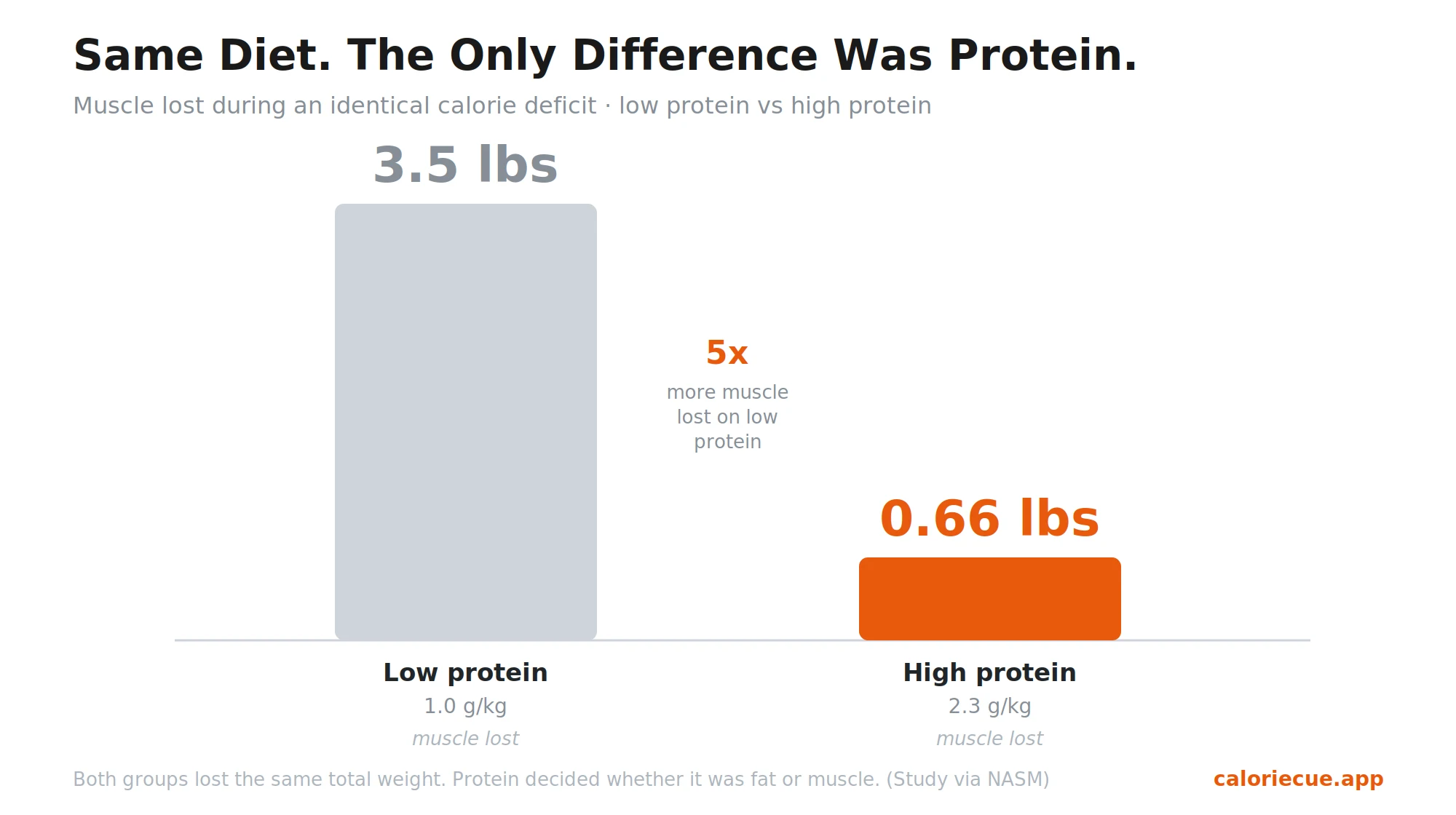
Five times more muscle lost, from the same diet, with the only difference being protein. The scale might show the same number for both groups — but one person ends up lean and firm, the other ends up smaller but soft, with a lower metabolism and a body they're less happy with. This is the difference between "losing weight" and "losing fat," and protein is what separates them.
Losing muscle is also self-sabotaging: muscle is metabolically active tissue, so losing it lowers your metabolism, making future weight loss harder and regain easier. Protecting muscle during a diet isn't vanity — it's protecting the engine that keeps you lean.
It Keeps You Full (So You Actually Stick to the Diet)
Protein is the most satiating of the three macronutrients. Gram for gram and calorie for calorie, it keeps you fuller longer than carbs or fat. This isn't a minor effect — it's often the difference between a diet you can sustain and one you abandon by week two.
When people complain that they're "starving" on their diet, the problem is frequently low protein. They're eating their calories in the form of carbs and fat, which don't trigger fullness the same way, so they're hungry all the time and white-knuckling it. Bump the protein up, and the same calorie deficit suddenly becomes tolerable, because you're not fighting constant hunger. For more on this, see our guide on how to eat more protein.
It Costs You Calories to Digest
Protein has the highest thermic effect of food of any macronutrient — your body burns roughly 20–30% of protein's calories just digesting and processing it, compared to about 5–10% for carbs and 0–3% for fat. So a portion of the calories in protein are effectively "free," burned in the act of digestion. It's a small edge, but during a diet, small edges compound.
How to Actually Hit Your Number
Knowing your target is useless if you can't reach it. For most people, the challenge isn't believing they need more protein — it's actually getting it onto the plate. Here's how.
Spread It Across the Day
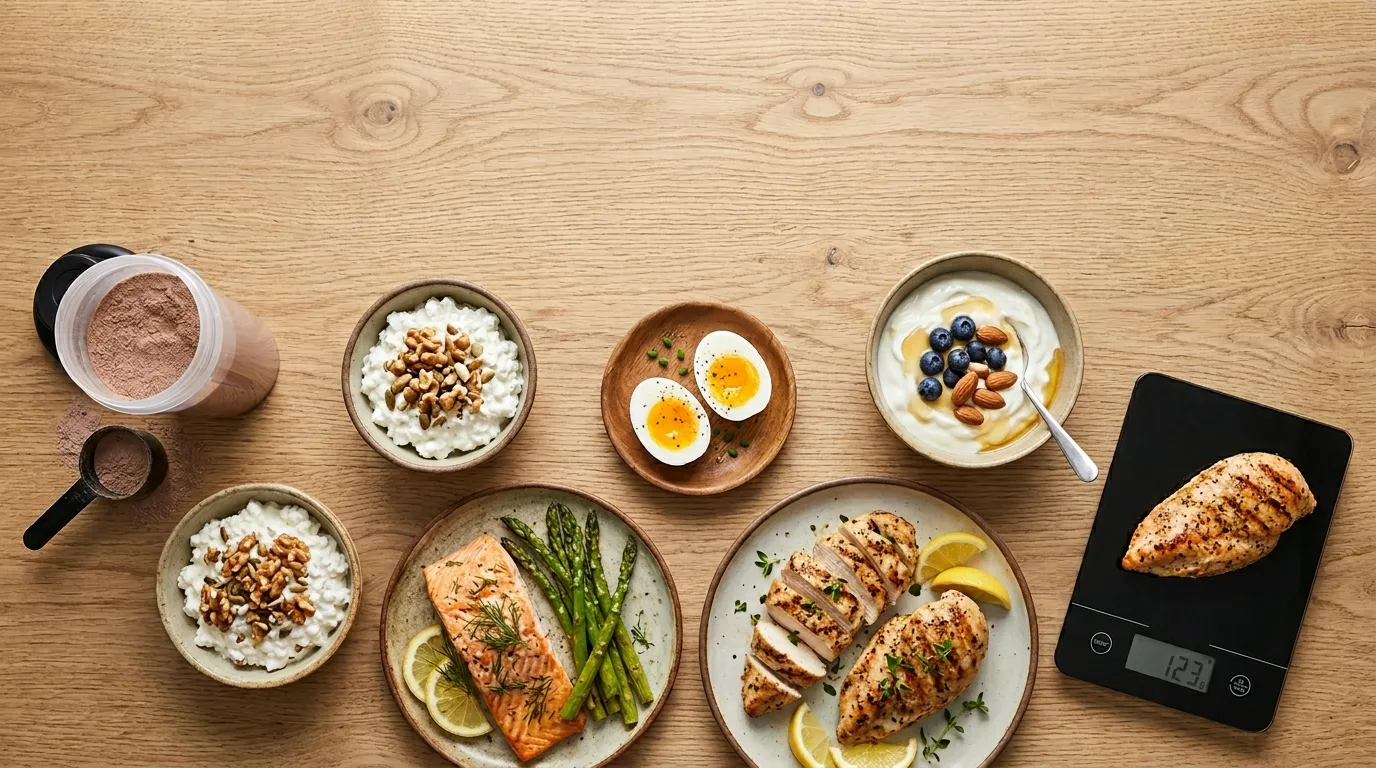
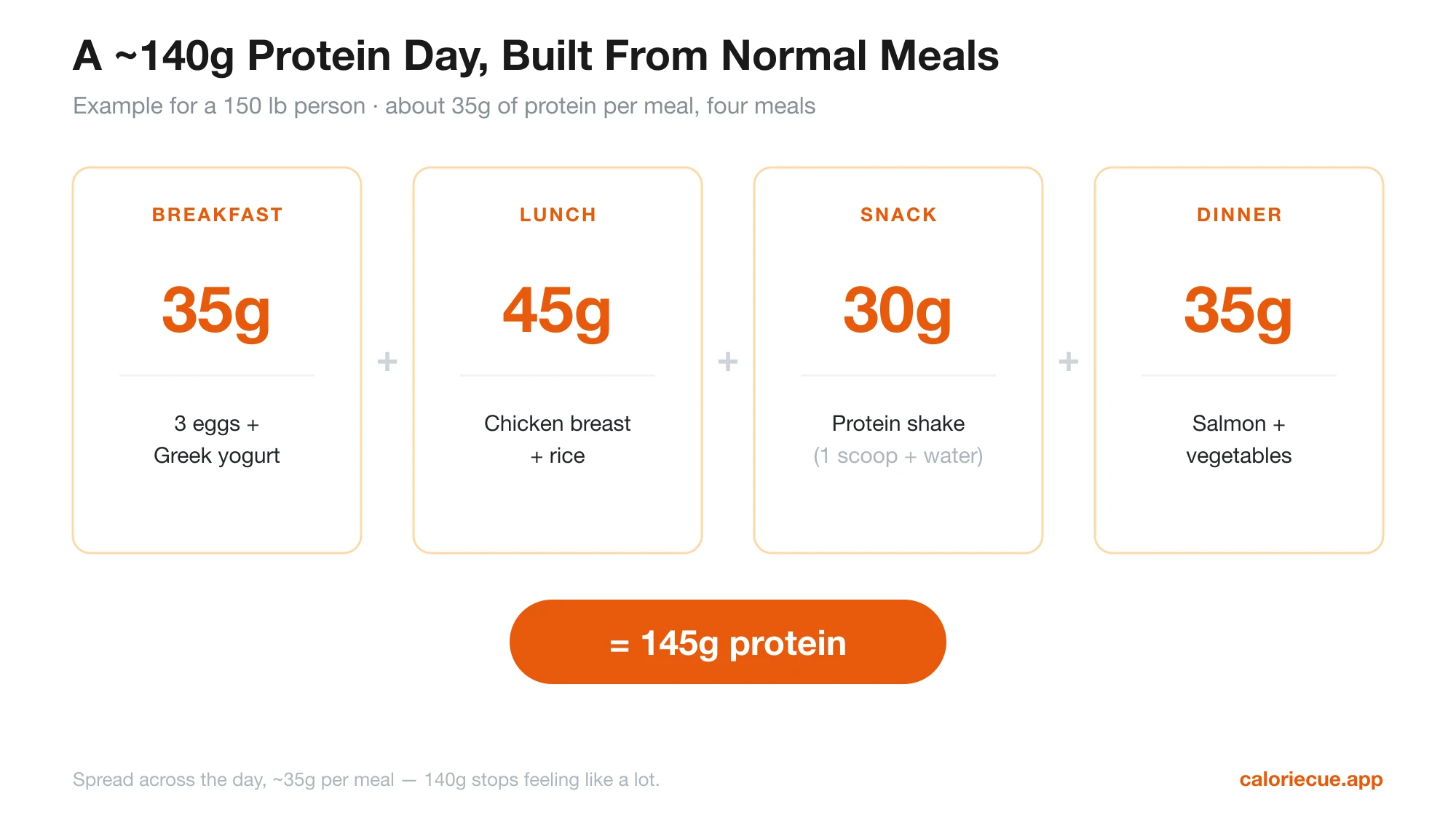
Don't try to cram all your protein into dinner. Your body uses protein best when it's distributed across meals — roughly 25–40 grams per meal across 3–4 meals. This also helps with satiety throughout the day, rather than being hungry until one big protein dump at night. (This is also a quiet fix for night eating, since a protein-rich breakfast and lunch kill evening hunger.)
Anchor Every Meal With a Protein First
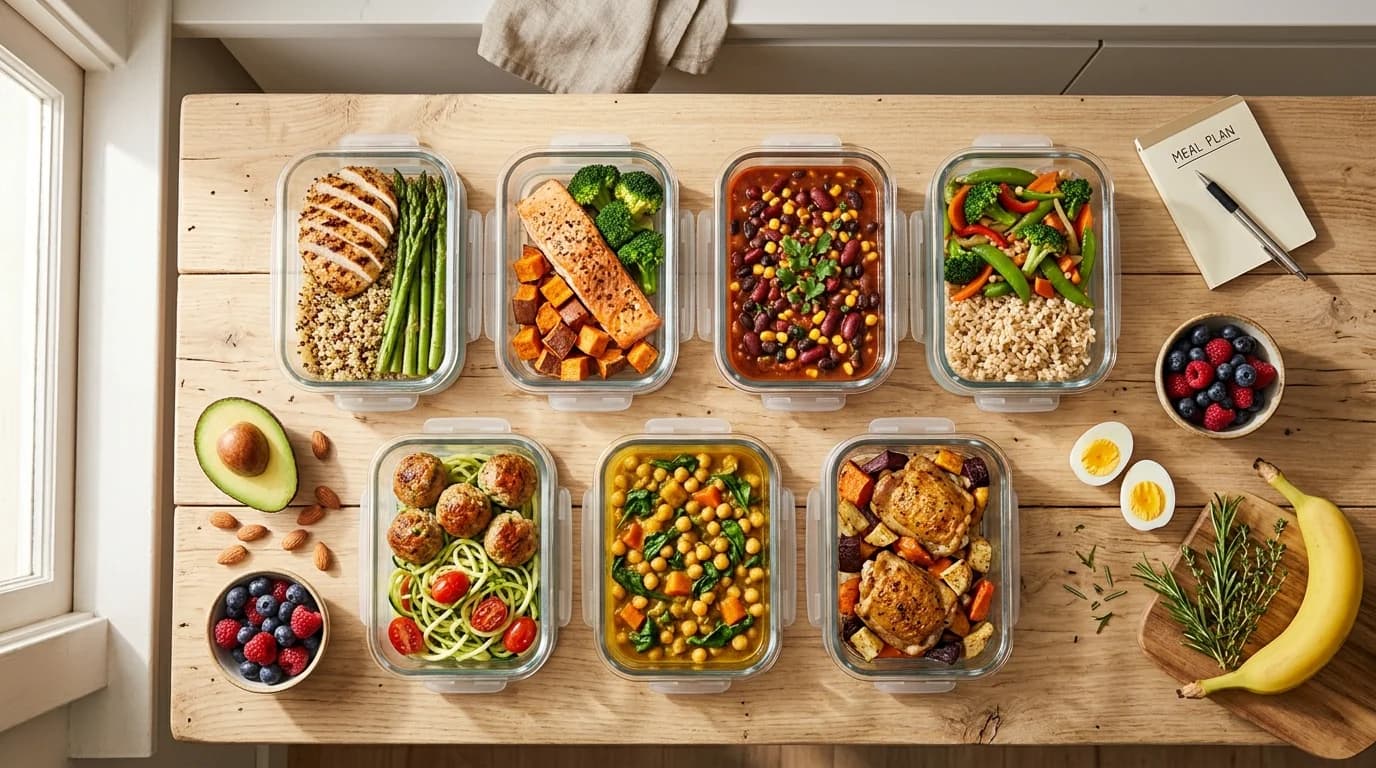
The simplest practical trick: decide your protein for each meal first, then build the rest of the meal around it. Most people do the opposite — they plan the meal and protein is an afterthought, which is why they fall short. Start with the chicken, fish, eggs, Greek yogurt, or cottage cheese, then add the carbs and vegetables.
Use Efficient Protein Sources
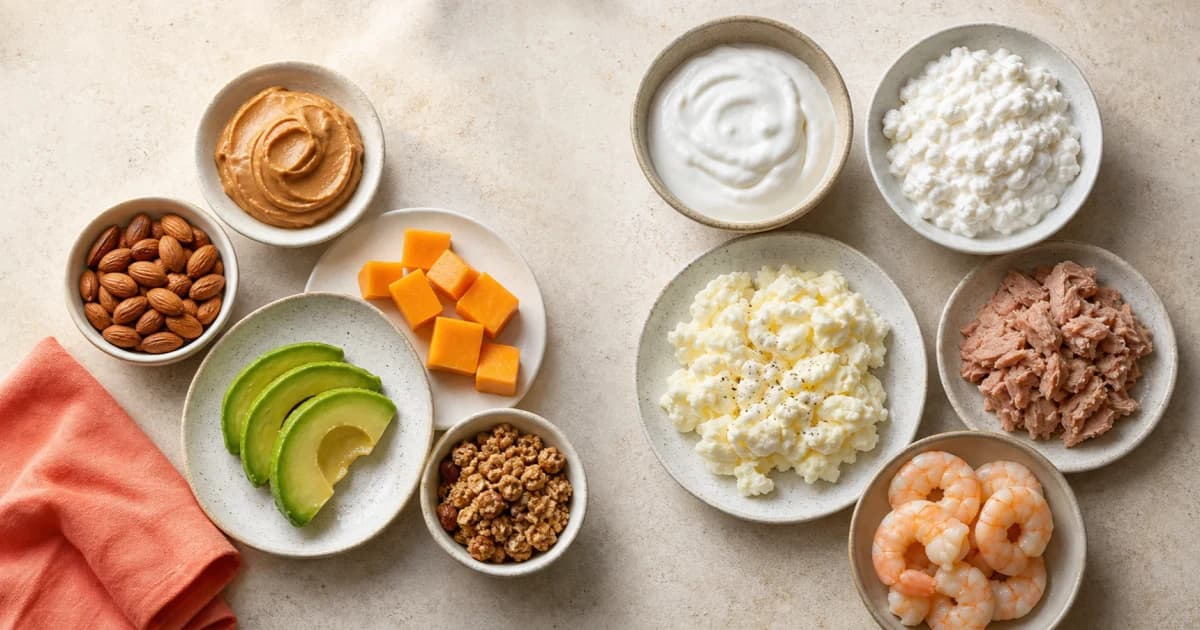
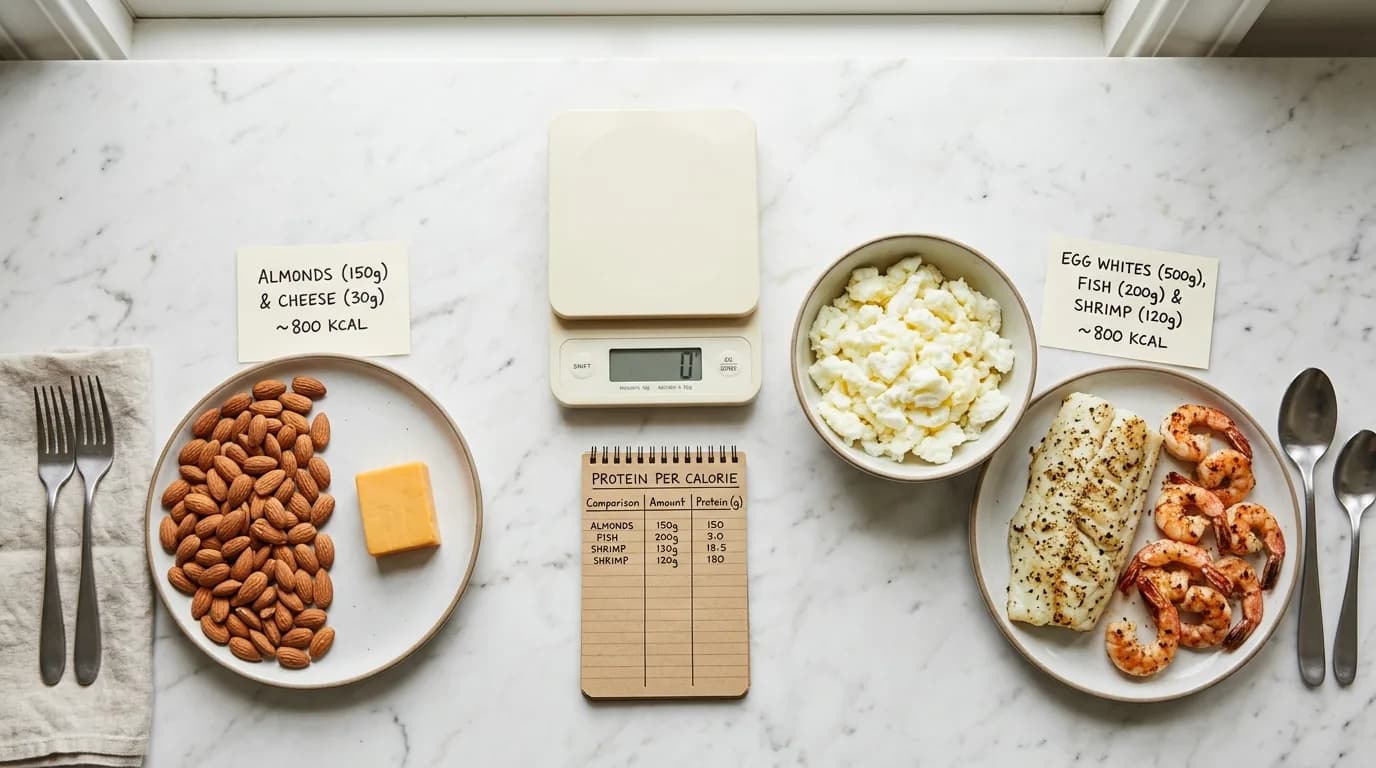
Some foods give you far more protein per calorie than others, which matters a lot when you're in a calorie deficit. Lean sources — chicken breast, white fish, shrimp, egg whites, nonfat Greek yogurt, low-fat cottage cheese — let you hit high protein numbers without eating your whole calorie budget. Our guide on protein per calorie ranks foods by exactly this, and best sources of protein covers the full picture. For a quick reference, high protein low calorie foods is a useful list.
Supplement Strategically
A protein shake is the easiest 25–30 grams you'll ever hit — water plus a scoop of whey or plant protein, 30 seconds, done. Shakes aren't magic and shouldn't be your whole intake, but they're a legitimate tool for closing the gap on busy days. One shake can be the difference between hitting 140 grams and falling short at 110.
Track It (At Least Until You Have a Feel for It)
Most people dramatically overestimate how much protein they're eating. A "high protein" day in someone's head is often 70 grams when they think it's 120. The only way to know is to track it, at least until you develop an accurate intuition. This is where logging earns its keep — see our guide on how to track calories, which covers protein alongside calories.
Can You Eat Too Much Protein?
Short version: for healthy people, no — not within any range you'd realistically reach through food.
The fear of protein "damaging your kidneys" is one of the most persistent myths in nutrition. It comes from the fact that people with pre-existing kidney disease need to limit protein. But in people with healthy kidneys, high protein intake has not been shown to cause kidney damage. StrengthLog notes that as of now, there's no known harmful upper limit for protein intake in healthy individuals.
The genuine caveats:
- If you have kidney disease (or risk factors for it), talk to your doctor before significantly increasing protein. This is a real medical exception.
- Don't crowd out everything else. Eating 300 grams of protein at the expense of vegetables, fiber, and healthy fats isn't optimal — balance still matters. The goal is adequate protein within a complete diet, not protein at all costs.
- More isn't better past a point. Once you're hitting 1.6–2.2 g/kg, eating even more protein doesn't provide additional muscle-preservation benefit for most people. There's no reason to force down 300 grams if your target is 150.
For the average healthy person aiming for the ranges in this article, protein is one of the safest things you can prioritize.
A Note on Older Adults
One group needs more protein, not less: older adults. As we age, our bodies become less responsive to protein — a phenomenon Examine describes as "anabolic resistance." Older muscles need a bigger protein stimulus to hold onto mass, which makes adequate protein even more important for anyone over about 60 trying to lose weight.
The cruel irony is that older adults often eat less protein (smaller appetites, dental issues, habit), right when they need more to fight age-related muscle loss. If you're older and dieting, hitting the higher end of the range (closer to 1 gram per pound of goal weight) and pairing it with resistance training is one of the most important things you can do to age well. Losing muscle in your 60s and 70s is far harder to reverse than in your 30s.
Frequently Asked Questions
How much protein do I need per day to lose weight?
For most people: roughly 1 gram per pound of goal body weight, or 1.6–2.2 grams per kilogram. For a 150-pound goal weight, that's about 110–150 grams per day. This range preserves muscle, maximizes fullness, and gets the full metabolic benefit of protein during a deficit. The 0.8 g/kg RDA is far too low for weight loss — it's a deficiency minimum, not a target.
Is 100 grams of protein a day enough to lose weight?
It depends on your size. For a smaller person (goal weight around 130–140 pounds), 100 grams is in a reasonable range. For a larger person, it's likely too low to fully preserve muscle. Use the 1 gram per pound of goal weight rule to find your specific number — 100 grams is a fine floor for many people but not optimal for everyone.
Should I count protein by current weight or goal weight?
If you're at a relatively healthy weight, current and goal are close enough that it doesn't matter much — use either. If you're significantly overweight or obese (BMI over 30), use your goal weight, because protein needs are driven by lean mass, not fat mass. Calculating off a high current weight overshoots.
Can I lose weight on a high-protein diet without counting calories?
Higher protein helps because it's so filling that many people naturally eat fewer total calories without trying. But weight loss still requires a calorie deficit — protein doesn't override that. High protein makes the deficit easier to achieve and protects your muscle while you're in it, but you still need to be eating less than you burn. See our guide on why your calorie deficit isn't working for more.
What's the best source of protein for weight loss?
Lean, protein-dense sources that give you the most protein per calorie: chicken breast, white fish, shrimp, egg whites, nonfat Greek yogurt, low-fat cottage cheese, and tuna. Our protein per calorie guide ranks them by efficiency. Whey or plant protein powder is the easiest way to close gaps.
Do I need protein powder to hit my target?
No, but it helps. You can hit any protein target with whole foods alone — eggs, chicken, fish, dairy, legumes. Protein powder is simply the most convenient way to add 25–30 grams quickly on busy days. It's a tool, not a requirement.
How much protein per meal should I aim for?
Roughly 25–40 grams per meal across 3–4 meals. Spreading protein out works better than cramming it all into one meal, both for muscle and for keeping you full throughout the day. If your daily target is 140 grams, that's about 35 grams across four meals.
The Bottom Line
The protein number you've probably been given — 0.8 grams per kilogram — answers the wrong question. It's the minimum to prevent deficiency in a sedentary person, not the amount you need to lose fat while keeping your muscle. Aiming for it during a diet is aiming at the floor.
The honest answer for weight loss: about 1 gram of protein per pound of your goal body weight, which lands most people in the 1.6–2.2 g/kg range — roughly double the RDA. If you're significantly overweight, base it on your goal weight, not your current weight. That single rule covers the vast majority of people.
This matters more than almost anything else you'll do on a diet, because protein is what decides whether the weight you lose is fat or muscle. Same calorie deficit, same number on the scale — but the high-protein dieter ends up lean and keeps their metabolism, while the low-protein dieter ends up soft and slows their metabolism down. Protein is the difference between losing weight and losing fat.
Hit your number by spreading protein across meals, anchoring each meal with a protein source first, leaning on efficient high-protein-per-calorie foods, and using a shake to close gaps. And track it, at least at first — almost everyone overestimates how much they're actually eating.
The hardest part of hitting a protein target consistently is knowing where you stand during the day. CalorieCue shows your protein adding up in real time as you snap photos of your meals — so you can see at lunch whether you're on track for 140 grams, or whether you need to add a shake before dinner. Take the guesswork out, hit your number, and keep the muscle you're working to protect. 7-day free trial, then paid. Download CalorieCue free on the App Store.
Stop aiming at the floor. Aim at the number that actually gets you what you want — a leaner, stronger body, not just a smaller one.
Download CalorieCue