On this page
- Egg calories and protein: the quick serving chart
- See how the portions compare
- Whole eggs vs egg whites: which should you choose?
- Why does one egg show 72 calories in one place and 78 in another?
- Egg size changes the numbers
- Carton egg whites: read the grams, not just the tablespoon count
- The calories cooking oil adds
- Log the breakfast, not just the eggs
- Make your next breakfast the first log
- Frequently asked questions
- How many calories and how much protein are in two eggs?
- How much protein is in an egg white?
- Are whole eggs or egg whites better for protein?
- How many eggs provide 20 grams of protein?
- Why do egg calorie counts say 70, 72 or 78?
- Do you count cooking oil when logging eggs?
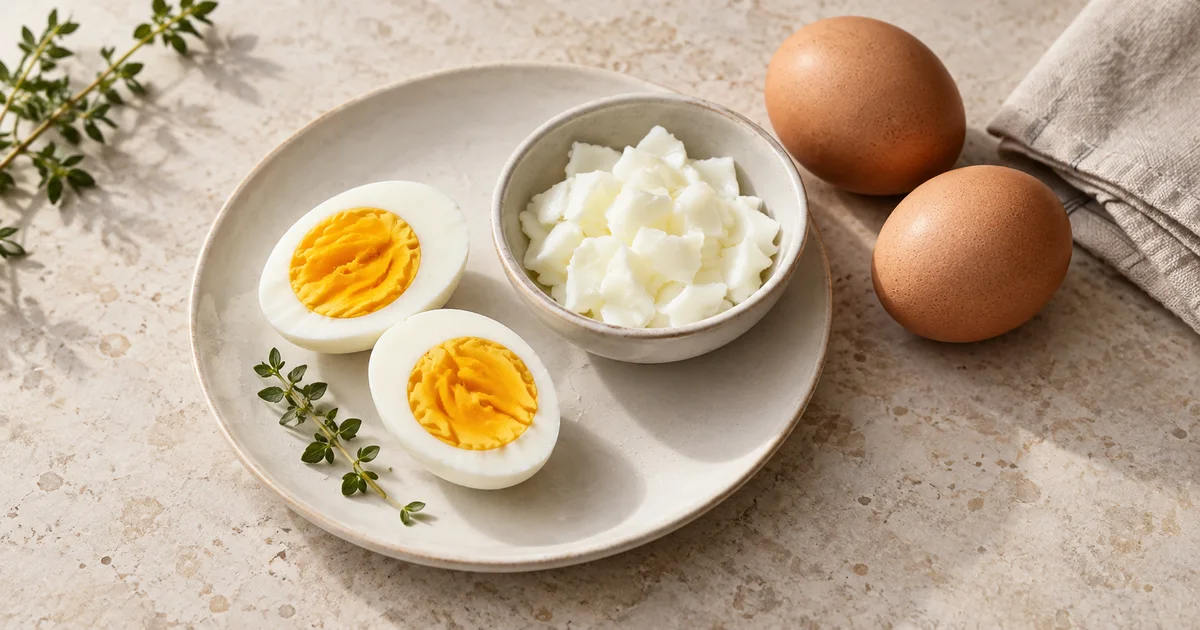
One large egg has about 72 calories and 6.3 g protein. One large egg white has about 17 calories and 3.6 g protein. Those are USDA raw-ingredient estimates, useful when you count the eggs going into a recipe. A large hard-boiled egg has a separate reference value of about 78 calories and 6.3 g protein.
For breakfast, the practical question is often: How can I get a little more protein without making the meal much bigger?
Try comparing two whole eggs with one whole egg plus three whites. The mixed portion gives about 4.5 g more protein for 20 fewer calories, before oil, butter or sides. You keep a yolk for flavor and add whites for more protein.
That is one useful option, not a rule that every breakfast needs fewer yolks. Here are the numbers, the tradeoffs, and how to log the meal you actually eat.
Egg calories and protein: the quick serving chart
The first table uses USDA FoodData Central entries for whole raw eggs and raw egg whites. A large whole egg is 50 g without its shell; its large white is 33 g. “Raw” describes the ingredient measurement before cooking, not a suggestion to eat eggs raw.
| Portion before cooking | Calories | Protein |
|---|---|---|
| 1 large whole egg | 72 | 6.3 g |
| 2 large whole eggs | 143 | 12.6 g |
| 3 large whole eggs | 215 | 18.8 g |
| 1 large egg white | 17 | 3.6 g |
| 3 large egg whites | 51 | 10.8 g |
| 6 large egg whites | 103 | 21.6 g |
| 1 large egg + 3 large whites | 123 | 17.1 g |
| 1 large egg + 4 large whites | 140 | 20.7 g |
Calculated from unrounded USDA values, then rounded to whole calories and one decimal place for protein. That is why two eggs show 143 calories rather than twice the rounded 72. Portions are lookup examples, not intake recommendations. Added ingredients are separate.
See how the portions compare
Switch between calories and protein below. The bars use a consistent scale within each view; selecting a portion shows its difference from two whole eggs.
The breakfast comparison
Same ingredient. Different balance.
Choose a portion. Switch the bars to see calories or protein on the same scale.
1 egg + 3 whites: 123 calories · 17.1 g protein. Compared with 2 whole eggs: 20 fewer calories and 4.5 g more protein.
USDA raw-ingredient estimates; no oil, milk or sides. Large whole egg: 50 g edible portion. Large white: 33 g. Illustrations show counts, not measured food volume. These portions are examples, not targets.
Notice that the mixed portion contains more egg white by weight than two whole eggs. The extra protein does not appear simply because you removed a yolk: you replaced one whole egg with three whites, increasing the amount of white in the meal.
Whole eggs vs egg whites: which should you choose?
Use whites when you want to add protein with relatively few calories. Use whole eggs when you want the yolk as part of the meal. Mixing them is an option too.
A whole egg has more protein than a single white because the yolk contains protein as well. Whites win on protein per calorie, not on protein per egg.
| Per 100 g, before cooking | Whole egg | Egg white |
|---|---|---|
| Calories | 143 | 52 |
| Protein | 12.56 g | 10.90 g |
| Fat | 9.51 g | 0.17 g |
| Protein per 100 calories | 8.8 g | 21.0 g |
The yolk also contributes nutrients that a protein ratio does not capture. For example, the NIH choline reference lists about 147 mg choline in one large hard-boiled egg. Choosing a whole egg is not “wasting” calories.
For a scramble, one whole egg plus three whites is a useful place to experiment: about 123 calories and 17.1 g protein before additions. If you enjoy two whole eggs, you can keep them and choose other foods around them. Your daily protein intake matters more than winning a ratio contest at every meal.
Our protein-per-calorie chart compares other foods when you want alternatives.
Why does one egg show 72 calories in one place and 78 in another?
Often, you are looking at different reference foods.
| USDA reference, one large egg | Edible weight | Calories | Protein |
|---|---|---|---|
| Whole, raw | 50 g | 72 | 6.3 g |
| Whole, hard-boiled | 50 g | 78 | 6.3 g |
The raw record contains 143 calories per 100 g, while the hard-boiled record contains 155. These are separate database references, not the same eggs measured before and after boiling. Do not conclude that boiling adds six calories to an egg. Water does not supply those calories.
For logging, choose the entry that fits your method:
- Cooking a scramble from ingredients? Count the eggs you crack using an appropriate size or raw edible weight, then add the milk, oil, cheese or butter used.
- Eating ready-cooked boiled eggs? Use the package label or a hard-boiled entry and the number or peeled weight eaten.
- Using a generic “fried egg” entry? Check its description. Prepared-food entries can already include cooking fat.
Labels may also round values or describe a different egg size. Use a matching entry consistently instead of switching to whichever number is lowest.
Egg size changes the numbers
“One egg” is convenient, but small and jumbo eggs are not the same portion. These are the edible weights in the USDA raw whole-egg record:
| Egg size | Weight without shell | Calories | Protein |
|---|---|---|---|
| Small | 38 g | 54 | 4.8 g |
| Medium | 44 g | 63 | 5.5 g |
| Large | 50 g | 72 | 6.3 g |
| Extra large | 56 g | 80 | 7.0 g |
| Jumbo | 63 g | 90 | 7.9 g |
For everyday tracking, choosing the size on your carton is a practical estimate. If you weigh ingredients, weigh the contents after cracking, excluding the shell. Size grades differ between countries; use your local label or edible weight if its sizing does not match this reference.
You do not need to weigh every egg to use the chart. Our guide to counting without a food scale explains how to work with known portions.
Carton egg whites: read the grams, not just the tablespoon count
A serving of liquid egg whites is not necessarily the white from one egg.
For example, Eggland’s Best egg whites list 25 calories and 5 g protein per 3 tablespoons (46 g). That is a specific US product label, checked September 29, 2026. The generic USDA large white in our chart weighs 33 g.
If you use 92 g of that carton product, you have two labeled servings: 50 calories and 10 g protein. Do not log it as “two egg whites” just because it is two servings.
For any carton, use:
Amount used ÷ labeled serving amount × calories or protein per serving
Keep the units consistent: grams with grams, or measured tablespoons with tablespoons. For other brands and formulations, follow their own labels. An egg substitute or flavored egg mixture can have different ingredients from plain whites.
The calories cooking oil adds
Two people can start with the same two eggs and log different breakfasts because one uses more cooking fat. The eggs are only part of the meal.
The animation below uses 9 calories per gram of fat as a simple oil estimate. It shows the amount of oil eaten with the portion, not necessarily everything poured into a pan shared by several servings.
What the pan adds
The eggs stay the same.
Start with two large eggs. Add an amount of oil eaten with the portion.
143 calories total · 12.6 g protein
Illustrative oil calculation: 9 calories per gram of fat; use your oil’s label for product-specific values. Assumes all selected oil is eaten with this portion. Oil adds no protein. Butter contains water too, so do not apply this formula to butter’s total weight.
At that calculation rate, two large eggs plus 5 g oil total 188 calories. With 10 g oil, the total is 233 calories. The protein stays at about 12.6 g because oil adds no protein.
Use the oil label for a more product-specific estimate. Butter contains water as well as fat, so 5 g butter is not equivalent to 5 g fat; calculate butter from its own label. The calories-per-gram guide explains that distinction.
Choose one logging method: raw eggs plus the ingredients you add, or a prepared-egg entry that matches the dish. A generic “scrambled eggs with butter” entry plus the full butter amount again can count the same fat twice.
If some oil is left in the pan, the amount eaten is uncertain. Measure what you add, divide it across the servings, and use a consistent estimate. A photograph cannot tell you exactly how much oil was absorbed.
Log the breakfast, not just the eggs
The most useful number is the total for your plate. Toast, cheese, avocado, sauce and milk can change it substantially.
Here is a worked example using the mixed egg portion and illustrative label values for the additions:
| Item | Calories used in this example |
|---|---|
| 1 large egg + 3 whites | 123 |
| Measured butter portion, according to its label | 35 |
| Slice of toast, according to its label | 100 |
| Vegetables, estimated portion | 20 |
| Breakfast total | 278 |
The egg portion provides about 17.1 g protein; add the protein from the other ingredients for the whole-meal total. The butter, toast and vegetable figures are arithmetic examples, not verified nutrition for a particular recipe. Replace them with your food and amounts.
For a shared scramble or a batch of egg muffins, add up the ingredients and divide the finished food into portions. The homemade-food calorie calculator handles that next step.
Make your next breakfast the first log
You have the egg numbers. Now put them into a repeatable routine:
- Choose your portion: whole eggs, whites, or a mix.
- Include the additions: cooking fat, milk, toppings and sides.
- Review the meal before saving: check that the estimate matches what went into the pan.
With CalorieCue, start from a photo of the finished breakfast, then review and adjust the foods and amounts before saving. Tell the log what the picture cannot establish reliably: the number of yolks in a scramble, the carton serving, and the cooking fat. You can then see the breakfast’s logged calories and protein together in your daily totals.
For more foods to keep on hand, use the high-protein grocery list. For the rest of your plate, the food calorie reference covers common servings.
Frequently asked questions
How many calories and how much protein are in two eggs?
Two large eggs provide about 143 calories and 12.6 g protein using USDA raw-ingredient values, before additions. Two large hard-boiled eggs have a separate reference value of about 155 calories and 12.6 g protein. Match the entry to your preparation.
How much protein is in an egg white?
One large white, about 33 g before cooking, provides 3.6 g protein and 17 calories. Three provide about 10.8 g protein and 51 calories. For a packaged egg-white product, use its label.
Are whole eggs or egg whites better for protein?
Whites provide more protein per calorie; a whole large egg provides more protein than one large white. Whole eggs also supply nutrients such as choline. A mix lets you increase protein while keeping a yolk. Choose based on the meal you want to eat.
How many eggs provide 20 grams of protein?
Using these large-egg references, three whole eggs provide about 18.8 g, and four provide 25.1 g. Six whites provide 21.6 g. One whole egg plus four whites provides about 20.7 g. These are examples, not recommended portions.
Why do egg calorie counts say 70, 72 or 78?
Egg size, label rounding and preparation can explain different numbers. The USDA raw reference gives 71.5 calories for a 50 g large egg; its separate hard-boiled reference gives 77.5. These records are not a before-and-after experiment.
Do you count cooking oil when logging eggs?
Yes: count the oil eaten with your portion. If you log raw eggs plus measured ingredients, add the fat separately. If you use a prepared scrambled-egg or fried-egg entry, check whether it already includes fat so you do not count it twice.
Nutrition sources: USDA FoodData Central SR Legacy records 171287, 172183 and 173424, retrieved September 29, 2026; the manufacturer label and NIH reference linked above. Values are estimates. The interactive graphics use the same unrounded raw-ingredient data as the serving chart.