On this page
- Quick answer
- Calories per gram calculator
- How to calculate calories from macros
- Calculate a full-day macro target
- What is the 4-4-9 rule?
- Why does my label math not add up?
- 1. The displayed values have been rounded
- 2. Fiber does not always provide four calories per gram
- 3. Sugar alcohols use different energy values
- 4. More specific food factors may be used
- A gram of food is not a gram of protein
- How many grams equal 100 calories?
- Does sugar have four calories per gram?
- How many calories are in one gram of alcohol?
- Are kcal and Calories the same?
- When should you use this formula?
- Calculate labels. Photograph meals.
- Frequently asked questions
- How many calories are in one gram?
- What is the 4-4-9 rule?
- How many calories are in a gram of protein?
- How many calories are in a gram of carbohydrates?
- How many calories are in a gram of fat?
- How many calories are in a gram of alcohol?
- Why do my calculated macros not match the label?
- Does fiber contain calories?
- Are kcal and Calories the same?
- Can I calculate calories using the total weight of food?
- The bottom line
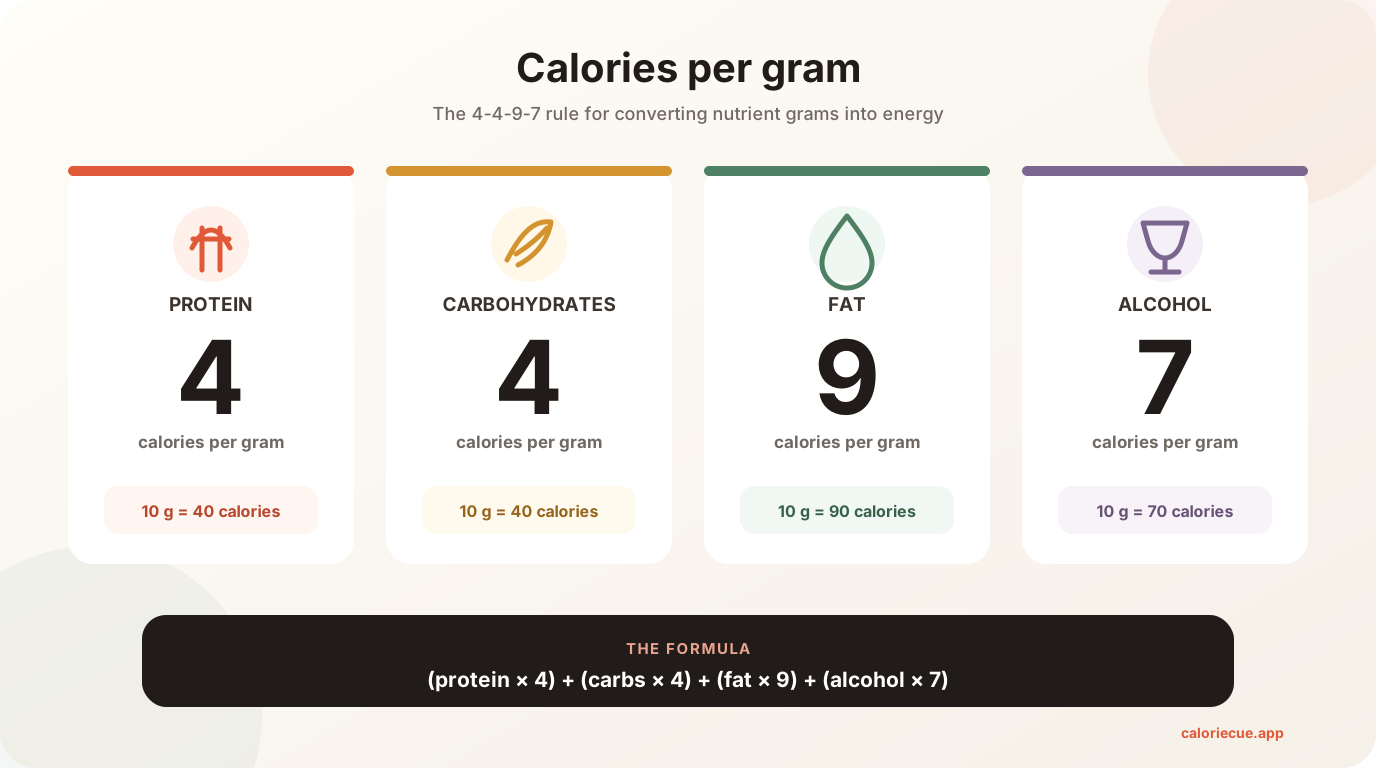
Protein and carbohydrates contain approximately 4 calories per gram, fat contains 9 calories per gram, and alcohol contains 7 calories per gram.
Use the calculator below to total a meal, or jump to the worked example to check your label arithmetic.
The useful part starts when you try to apply it. How do you turn 140 grams of protein, 180 grams of carbs, and 60 grams of fat into a calorie target? Why does a snack bar calculate to 199 calories when the package says 200? Does fiber count as four? And does 100 grams of chicken contain 400 calories because protein contains four calories per gram?
This guide answers those questions and gives you a calculator you can use on any meal, recipe, food label, or daily macro target.
Quick answer
Use the 4-4-9-7 rule:
| Energy source | Calories per gram | Calories in 10 grams | Calculation |
|---|---|---|---|
| Protein | 4 | 40 | Protein grams × 4 |
| Carbohydrates | 4 | 40 | Carb grams × 4 |
| Fat | 9 | 90 | Fat grams × 9 |
| Alcohol | 7 | 70 | Alcohol grams × 7 |
The complete formula is:
Calories = (protein × 4) + (carbohydrates × 4) + (fat × 9) + (alcohol × 7)
The USDA Food and Nutrition Information Center confirms the general 4-4-9 values for protein, carbohydrate, and fat. Alcohol is not one of the three primary macronutrients, but it still supplies energy at roughly 7 calories per gram.
The important distinction: these numbers apply to grams of nutrients, not grams of total food. A 100-gram food can include water, fiber, minerals, and several macros at once.
Calories per gram calculator
Enter the grams from a food label, recipe, meal, or macro target. The result updates automatically and shows how much each nutrient contributes to the total.
Interactive tool
Macro Calorie Calculator
Enter the grams from a food label, recipe, meal, or daily macro target. The result updates automatically using 4-4-9-7.
Estimated total
415 calories
General estimate before label rounding
A packaged-food label may differ slightly because manufacturers calculate from unrounded values and may use different factors for fiber or sugar alcohols.
The calculator gives a general estimate before label rounding. If the total is a few calories away from a packaged food's number, keep reading before assuming either number is wrong.
How to calculate calories from macros
Multiply each nutrient by its calorie value, then add the results.
Suppose a snack bar contains:
- 10 grams of protein
- 24 grams of carbohydrates
- 7 grams of fat
The calculation is:
| Nutrient | Math | Calories |
|---|---|---|
| Protein | 10 × 4 | 40 |
| Carbohydrates | 24 × 4 | 96 |
| Fat | 7 × 9 | 63 |
| Total | 40 + 96 + 63 | 199 |
The package will probably display 200 calories. A one-calorie difference is normal because the displayed nutrient grams and calories have both been rounded.
Calculate a full-day macro target
Now suppose your daily targets are:
- 140 grams of protein
- 180 grams of carbohydrates
- 60 grams of fat
Your calorie target would be:
| Nutrient | Math | Calories |
|---|---|---|
| Protein | 140 × 4 | 560 |
| Carbohydrates | 180 × 4 | 720 |
| Fat | 60 × 9 | 540 |
| Total | 560 + 720 + 540 | 1,820 |
If you need help choosing those gram targets, use the complete guide to counting macros. If you need to find your total calorie target first, use the free TDEE calculator.
What is the 4-4-9 rule?
The 4-4-9 rule is a shortcut for estimating energy from the three primary macronutrients:
- Protein: 4 calories per gram
- Carbohydrates: 4 calories per gram
- Fat: 9 calories per gram
The order is always protein, carbohydrate, fat: 4, 4, 9. Alcohol adds the fourth number—7—when it is relevant.
Fat contains more than twice as many calories per gram as protein or carbohydrates. That does not make dietary fat unhealthy. It explains why oils, butter, nuts, cheese, avocado, and fatty meats can raise a meal's calories quickly even when the portion looks small.
A tablespoon of olive oil contains around 14 grams of fat. Fourteen multiplied by nine is 126, which is why the label typically shows about 120 calories after its permitted calculations and rounding. By comparison, you would need roughly 30 grams of pure protein to reach a similar calorie total.
If you are trying to fit more protein inside a fixed calorie target, our protein-per-calorie chart ranks foods by that exact efficiency.
Why does my label math not add up?
A small mismatch does not mean the manufacturer ignored basic arithmetic. Four things commonly explain the difference.
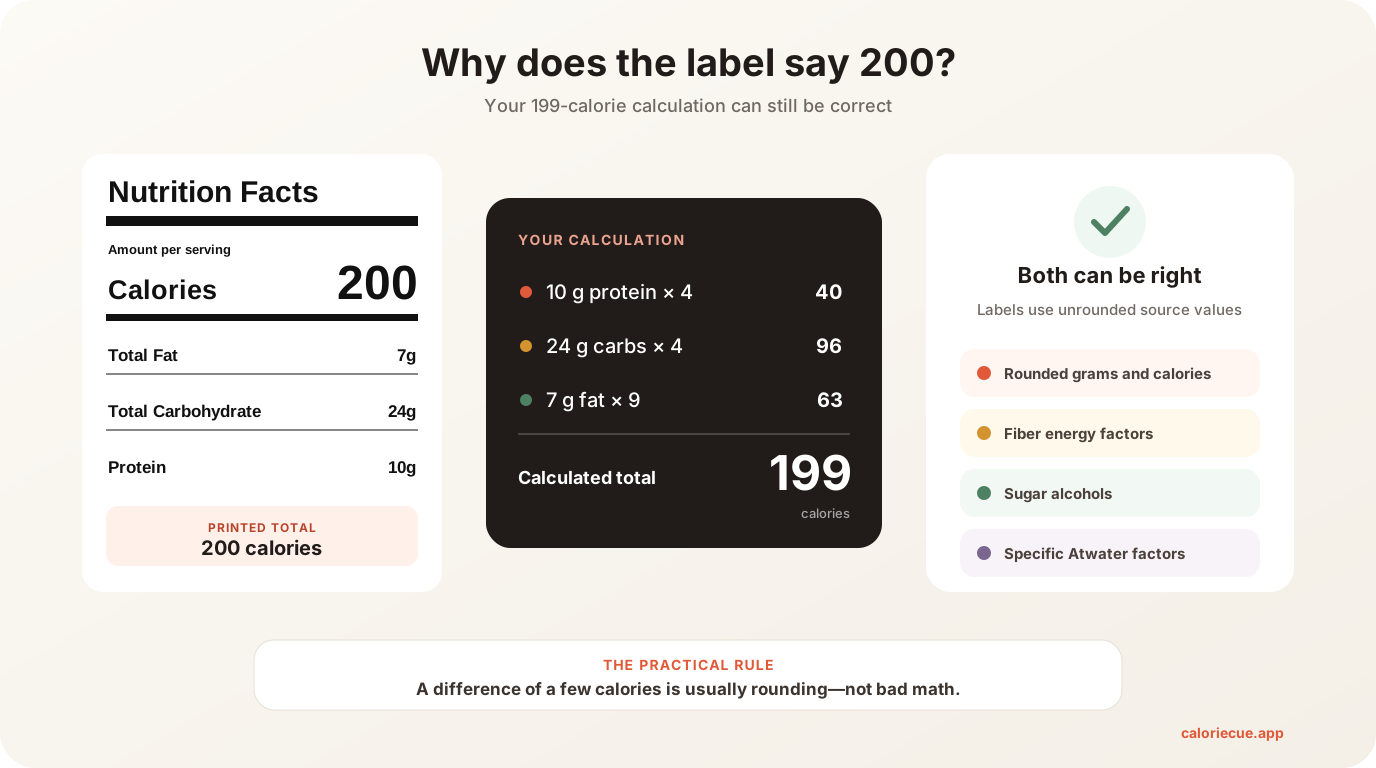
1. The displayed values have been rounded
Manufacturers normally calculate calories from unrounded nutrient amounts. Consumers see rounded grams and a rounded calorie total.
Under U.S. nutrition-label regulations, calories are generally displayed in five-calorie increments up to and including 50 calories, and ten-calorie increments above 50. Protein and carbohydrate grams are generally displayed in whole grams, while fat has its own rounding increments.
Imagine the food actually contains 9.6 grams of protein, 23.6 grams of carbs, and 7.3 grams of fat. The printed label may show 10, 24, and 7, while the manufacturer used the more precise values for its calculation. Rebuilding the total from the printed values cannot reproduce the original calculation exactly.
2. Fiber does not always provide four calories per gram
Fiber appears under total carbohydrate, but not every gram is digested like starch or sugar.
For U.S. label calculations, the FDA allows a general factor of 2 calories per gram for soluble non-digestible carbohydrate, while insoluble non-digestible carbohydrate can contribute 0 calories per gram.
That is why multiplying all total carbohydrate by four can overestimate the calories in a high-fiber product.
Do not automatically subtract every gram of fiber and assume it contributes zero. Different fibers are treated differently, and the package's calorie total is usually the more useful number for tracking the packaged food.
3. Sugar alcohols use different energy values
Sugar alcohols are carbohydrates, but they generally provide fewer calories than regular sugar.
The FDA's Nutrition Facts guidance lists different general factors for individual sugar alcohols. Erythritol uses 0 calories per gram, while maltitol, sorbitol, xylitol, and others use values between roughly 1.6 and 3 calories per gram.
This is why protein bars, reduced-sugar sweets, and many keto-labeled foods are especially likely to disagree with a simple total-carbohydrate-times-four calculation.
4. More specific food factors may be used
Four, four, and nine are general energy factors. U.S. regulations also permit specific Atwater factors and other approved methods for particular foods or ingredients.
For everyday tracking, the general formula is accurate enough to understand where your calories come from. Reconstructing a commercial label to the exact calorie is a different job—and one that usually requires the manufacturer's unrounded data.
Quick diagnostic: a difference of a few calories is usually rounding. A larger gap deserves a second look at serving size, fiber, sugar alcohols, alcohol, or whether you are comparing the product as packaged with the product as prepared.
A gram of food is not a gram of protein
If protein contains four calories per gram, why does 100 grams of chicken breast not contain 400 calories?
Because only part of the chicken's weight is protein. Its total weight also includes water, fat, minerals, and other components.
The same principle applies to every food:
- Cucumber: mostly water, so 100 grams contains very few calories.
- Cooked chicken breast: a mixture of water, protein, and some fat, so 100 grams is roughly 165 calories rather than 400.
- Cooked rice: mostly water and carbohydrate, so 100 grams is roughly 130 calories rather than 400.
- Olive oil: almost entirely fat, so 100 grams approaches 900 calories.
The 4-4-9-7 formula needs the grams of each energy source. If you only know the food's total weight, you also need its macronutrient breakdown or a trusted calories-per-100-grams value. For quick references to common serving sizes, use the calories in food list.
How many grams equal 100 calories?
You can reverse the formula when all 100 calories come from one energy source:
| Source | Calculation | Grams for about 100 calories |
|---|---|---|
| Protein | 100 ÷ 4 | 25 g |
| Carbohydrates | 100 ÷ 4 | 25 g |
| Fat | 100 ÷ 9 | 11.1 g |
| Alcohol | 100 ÷ 7 | 14.3 g |
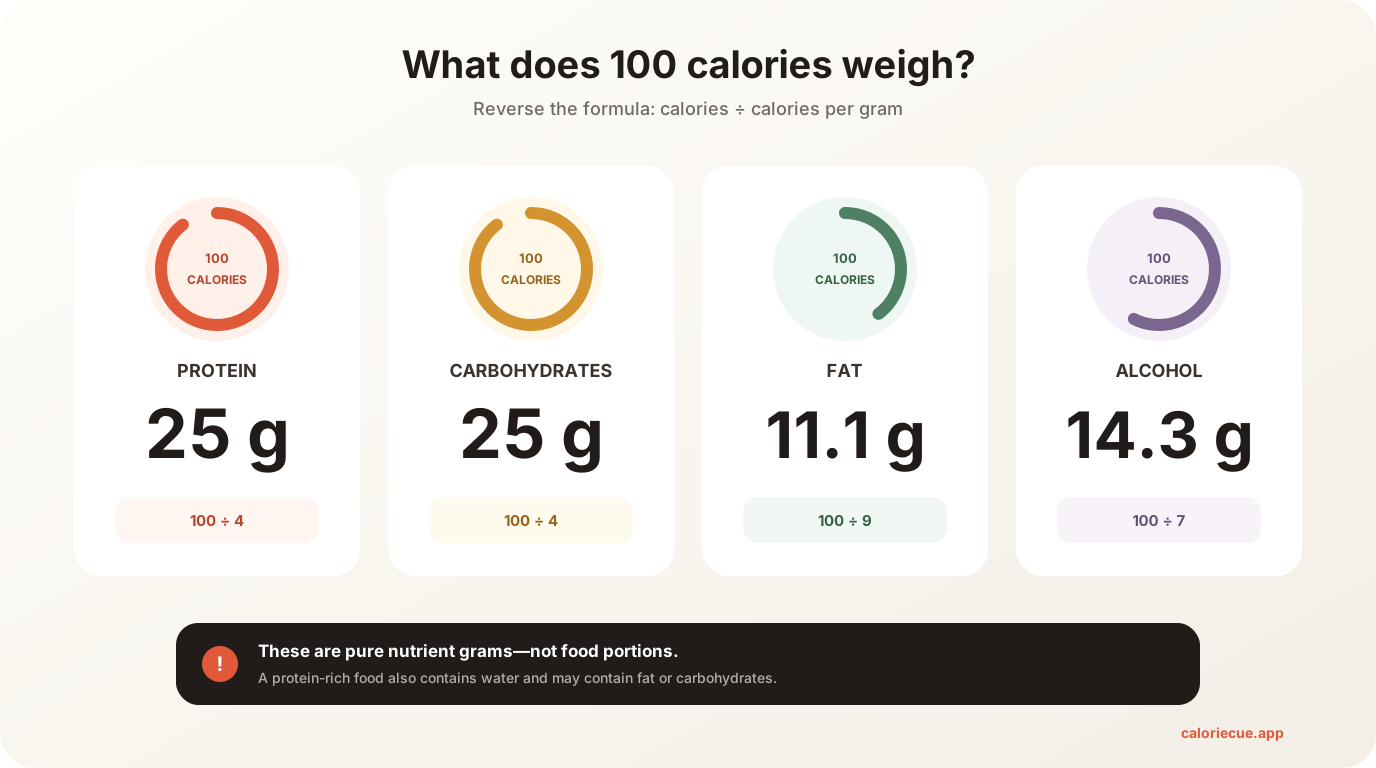
This explains why high-fat foods tend to have smaller serving sizes. Just 11.1 grams of fat supplies roughly the same energy as 25 grams of protein or carbohydrates.
It does not mean 25 grams of chicken contains 100 calories. The table describes pure nutrient grams, not the total weight of a food containing that nutrient.
Does sugar have four calories per gram?
Yes. Regular dietary sugars are carbohydrates and provide approximately 4 calories per gram.
That includes:
- Glucose
- Fructose
- Sucrose
- Lactose
- Table sugar
A teaspoon of table sugar contains about four grams, which works out to roughly 16 calories.
Sugar alcohols are the important exception. Despite the name, they are not regular sugar and do not contain the alcohol found in beer, wine, or spirits. Their calorie values vary by type.
How many calories are in one gram of alcohol?
Alcohol provides approximately 7 calories per gram—more than protein or carbohydrates, but less than fat.
A U.S. standard drink contains around 14 grams of pure alcohol. The alcohol alone therefore contributes approximately 98 calories before counting juice, soda, cream, syrup, or other mixers.
This is why two drinks with the same amount of alcohol can have very different calorie totals. Straight spirits contain calories from alcohol. A cocktail can contain those alcohol calories plus a significant amount from sugar or fat.
If drinks are an important part of your calorie intake, see the comparison of what to drink when you want to lose weight.
Are kcal and Calories the same?
In nutrition, yes.
One Calorie with a capital C equals one kilocalorie, written as kcal. It represents 1,000 small scientific calories.
Therefore:
- 100 Calories on a food label = 100 kcal
- A 2,000-Calorie diet = 2,000 kcal
- A food with 250 kcal contains what everyday nutrition language calls 250 calories
Food labels, nutrition articles, and tracking apps normally use "calories" as the plain-language version of kilocalories.
When should you use this formula?
The calories-per-gram formula is useful when you want to:
- Check whether a Nutrition Facts label looks reasonable
- Convert daily macro targets into a calorie target
- Estimate calories in a recipe with known macros
- Understand where a meal's calories are coming from
- Compare the impact of adding protein, carbs, fat, or alcohol
- Double-check an entry in a calorie-tracking app
It is less useful when you only know the total weight of a mixed meal. A bowl, wrap, curry, casserole, or restaurant plate can contain several ingredients, cooking oil, sauce, water, and portions you did not measure.
That is the point where correct math becomes inconvenient math.
Calculate labels. Photograph meals.
The 4-4-9-7 rule is excellent for checking a package or converting known macro targets. It is less practical when you are looking at a mixed plate and do not know the grams of every ingredient.
CalorieCue lets you photograph a meal and receive an estimated breakdown of calories, protein, carbohydrates, and fat. You review the estimate, correct anything obvious, and keep moving instead of searching a database and multiplying every ingredient.
For the complete tracking workflow, save the calorie-counting cheat sheet. If you are deciding whether calories or macros deserve more attention, read calorie counting vs. macro counting.
Frequently asked questions
How many calories are in one gram?
It depends on what the gram contains. Protein and carbohydrates have about 4 calories per gram, fat has 9, and alcohol has 7. A gram of whole food has no fixed calorie value because whole foods also contain water, fiber, minerals, and mixtures of nutrients.
What is the 4-4-9 rule?
The 4-4-9 rule estimates calories from the three primary macronutrients. Multiply protein grams by 4, carbohydrate grams by 4, and fat grams by 9. Add alcohol at 7 calories per gram when it is present.
How many calories are in a gram of protein?
Protein provides approximately 4 calories per gram. Twenty-five grams of pure protein therefore represents about 100 calories. A protein-rich food may contain additional calories from fat or carbohydrates.
How many calories are in a gram of carbohydrates?
Digestible carbohydrates provide approximately 4 calories per gram. Regular sugar and starch use that factor, while fiber and sugar alcohols may use lower energy values.
How many calories are in a gram of fat?
Fat provides approximately 9 calories per gram. The factor applies to saturated, monounsaturated, polyunsaturated, and trans fats.
How many calories are in a gram of alcohol?
Alcohol provides approximately 7 calories per gram. Any calories from mixers, juice, cream, or added sugar must be counted separately.
Why do my calculated macros not match the label?
The most common reasons are rounded nutrient values, rounded calories, fiber, sugar alcohols, specific Atwater factors, or a serving-size mismatch. A difference of a few calories is normal.
Does fiber contain calories?
It depends on the fiber. Under U.S. label calculations, soluble non-digestible carbohydrate can use a general factor of 2 calories per gram, while insoluble non-digestible carbohydrate can contribute zero.
Are kcal and Calories the same?
Yes in nutrition. One capital-C Calorie equals one kilocalorie, or kcal. A label showing 200 Calories therefore represents 200 kcal.
Can I calculate calories using the total weight of food?
Not from weight alone. The 4-4-9-7 formula applies to nutrient grams, not total food grams. You need the food's macro breakdown or its known calories per 100 grams.
The bottom line
Remember four numbers:
Protein 4. Carbohydrates 4. Fat 9. Alcohol 7.
Use them to convert macro targets, understand a meal, or check a label. Do not panic if your answer differs by a few calories—the displayed values may have been rounded, and fiber or sugar alcohols may use different factors.
For a packaged food, use the formula. For a mixed meal, let CalorieCue do the estimating.
Download CalorieCue