On this page
- Homemade food calorie calculator
- The recipe calorie formula
- Method 1: Equal servings
- Method 2: Finished weight
- How to calculate homemade food calories in five steps
- 1. List every edible ingredient
- 2. Find calories for the amount actually used
- 3. Add the ingredient calories
- 4. Measure the finished yield
- 5. Calculate and save your portion
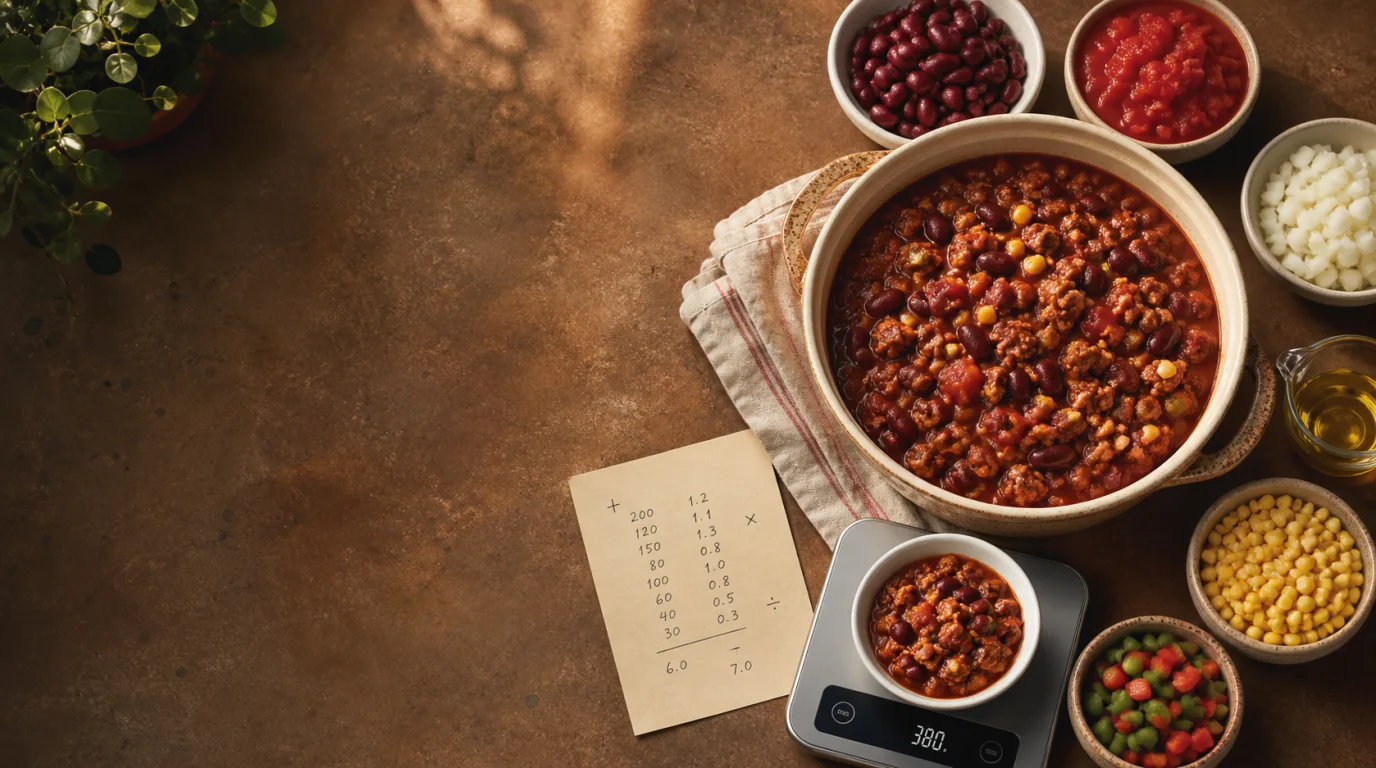
- Worked example: turkey and bean chili
- Should ingredients be weighed raw or cooked?
- What happens when food gains or loses water?
- How to count an ingredient with no nutrition label
- Seven errors that change the result
- When to recalculate a saved recipe
- Save the recipe once, then make logging easy
- Frequently asked questions
- How do I calculate calories in a homemade recipe?
- How can I find calories for an ingredient with no label?
- Should I weigh ingredients raw or cooked?
- Does cooking change the total calories in a recipe?
- How do I calculate calories per 100 grams?
- Why does my calculation differ from a nutrition label?
- The bottom line
To calculate calories in homemade food, add the calories in every edible ingredient, then divide the recipe total by the number of servings.
For a recipe containing 1,700 calories that makes 5 equal servings:
1,700 ÷ 5 = 340 calories per serving
If the portions are not equal, weigh the finished recipe and your portion instead:
Total recipe calories ÷ finished recipe weight × portion weight
For the same 1,700-calorie recipe weighing 2,000 grams, a 400-gram bowl contains:
1,700 ÷ 2,000 × 400 = 340 calories
The key distinction: total food weight does not tell you total calories. First calculate the calories contributed by the ingredients. Finished weight is only used to divide that known total into portions.
Homemade food calorie calculator
Enter the calories for the full amount of each ingredient—not the calories in the small portion you plan to eat. Then enter either the number of servings or the finished recipe and portion weights.
Interactive recipe worksheet
Homemade Food Calorie Calculator
Enter the calories for every edible ingredient, then divide the finished recipe by servings or by weight. The example below is a five-serving turkey and bean chili.
Step 1
Add every ingredient
Step 2
Describe the finished recipe
Servings gives a quick split. Finished and portion weights give a more precise answer when portions are uneven.
Recipe result
Total recipe
1,700 calories
Per serving
340 calories
Per 100 grams
85 calories
Your portion
340 calories
For the best estimate, include oils, sauces, toppings, and every other edible ingredient.
The default example is a five-serving turkey and bean chili. Replace those numbers with the values from your actual labels or food-database entries. The calculator keeps the unrounded math internally and rounds the displayed result to the nearest whole calorie.
The recipe calorie formula
There are two reliable ways to divide a homemade recipe.
Method 1: Equal servings
Use this when you split the finished dish into genuinely equal containers or pieces.
Calories per serving = total ingredient calories ÷ number of servings
This is fast and works well for meal-prep boxes, muffins of the same size, evenly cut casseroles, or a pot divided with the same ladle each time.
Method 2: Finished weight
Use this when one serving may be larger than another or when you want to log any portion by weight.
Calories per gram = total ingredient calories ÷ finished edible weight in grams
Then:
Portion calories = calories per gram × portion weight in grams
You can also calculate a reusable database value:
Calories per 100 g = total ingredient calories ÷ finished weight × 100
The weight method is usually more precise because it does not assume that five bowls, six slices, or eight scoops are identical.
How to calculate homemade food calories in five steps
1. List every edible ingredient
Write down the full amount of everything going into the recipe:
- meat, fish, tofu, eggs, beans, or other protein
- rice, pasta, flour, bread, potatoes, or other starch
- vegetables and fruit
- cooking oil, butter, cream, cheese, or coconut milk
- sauces, dressings, stock, sugar, and condiments
- toppings added before the servings are divided
Oil, butter, sauces, and toppings are easy to miss because they may not look like a separate part of the final dish. They still belong in the recipe total when they are eaten.
Water, ice, salt, and many dried spices add weight or flavor but little or no energy. Still record calorie-containing spice blends, sweetened sauces, and stock concentrates when their labels show calories.
2. Find calories for the amount actually used
For a packaged ingredient, start with its Nutrition Facts label:
Calories used = label calories per serving × number of label servings used
If a sauce has 60 calories per 125 grams and you use 250 grams, the sauce contributes 120 calories.
The FDA Nutrition Facts label guide explains that the calorie and nutrient amounts on a label refer to the listed serving size. Using two servings means multiplying the listed calories by two.
For an ingredient without a label, search USDA FoodData Central, the U.S. Department of Agriculture's food-composition database. Match all three details before using a result:
- the food itself;
- the state—raw, cooked, baked, boiled, or fried;
- any preparation detail—drained, skinless, lean percentage, or prepared with added fat.
Our calories in food list is a faster reference for common ingredients, but FoodData Central is better when preparation details could materially change the result.
3. Add the ingredient calories
Once every ingredient is converted to calories for the amount used, add them together:
Recipe total = ingredient 1 + ingredient 2 + ingredient 3 + every remaining ingredient
Do not divide individual ingredients by servings first. Sum the complete recipe, then divide once. This reduces rounding and makes the calculation easier to audit.
If you only have grams of protein, carbohydrate, and fat for an ingredient, the calories-per-gram calculator can provide a general 4-4-9 estimate. For packaged food, use the label's calorie total when available because official calculations may account for fiber, sugar alcohols, and specific energy factors.
4. Measure the finished yield
Choose one yield method:
- Count equal servings: divide the food into equal containers, slices, or portions and record the count.
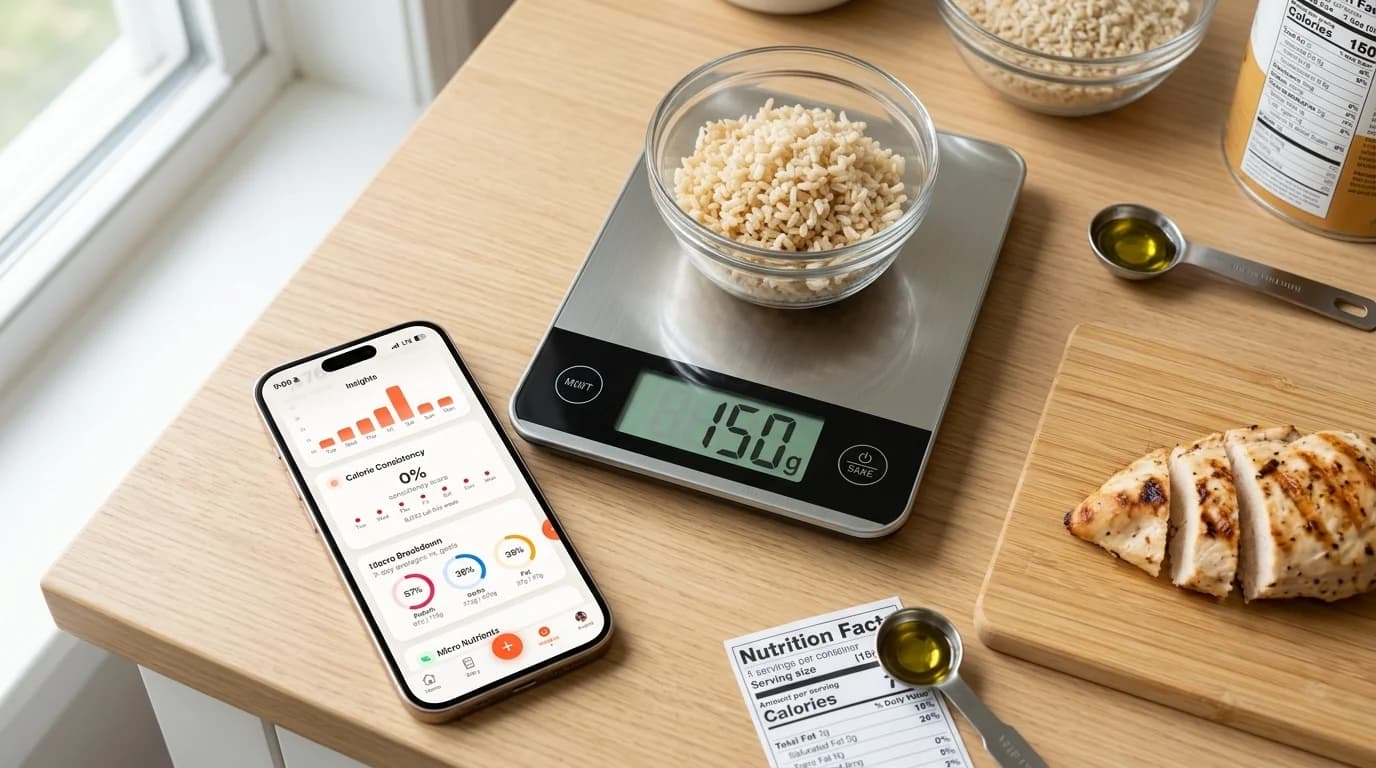
- Weigh the finished recipe: place the empty pot or storage container on the scale and tare it before adding the cooked food. If that is not possible, subtract the container's known empty weight from the combined weight.
Use only the edible finished recipe weight. Do not include the Dutch oven, baking dish, slow-cooker insert, bones, or other parts nobody will eat.
5. Calculate and save your portion
For equal meal-prep boxes, divide the recipe total by the number of boxes. For a portion chosen later, multiply the recipe's calories per gram by the portion's weight.
Save these details together:
- recipe name
- total calories
- finished weight or number of servings
- calories per serving or per 100 grams
- date or version if you change the recipe often
Doing the complete math once makes the next serving a one-line log instead of another ingredient-by-ingredient calculation.
Worked example: turkey and bean chili
This is an illustrative example, not a universal nutrition entry. Your brands, quantities, and recipe will be different.
| Ingredient | Amount used | Calories in amount used |
|---|---|---|
| Ground turkey | Full recipe amount | 640 |
| Kidney beans | Full recipe amount | 420 |
| Crushed tomatoes | Full recipe amount | 180 |
| Olive oil | Full recipe amount | 120 |
| Onion, corn, peppers, and seasonings | Full recipe amount | 340 |
| Recipe total | 1,700 |
If the chili makes five equal containers:
1,700 ÷ 5 = 340 calories per container
If the finished chili weighs 2,000 grams:
1,700 ÷ 2,000 = 0.85 calories per gram
That gives two useful shortcuts:
- 100 grams: 0.85 × 100 = 85 calories
- 400-gram bowl: 0.85 × 400 = 340 calories
The serving-count method and weight method agree here because each of the five portions weighs exactly 400 grams. If one bowl weighs 350 grams and another weighs 475, the weight method adjusts automatically.
Should ingredients be weighed raw or cooked?
You may use raw or cooked weights, but the nutrition entry must describe the same state as the food you weighed.
- If you weigh raw chicken, use a raw chicken entry.
- If you weigh cooked rice, use a cooked rice entry.
- If you weigh drained canned beans, use the drained weight and a matching drained entry when available.
Do not weigh an ingredient raw and apply a cooked value simply because the final meal is cooked. Cooking often changes water content, so the calories per 100 grams can be very different even when the ingredient began as the same food.
After the ingredient calories are totaled, the recipe becomes one combined batch. At that point, use the finished batch weight only to work out its calorie density and the calories in a serving.
This is the same consistency rule covered in our broader guide to counting calories accurately: match the measurement to the database description.
What happens when food gains or loses water?
Water changes weight without contributing calories. Pasta and rice absorb water and become heavier. Soup can lose water while simmering and become lighter. That changes calories per gram, not the calories supplied by the ingredients that remain in the edible recipe.
Imagine a soup that contains 1,200 ingredient calories:
- At a finished weight of 2,400 grams, it has 50 calories per 100 grams.
- After more water evaporates, a finished weight of 2,000 grams gives 60 calories per 100 grams.
The pot still begins with the same 1,200-calorie ingredient total, but the second version is more calorie-dense by weight.
There is one important exception: if you discard something that contains energy, the edible total can change. Examples include pouring off rendered fat, throwing away an oil-based marinade, draining a sweet cooking liquid, or removing skin after its calories were included. Home calculations rarely measure those losses perfectly, so document a consistent practical estimate instead of pretending the result is exact.
How to count an ingredient with no nutrition label
Food without a package is not food without data. Use this order:
- Search the exact food in USDA FoodData Central. Prefer a specific description over a generic near-match.
- Check the data type and preparation. Raw spinach and cooked spinach are not interchangeable per 100 grams; neither are raw and fried potatoes.
- Use grams when possible. Household cups and pieces vary, while grams transfer cleanly into the recipe calculation.
- Record the entry you chose. Use it again next time so your tracking stays consistent.
For a meal someone else cooked, you may not know the recipe total or finished yield. In that case this method cannot manufacture missing information. Use visible components and practical portion cues from our guide to counting calories without a food scale, or use a photo estimate and treat it as an estimate rather than a measured recipe.
Seven errors that change the result
| Error | What goes wrong | Practical fix |
|---|---|---|
| Forgetting cooking oil | The recipe total starts too low | Measure oil, butter, spray, and pan sauces |
| Using one serving instead of the amount added | Only part of an ingredient is counted | Multiply label calories by servings used |
| Mixing raw weight with cooked data | Water change distorts the calorie value | Match weight and database state |
| Ignoring drained or discarded food | Calories not eaten remain in the total | Count the edible amount as consistently as possible |
| Dividing into unequal portions | "One serving" is not one consistent amount | Weigh the finished batch and each portion |
| Forgetting toppings | The base recipe is accurate but the bowl is not | Add cheese, cream, dressing, and garnishes |
| Rounding every step | Small errors accumulate | Keep full values until the final displayed result |
Packaged-food arithmetic may still differ slightly from the printed label. Under 21 CFR 101.9, manufacturers can use specific Atwater factors or general energy factors and apply them to actual amounts before rounding. The rule also prescribes how displayed calories are rounded. A small label mismatch is therefore not proof that your calculator is broken.
When to recalculate a saved recipe
You do not need to rebuild a saved recipe every time you cook it. Recalculate when a change is large enough to affect the result:
- a different amount of oil, cheese, cream, nuts, or another calorie-dense ingredient
- a different meat fat percentage
- a major brand substitution with different label values
- a doubled or halved batch
- a finished yield that changes because the recipe is cooked down much further
Minor differences in onion size, spices, or a splash of water usually do not justify turning dinner into a laboratory experiment. Accuracy should make tracking more useful, not make cooking impossible.
For weekly cooking, the method fits naturally into calorie-counting meal prep: calculate the batch once, portion it, and reuse the saved meal through the week.
Save the recipe once, then make logging easy
The durable workflow is simple:
- total the ingredients when you create or meaningfully change the recipe;
- save the recipe total and its yield;
- log a saved serving or enter the weight you actually eat.
When you do not have the recipe—at a restaurant, a friend's home, or a buffet—a quick estimate is more realistic than exact batch math. CalorieCue lets you photograph the plate, review the estimated foods and portions, and keep moving without pretending the result came from a kitchen scale.
Download CalorieCueFrequently asked questions
How do I calculate calories in a homemade recipe?
Add the calories in the full amount of every edible ingredient, including oil, sauces, and toppings. Divide that recipe total by the number of equal servings. For a weighed portion, divide the total by the finished recipe weight and multiply by your portion weight.
How can I find calories for an ingredient with no label?
Use USDA FoodData Central and choose an entry that matches the food and preparation state. Calculate the calories for the number of grams you used, then add that amount to the recipe total.
Should I weigh ingredients raw or cooked?
Either works when the database entry matches the state you measured. Raw weight goes with raw nutrition data; cooked weight goes with cooked data. Do not mix them within the same ingredient calculation.
Does cooking change the total calories in a recipe?
Water gain or loss changes calories per gram but adds no calories itself. The edible calorie total can change when energy-containing fat, liquid, marinade, skin, or other food is discarded.
How do I calculate calories per 100 grams?
Divide the recipe's total calories by its finished edible weight in grams, then multiply by 100. A 1,700-calorie recipe weighing 2,000 grams contains 85 calories per 100 grams.
Why does my calculation differ from a nutrition label?
Labels can use unrounded nutrient inputs, specific energy factors, and prescribed rounding. Your ingredient entry may also differ from the exact product or preparation. Keep full numbers through the calculation, but expect the final result to remain an informed estimate rather than a laboratory measurement.
The bottom line
The most useful homemade-food formula is not complicated:
Add every ingredient calorie. Measure the finished yield. Divide the total by the serving you actually eat.
Count equal containers when the portions are truly equal. Use finished weight when they are not. Match raw food to raw data and cooked food to cooked data. Include oils and toppings, but accept that discarded fat and liquid introduce some uncertainty.
Do that once for each regular recipe, save the result, and homemade meals become some of the easiest foods in your day to track.