On this page
- Greek yogurt calories and protein by serving size
- Nonfat, low-fat and whole-milk Greek yogurt compared
- Why your tub’s label may show different numbers
- How many calories are in one cup?
- Plain versus flavored: check more than the fat percentage
- Count the yogurt bowl, including the toppings
- Put your next bowl in the diary
- Frequently asked questions
- How many calories and how much protein are in 100 g of Greek yogurt?
- How much protein is in 200 g of Greek yogurt?
- How many calories are in a cup of Greek yogurt?
- Is 0% Greek yogurt better than 2% or whole milk?
- Does plain Greek yogurt contain sugar?
- Should I count honey and granola separately from the yogurt?
Plain nonfat Greek yogurt has about 59 calories and 10.2 g protein per 100 g. A 170 g portion has about 100 calories and 17.3 g protein; a 200 g bowl has 118 calories and 20.4 g protein. Those are USDA reference values, before toppings.
The catch is that “Greek yogurt” describes more than one food. A plain nonfat tub, a whole-milk yogurt and a sweetened vanilla pot can have different nutrition—even when the containers look the same size.
Start with the type and the weight. Then count what you add. That gives you a more useful answer than choosing the first yogurt entry in a food log.
Greek yogurt calories and protein by serving size
This chart uses the USDA FoodData Central record for plain nonfat Greek yogurt: 59 calories and 10.19 g protein per 100 g.
| Portion | Calories | Protein |
|---|---|---|
| 100 g | 59 | 10.2 g |
| 150 g | 89 | 15.3 g |
| 170 g | 100 | 17.3 g |
| 200 g | 118 | 20.4 g |
Values are calculated from the unrounded reference, then rounded to whole calories and one decimal place for protein. These are portion examples, not recommended serving sizes. A particular brand’s label may differ.
If you want a bowl containing roughly 20 g protein from the yogurt alone, 200 g of this reference food gets you there. You still need to check your own tub: “200 g of yogurt” and “20 g of protein” are not interchangeable across every product.
For other breakfast ingredients and everyday foods, use the calories in food list.
Nonfat, low-fat and whole-milk Greek yogurt compared
Compare the same weight before deciding which numbers fit your meal. Here is a 170 g portion of each plain USDA reference:
| Type, 170 g | Calories | Protein |
|---|---|---|
| Nonfat | 100 | 17.3 g |
| Low-fat (about 2%) | 124 | 16.9 g |
| Whole milk (5%) | 165 | 15.3 g |
The low-fat record contains 73 calories, 9.95 g protein and 1.92 g fat per 100 g. The whole-milk record contains 97 calories, 9 g protein and 5 g fat per 100 g. These are separate reference foods, not measurements of one recipe with fat added or removed. Whole-milk products do not all contain exactly 5% fat.
For a 200 g portion, those low-fat and whole-milk values become 146 calories with 19.9 g protein, and 194 calories with 18 g protein, respectively.
The nonfat reference provides more protein per calorie. Whole-milk yogurt may be the texture and taste you prefer. Neither comparison tells you everything about the finished breakfast, especially once you add toppings.
Use the protein-per-calorie chart when you want to compare yogurt with eggs, cottage cheese, fish or other protein foods. For shopping ideas, the high-protein, low-calorie grocery list groups those choices by aisle.
Why your tub’s label may show different numbers
Use a matching package label ahead of a generic database entry. The reference table is a useful fallback; your label describes the product you actually bought.
Products, formulations and label rounding vary. Check the serving size, calories and protein on your own package before using the generic table.
For the worked example below, assume a label lists 90 calories and 18 g protein per ¾ cup (170 g). These are illustrative label values for practicing the calculation; substitute the numbers from your package.
To adjust any label to your portion, use:
Amount eaten in grams ÷ label serving in grams × calories or protein per serving
Suppose you eat 250 g using that example label:
- Calories: 250 ÷ 170 × 90 = about 132.
- Protein: 250 ÷ 170 × 18 = about 26.5 g.
That calculation uses the product label throughout. Avoid combining one brand’s calories with another entry’s protein.
How many calories are in one cup?
A measuring cup and a single-serving yogurt container are different things.
The example label above defines ¾ cup as 170 g. Using those illustrative values, one measuring cup works out to about 227 g, 120 calories and 24 g protein. Use your own label’s serving weight and nutrition values for the yogurt you eat.
When serving from a large tub, put your bowl on a food scale, zero it, and add the yogurt. If you do not use a scale, the package’s stated container weight or measured volume is a practical starting point. Our guide to counting calories without a food scale covers other portion estimates.
Plain versus flavored: check more than the fat percentage
“0% fat” does not tell you whether a yogurt is plain, sweetened or served with a separate fruit mixture. Check these details together:
- Serving weight: compare equal amounts, rather than a small pot with a large one.
- Calories and protein: use both numbers for that same serving.
- Ingredients and added sugars: see what is included in the product.
- Topping compartment: check whether the nutrition panel includes it.
Plain dairy yogurt can contain sugar even when it has no added sugar. The FDA explains that total sugars include naturally occurring sugars in milk as well as any added sugars. A label showing some total sugar is not evidence that a plain yogurt was sweetened.
Flavored yogurt can still fit your breakfast. Log the actual flavor and portion instead of assigning it the plain nonfat numbers.
Count the yogurt bowl, including the toppings
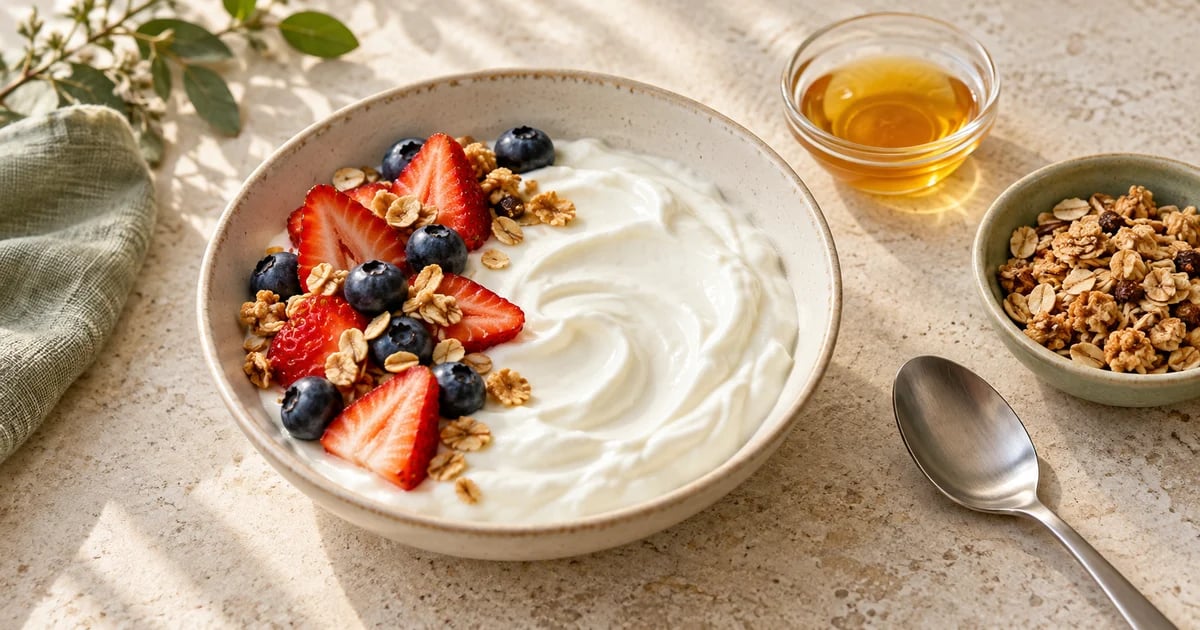
Fruit, honey and granola turn plain yogurt into a different meal. Here is a worked example using the USDA nonfat yogurt above, raw strawberries and honey:
| Ingredient | Calories | Protein |
|---|---|---|
| Yogurt, 200 g | 118 | 20.4 g |
| Strawberries, 100 g | 32 | 0.7 g |
| Honey, 10 g | 30 | 0.0 g |
| Bowl total | 180 | 21.1 g |
Calculated before rounding. Strawberries provide 32 calories and 0.67 g protein per 100 g; honey provides 304 calories and 0.3 g protein per 100 g. The tiny protein amount in 10 g honey rounds to 0.0 g. The cover image illustrates a yogurt bowl; it does not depict these measured portions.
Granola is not included in this example. If you add it, use its own label and the amount you pour. The same applies to nuts, nut butter, seeds or protein powder. None needs to be excluded to make the bowl “count”; each just belongs in the total.
Make a repeat bowl easy to log. Measure your usual yogurt and toppings once, record the ingredients, and reuse those amounts when you make the same bowl. Update the entry when you change the portion or product.
For a batch of yogurt parfaits, add up all the ingredients and divide them among the portions you actually make. The homemade-food calorie guide walks through that calculation.
Put your next bowl in the diary
Start with the yogurt label, add the toppings, and review the total for the whole bowl. CalorieCue can estimate a meal’s calories and macros from a photo and show your logged calories and protein together on the daily dashboard.
Before saving a photo estimate, check the yogurt type, portion and additions. A photo cannot reliably establish the fat percentage or how much honey is mixed into the yogurt; use the package and measured amounts to review it. The photo food logging guide explains what to check.
Try it with your next breakfast:
Download CalorieCueFrequently asked questions
How many calories and how much protein are in 100 g of Greek yogurt?
The USDA plain nonfat reference provides 59 calories and 10.19 g protein per 100 g, rounded to 10.2 g in this guide. The plain low-fat reference provides 73 calories and 9.95 g protein; the whole-milk reference provides 97 calories and 9 g protein. Use your product’s label when available.
How much protein is in 200 g of Greek yogurt?
Using the USDA plain references, 200 g provides about 20.4 g protein and 118 calories for nonfat, 19.9 g protein and 146 calories for low-fat, or 18 g protein and 194 calories for whole milk. Brands and flavored products can differ.
How many calories are in a cup of Greek yogurt?
Use the gram weight on your product’s label. For an illustrative label listing 90 calories and 18 g protein per ¾ cup (170 g), one measuring cup works out to about 227 g, 120 calories and 24 g protein. Substitute your own label values. A single-serving yogurt container is not necessarily one measuring cup.
Is 0% Greek yogurt better than 2% or whole milk?
The plain nonfat USDA reference supplies more protein per calorie than the low-fat or whole-milk references. That is useful when comparing protein and calories, but it does not make it the best choice for everyone. Compare equal portions and choose the texture, taste and overall meal that suit you.
Does plain Greek yogurt contain sugar?
Plain dairy yogurt can contain naturally occurring milk sugar even when its label shows zero added sugars. Total sugars and added sugars are different lines on US nutrition labels. Check both, along with calories, protein and the serving size.
Should I count honey and granola separately from the yogurt?
Yes, when you add them to plain yogurt yourself. Log the yogurt portion and each topping. If you use a packaged yogurt with a topping compartment, check whether its nutrition label already includes that topping before adding it again.