On this page
- How to shop when you're counting calories
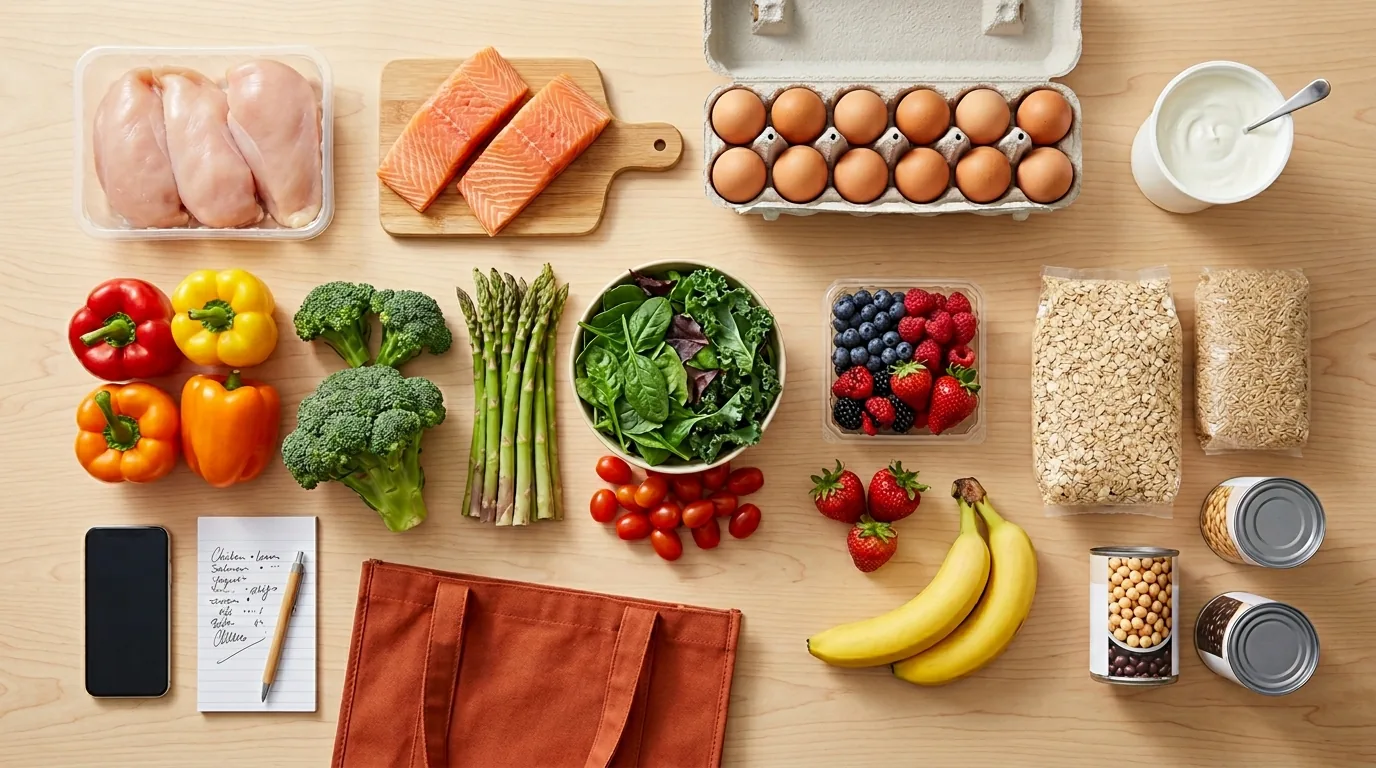
- The calorie counting grocery list
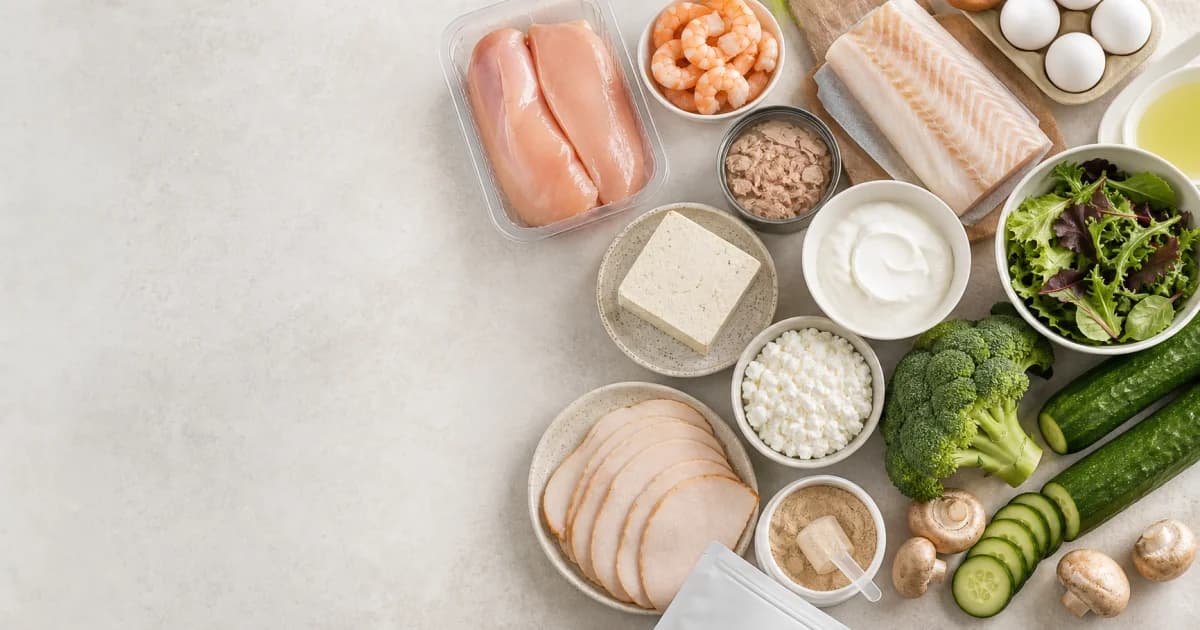
- Proteins — meat, poultry & seafood
- Eggs & dairy
- Vegetables
- Fruit
- Grains, carbs & starches
- Legumes, nuts & pantry
- Smart snacks
- Flavor without the calories
- Drinks
- What to leave on the shelf
- Swaps that quietly save you hundreds of calories
- Let CalorieCue build the list for you
- Print it and take it with you
- Frequently asked questions
- What should be on a calorie counting grocery list?
- What groceries make calorie counting easier?
- What foods are best for a calorie deficit?
- What should I avoid buying when counting calories?
- How do I make a grocery list for a calorie deficit?
- What are the best low-calorie grocery staples?
- Does CalorieCue make a grocery list for you?
Calorie Counting Grocery List: 75+ Foods to Buy by Aisle
A good calorie counting grocery list makes tracking easier before the week starts. If your cart is built around foods with predictable servings, high protein, high volume, and simple labels, logging takes less effort and your calorie deficit gets easier to repeat.
Calorie counting doesn't fall apart at dinner. It falls apart at the grocery store.
If your cart comes home full of the wrong stuff, you've already lost the week before you've logged a single meal — because you eat what's in the house. Fill it with high-satiety, easy-to-track foods and the deficit almost takes care of itself. Fill it with calorie-dense, hard-to-measure stuff and you'll spend all week fighting your own kitchen. If you still need the tracking basics first, start with how to count calories, then use this list to build the cart.
So here's the whole list, organized the way you actually walk the store, with approximate calories per serving — plus what to leave on the shelf, the swaps that quietly save you hundreds of calories a week, and a printable version you can take with you. For exact lookup values beyond this shopping list, use the calories in food list.
Prefer to skip the by-hand version entirely? CalorieCue can now build the whole list straight from your weekly meal plan — more on that below.
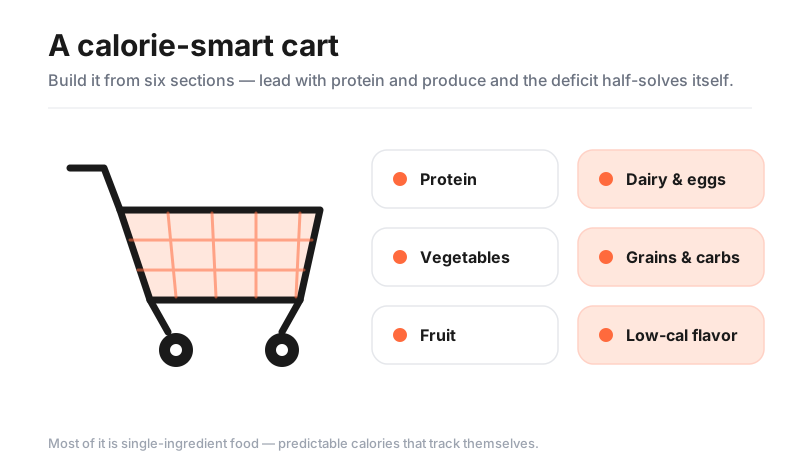
How to shop when you're counting calories
Before the list, four rules that make the whole trip easier:
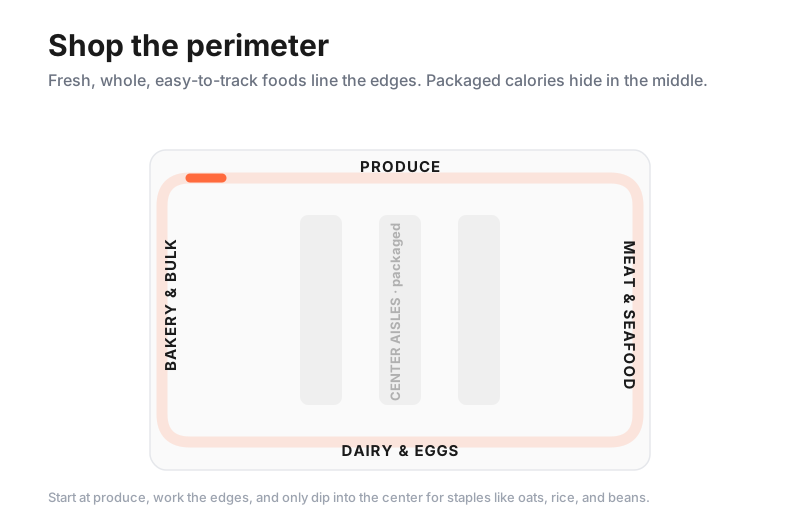
Shop the perimeter first. The edges of almost every store are where the fresh, whole, easy-to-track foods live — produce, meat and seafood, dairy and eggs. The center aisles are where packaged, calorie-dense, hard-to-estimate foods hide. Work the outside, then dip into the middle only for staples like oats, rice, and beans.
Lead with protein and produce. These two give you the most fullness per calorie — protein because it's the most satiating macro, vegetables because they're high-volume and low-calorie. Build the cart around them and hunger stops being the thing that derails you. For the leanest protein anchors, use the ranked list of foods high in protein and low in calories.
Favor single-ingredient foods. A chicken breast, a bag of rice, a head of broccoli — these are simple to track because the calories are predictable. Mixed and packaged foods are where tracking gets fuzzy. (When you do cook something with a dozen ingredients, that's what a photo app is for — more on that below.)
Don't bring trigger foods home. Willpower at the store is far easier than willpower at 9 p.m. on the couch. The single most effective portion-control move is simply not buying the thing.
The calorie counting grocery list
Calories below are approximate, per common serving. Use them to build the cart; check the label for exact numbers, or look up anything specific in our full calorie reference list. If you are building a full week around this list, pair it with the calorie counting diet plan so the groceries map to actual meals.
Proteins — meat, poultry & seafood
| Food (per serving) | Calories |
|---|---|
| Chicken breast, skinless — 100 g cooked | 165 |
| Turkey breast, skinless — 100 g | 135 |
| Lean ground turkey (93%) — 100 g | 170 |
| Pork tenderloin — 100 g | 145 |
| Lean beef (sirloin / 93% ground) — 100 g | 185 |
| Salmon — 100 g | 200 |
| Cod or other white fish — 100 g | 105 |
| Tilapia — 100 g | 130 |
| Shrimp — 100 g | 99 |
| Canned tuna in water — 1 can, drained | 110 |
Eggs & dairy
| Food (per serving) | Calories |
|---|---|
| Whole eggs — 1 large | 70 |
| Egg whites — 1 white | 17 |
| Nonfat Greek yogurt, plain — 6 oz | 90 |
| Low-fat cottage cheese — ½ cup | 90 |
| Skim milk — 1 cup | 80 |
| Unsweetened almond milk — 1 cup | 30 |
| Reduced-fat cheese — 1 slice | 50 |
| Part-skim string cheese — 1 stick | 80 |
Vegetables
The high-volume heroes — you can eat a lot of these for very little.
| Food (per serving) | Calories |
|---|---|
| Spinach / leafy greens — 1 cup raw | 7 |
| Mushrooms — 1 cup | 15 |
| Cucumber — 1 cup | 16 |
| Zucchini — 1 cup | 20 |
| Bell peppers — 1 cup | 25 |
| Cauliflower — 1 cup | 25 |
| Asparagus — 1 cup | 27 |
| Broccoli — 1 cup | 30 |
| Tomatoes — 1 cup | 30 |
| Green beans — 1 cup | 35 |
| Carrots — 1 cup | 50 |
Fruit
| Food (per serving) | Calories |
|---|---|
| Watermelon — 1 cup | 45 |
| Kiwi — 1 fruit | 45 |
| Strawberries — 1 cup | 50 |
| Orange — 1 medium | 60 |
| Raspberries — 1 cup | 65 |
| Blueberries — 1 cup | 85 |
| Apple — 1 medium | 95 |
| Grapes — 1 cup | 100 |
| Banana — 1 medium | 105 |
Grains, carbs & starches
| Food (per serving) | Calories |
|---|---|
| Corn tortilla — 1 | 60 |
| Whole-grain bread — 1 slice | 80 |
| Sweet potato — 1 medium | 110 |
| Rolled oats — ½ cup dry | 150 |
| Potato — 1 medium | 160 |
| Whole-wheat pasta — 1 cup cooked | 180 |
| White rice — 1 cup cooked | 205 |
| Brown rice — 1 cup cooked | 215 |
| Quinoa — 1 cup cooked | 220 |
Legumes, nuts & pantry
Protein- and fiber-rich, but nuts are calorie-dense — buy them, just portion them.
| Food (per serving) | Calories |
|---|---|
| Edamame, shelled — ½ cup | 100 |
| Black beans — ½ cup | 110 |
| Lentils — ½ cup cooked | 115 |
| Chickpeas — ½ cup | 135 |
| Peanut butter — 1 tbsp | 95 |
| Almonds — 1 oz (~23) | 165 |
| Walnuts — 1 oz | 185 |
Smart snacks
| Food (per serving) | Calories |
|---|---|
| Air-popped popcorn — 1 cup | 30 |
| Rice cake — 1 | 35 |
| Hummus — 2 tbsp | 70 |
| Beef or turkey jerky — 1 oz | 80 |
| Protein bar — 1 (varies) | ~200 |
Flavor without the calories
This is the section that keeps the diet sustainable — big taste, almost no calories.
| Food (per serving) | Calories |
|---|---|
| Herbs & spices | ~0 |
| Hot sauce — 1 tsp | 0–5 |
| Lemon / lime juice — 1 tbsp | 4 |
| Mustard — 1 tsp | 3 |
| Salsa — 2 tbsp | 10 |
| Low-sodium soy sauce — 1 tbsp | 10 |
| Balsamic vinegar — 1 tbsp | 14 |
Drinks
Water, sparkling water, black coffee, and unsweetened tea are all essentially free. Keep them stocked so the easy default isn't a sugary drink.
What to leave on the shelf
Not "forbidden" — just high calorie for how little they fill you up, and easy to over-pour or overeat:
- Sugary drinks (soda, juice, sweetened coffee) — liquid calories that don't register as food
- Creamy dressings, mayo, and oil-heavy sauces — easy to add 200+ calories without noticing
- Chips, crackers, and packaged sweets — engineered to be hard to stop eating
- "Healthy" granola and trail mix — calorie-dense and easy to over-portion
- Large bottles of oil and jars of nut butter — fine in a teaspoon, dangerous by the spoonful
You don't have to ban these. Just don't keep a week's supply in arm's reach.
Swaps that quietly save you hundreds of calories
Same job on your plate, a fraction of the calories. Make a few of these your defaults and the savings stack up across the week:
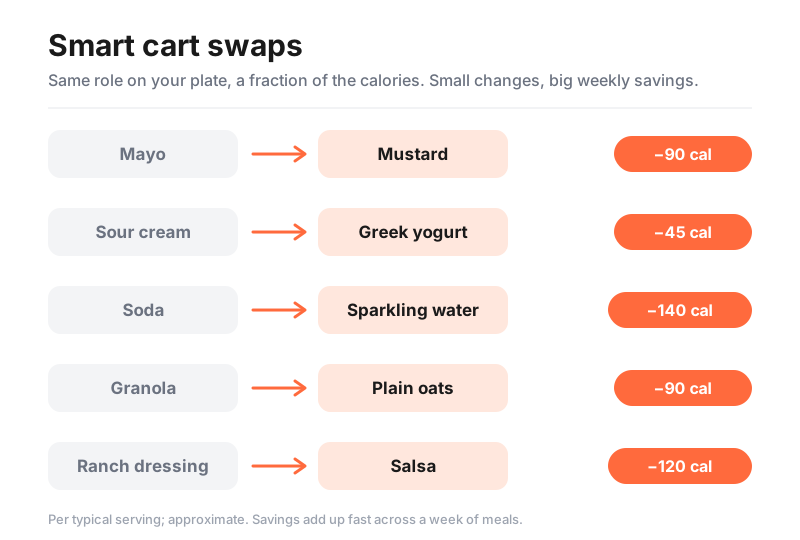
For more of this thinking — eating more food for fewer calories — see our guide to volume eating.
Let CalorieCue build the list for you
Everything above works with a pen and a printout. But if you track in CalorieCue, you can skip the by-hand part entirely.
Set your meal plan for the week, and the built-in grocery list pulls every food and recipe from it into one shopping list — automatically grouped by category (Protein, Dairy, Grains, and the rest), the same way this guide is organized. Pick the week, get the list, head to the store.
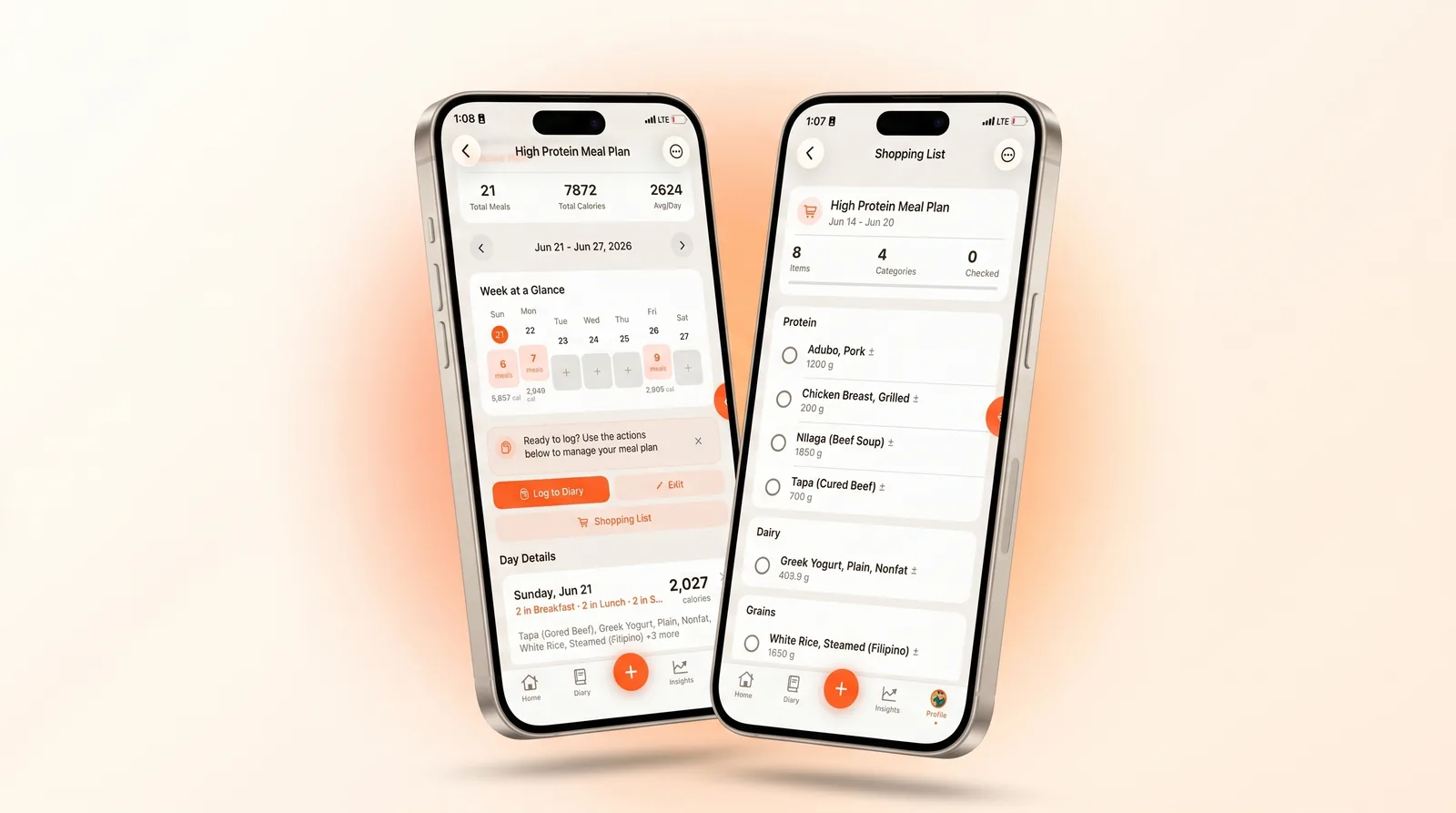
That closes the loop on the whole cycle. Most of what you bring home is easy to track — single-ingredient foods have predictable calories. The meals you cook from those groceries are the harder part: a stir-fry or a grain bowl with eight ingredients has no label. So you snap a photo of the finished plate and let the AI estimate the calories and protein — no weighing, no adding components up by hand.
Plan → list → shop → cook → track, all in one place. That's what we built CalorieCue for. New to it? Pair this list with what to do after you download a calorie tracker.
Print it and take it with you
The fastest way to make this stick is to not rely on memory at the store. Save this page or grab the printable checklist version, circle your regulars, and build the same reliable cart every week. (Pair it with our complete calorie counting cheat sheet for a full printable kit.)
A cart built right is half the battle won — before you've cooked a thing.
Build the cart, then let the app close the loop — download CalorieCue free and snap your first meal.
Download CalorieCueFrequently asked questions
What should be on a calorie counting grocery list?
A calorie counting grocery list should start with lean protein, high-volume vegetables, fruit, simple carbs like oats, rice, and potatoes, portionable snacks, and low-calorie flavor like herbs, mustard, salsa, and hot sauce. These foods are filling, predictable, and easy to log.
What groceries make calorie counting easier?
Single-ingredient foods make calorie counting easier because serving sizes are predictable: chicken breast, tuna, eggs, Greek yogurt, rice, potatoes, berries, leafy greens, broccoli, and canned beans. Pre-portioned snacks, zero-calorie drinks, and low-calorie sauces also reduce guesswork.
What foods are best for a calorie deficit?
High-protein, high-volume foods that keep you full on fewer calories — lean meats, fish, eggs, Greek yogurt, beans, and non-starchy vegetables. They make a deficit feel less like deprivation, which is what makes it stick.
What should I avoid buying when counting calories?
Sugary drinks, creamy dressings and oil-heavy sauces, chips and packaged sweets, and calorie-dense "healthy" foods like granola that are easy to over-portion. You don't have to ban them — just don't keep a large supply at home.
How do I make a grocery list for a calorie deficit?
Start with protein and vegetables, add fruit and whole-food carbs, include low-calorie flavor, and skip or minimize the calorie-dense extras. Use this list as a template, circle your regulars, and rebuild the same cart each week. If you are not sure how large your deficit should be, use the calorie deficit formula before shopping.
What are the best low-calorie grocery staples?
Leafy greens, broccoli, peppers, and other non-starchy vegetables (often under 30 calories a cup), plus white fish, shrimp, egg whites, and nonfat Greek yogurt for high-protein, low-calorie options.
Does CalorieCue make a grocery list for you?
Yes. CalorieCue auto-generates a grocery list from your weekly meal plan — it pulls in every food and recipe and groups them by category (Protein, Dairy, Grains, and more), so you can pick a week and get a ready-to-shop list without writing anything down.