On this page
- Find Your Calorie Target (30 Seconds)
- The Portion Size Quick-Reference
- The Hand Method
- Portions That Trip People Up
- Common Foods Calorie Quick-Reference
- Proteins
- Carbs
- Fats
- Fruits & Vegetables
- Drinks
- Snacks
- High-Protein, Low-Calorie Foods (and Smart Swaps)
- How to Track Calories at Restaurants & Fast Food
- 7 Calorie Counting Rules That Make It Easy
- 1. Track as you eat, not hours later
- 2. Use AI photo tracking
- 3. Track weekends too
- 4. Aim for ±100 calories, not perfection
- 5. Track beverages
- 6. Meal prep = predictable calories
- 7. Review weekly averages, not daily numbers
- The Fastest Way to Track
- Download the Free Cheat Sheet PDF
- Frequently Asked Questions
- Do I need to count calories every day?
- How accurate does my calorie counting need to be?
- What's the easiest way to count calories?
- How long should I count calories?
- Can I lose weight without counting calories?
- Is the cheat sheet really a downloadable PDF?
- What's included in the printable cheat sheet?
- Start Counting Today
Calorie counting doesn't need to be complicated. This guide gives you everything you need to start — plus a free, multi-page PDF you can print and keep.
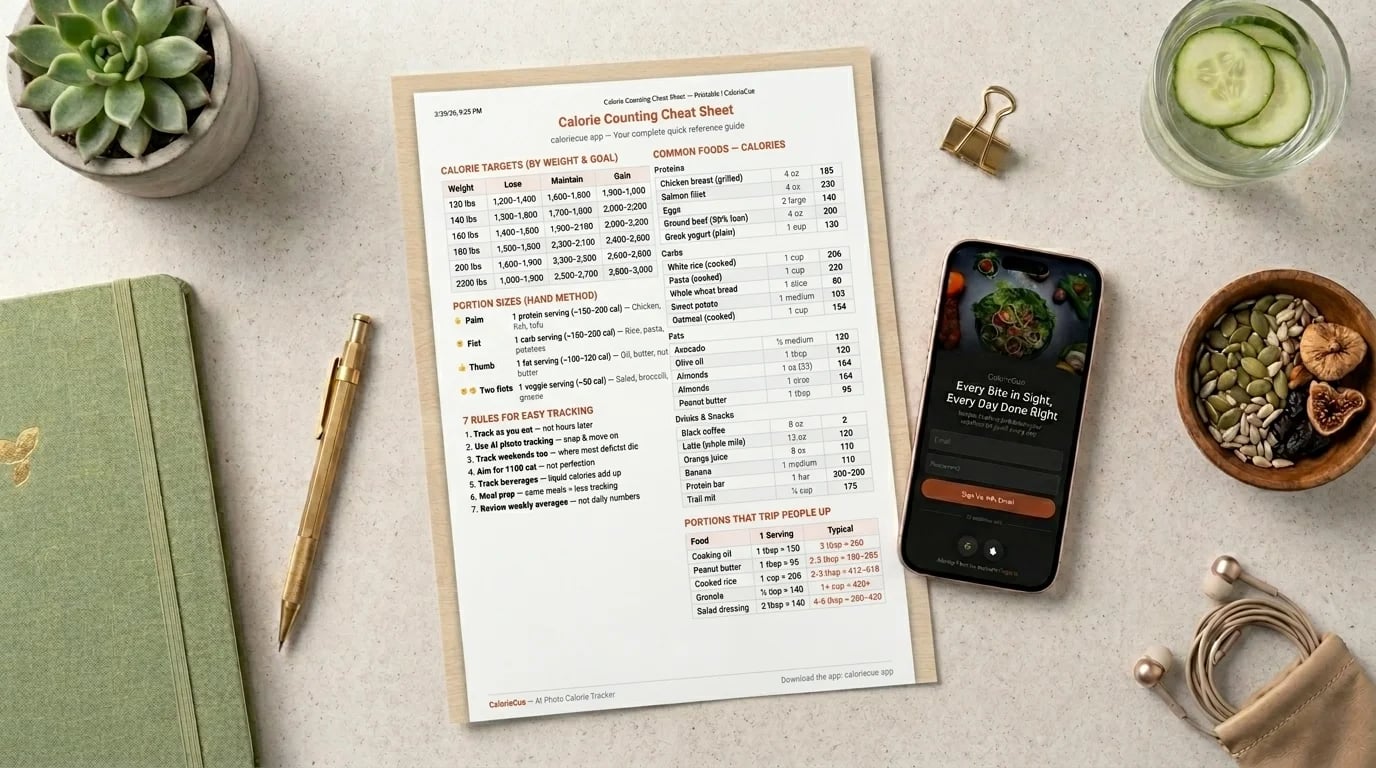
This is the cheat sheet you'll actually use. The downloadable PDF covers your calorie target, a portion-size quick-reference, 80+ common food calories, high-protein swaps, a restaurant and fast-food guide, and a printable 7-day tracking log.
Get the free PDF below (we'll email it and give you an instant download), or keep reading for the full guide.
Get the Free 5-Page Cheat Sheet PDF
Calorie targets, 80+ food calories, high-protein swaps, a restaurant guide, and a printable 7-day tracking log. Enter your email and we'll send you the PDF.
Find Your Calorie Target (30 Seconds)
You don't need a complex formula to get started. This table gives you a solid starting range based on your body weight and goal. These estimates are for moderately active adults — if you want a more precise number, use our free TDEE calculator.
| Your Weight | Lose Weight | Maintain | Gain Muscle |
|---|---|---|---|
| 120 lbs | 1,200–1,400 | 1,600–1,800 | 1,900–2,100 |
| 140 lbs | 1,300–1,500 | 1,700–1,900 | 2,000–2,200 |
| 160 lbs | 1,400–1,600 | 1,900–2,100 | 2,200–2,400 |
| 180 lbs | 1,500–1,800 | 2,100–2,300 | 2,400–2,600 |
| 200 lbs | 1,600–1,900 | 2,300–2,500 | 2,600–2,800 |
| 220+ lbs | 1,800–2,100 | 2,500–2,700 | 2,800–3,000 |
These ranges are based on standard estimates using the Mifflin-St Jeor equation, which research published in the Journal of the American Dietetic Association found to be the most accurate predictive equation for estimating resting metabolic rate. For a deeper breakdown of how to find your calorie target, check our full guide.
Your calorie target should feel challenging but not miserable. If you're constantly hungry, irritable, or losing energy, you're cutting too much. A sustainable calorie deficit is one you can maintain for months — not just a few days.
The Portion Size Quick-Reference
You won't always have a food scale nearby — and you don't need one. The hand method is a surprisingly accurate way to estimate portion sizes, and research from the University of Sydney's Boden Institute supports that hand-based portion estimation methods can effectively help people manage their food intake.
The Hand Method
- Your palm = 1 protein serving (~150–200 cal) — chicken breast, fish fillet, tofu block
- Your fist = 1 carb serving (~150–200 cal) — cooked rice, pasta, potatoes
- Your thumb = 1 fat serving (~100–120 cal) — oil, butter, nut butter
- Two fists = 1 vegetable serving (~50 cal) — salad, steamed broccoli, mixed greens
This works because your hand size scales roughly with your body size — larger people need larger portions, and their hands are proportionally bigger.
Portions That Trip People Up
These are the foods where most people unknowingly double or triple their calorie intake:
| Food | Actual Serving | Calories | What Most People Use | Real Calories |
|---|---|---|---|---|
| Cooking oil | 1 tbsp | 120 cal | 3 tbsp (a heavy pour) | 360 cal |
| Peanut butter | 1 tbsp | 95 cal | 2–3 tbsp (a generous scoop) | 190–285 cal |
| Cooked rice | 1 cup | 206 cal | 2–3 cups (restaurant portion) | 412–618 cal |
| Granola | ⅓ cup | 140 cal | 1+ cup (full bowl) | 420+ cal |
| Salad dressing | 2 tbsp | 140 cal | 4–6 tbsp (drenched) | 280–420 cal |
A study in the Annals of Internal Medicine found that even trained dietitians underestimate calorie content in restaurant meals by an average of 30%. If the pros get it wrong, you're not failing — you're being human. The fix is simple: measure when you can, and use the hand method when you can't.
Common Foods Calorie Quick-Reference
Here are 30 of the most commonly eaten foods with calories per standard serving. For the full breakdown of 100+ foods, see our complete calorie reference.
Proteins
| Food | Serving | Calories | Protein |
|---|---|---|---|
| Chicken breast (grilled) | 4 oz | 185 cal | 35g |
| Salmon fillet | 4 oz | 230 cal | 25g |
| Eggs | 2 large | 140 cal | 12g |
| Ground beef (90% lean) | 4 oz | 200 cal | 22g |
| Greek yogurt (plain) | 1 cup | 130 cal | 22g |
Carbs
| Food | Serving | Calories | Carbs |
|---|---|---|---|
| Cooked white rice | 1 cup | 206 cal | 45g |
| Cooked pasta | 1 cup | 220 cal | 43g |
| Whole wheat bread | 1 slice | 80 cal | 14g |
| Sweet potato | 1 medium | 103 cal | 24g |
| Oatmeal (cooked) | 1 cup | 154 cal | 27g |
Fats
| Food | Serving | Calories | Fat |
|---|---|---|---|
| Avocado | ½ medium | 120 cal | 11g |
| Olive oil | 1 tbsp | 120 cal | 14g |
| Almonds | 1 oz (23 nuts) | 164 cal | 14g |
| Peanut butter | 1 tbsp | 95 cal | 8g |
| Cheddar cheese | 1 oz | 113 cal | 9g |
Fruits & Vegetables
| Food | Serving | Calories |
|---|---|---|
| Banana | 1 medium | 105 cal |
| Apple | 1 medium | 95 cal |
| Broccoli | 1 cup | 55 cal |
| Mixed salad greens | 2 cups | 20 cal |
| Blueberries | 1 cup | 85 cal |
Drinks
| Drink | Serving | Calories |
|---|---|---|
| Black coffee | 8 oz | 2 cal |
| Latte (whole milk) | 12 oz | 180 cal |
| Orange juice | 8 oz | 110 cal |
| Coca-Cola | 12 oz can | 140 cal |
| Beer (regular) | 12 oz | 153 cal |
Snacks
| Snack | Serving | Calories |
|---|---|---|
| Protein bar | 1 bar | 200–250 cal |
| Tortilla chips | 1 oz (10 chips) | 140 cal |
| Dark chocolate | 1 oz | 170 cal |
| Microwave popcorn | 3 cups popped | 100 cal |
| Trail mix | ¼ cup | 175 cal |
High-Protein, Low-Calorie Foods (and Smart Swaps)
If there's one macro to prioritize while losing weight, it's protein. It keeps you full, costs the most calories to digest, and protects muscle — so the weight you lose is fat, not lean tissue. For the full breakdown, see how much protein per day to lose weight.
These foods give you the most protein for the fewest calories:
That efficiency partly comes from the 4-4-9-7 rule: protein provides 4 calories per gram, while fat provides 9. Leaner protein sources therefore fit more protein into the same calorie budget.
If you also track protein, carbohydrates, and fat, use the separate macro tracking cheat sheet; the calorie PDF stays focused on energy, portions, restaurants, and the daily calorie log.
| Food | Serving | Protein | Calories |
|---|---|---|---|
| Egg whites | 3 large | 11g | 50 cal |
| Cod | 4 oz | 20g | 90 cal |
| Shrimp | 4 oz | 23g | 120 cal |
| Tuna (canned in water) | 4 oz | 29g | 130 cal |
| Chicken breast | 4 oz | 35g | 185 cal |
| Greek yogurt (nonfat) | 1 cup | 22g | 130 cal |
| Cottage cheese (low-fat) | 1 cup | 24g | 180 cal |
| Whey protein | 1 scoop | 25g | 120 cal |
And these small swaps cut calories without cutting how much you eat:
| Instead of | Try | You save |
|---|---|---|
| Mayo on a sandwich | Mustard or mashed avocado | ~80 cal |
| Sour cream (½ cup) | Plain Greek yogurt | ~100 cal |
| Soda (12 oz) | Sparkling water | ~140 cal |
| Whole-milk latte | Skim latte or Americano | ~90–150 cal |
| White rice (1 cup) | Cauliflower rice | ~180 cal |
| 1 cup granola | ⅓ cup granola + berries | ~280 cal |
Want more ideas? Our guide to high-protein, low-calorie foods goes deeper on building meals that keep you full on fewer calories — and our protein per calorie chart ranks which foods deliver the most protein for the fewest calories.
How to Track Calories at Restaurants & Fast Food
Eating out is the single hardest place to track — hidden oils, butter, and oversized portions make meals far more calorie-dense than they look. You won't be exact, so aim for the right ballpark and round up when you're unsure.
| Meal | Typical Calories |
|---|---|
| Fast-food cheeseburger (single) | 300–350 cal |
| Crispy chicken sandwich | 470–570 cal |
| Medium fries | 320–380 cal |
| Burrito bowl (rice, chicken, beans) | 600–750 cal |
| Flavored latte (medium) | 250–350 cal |
| Caesar salad with chicken | 600–900 cal |
| Pasta with cream sauce | 1,000–1,400 cal |
| 8 oz steak + sides | 800–1,100 cal |
A few habits keep restaurant meals from blowing up your day:
- Check the calories before you go — most chains post them online.
- Get sauces and dressings on the side, then dip instead of drench.
- Swap fries for a side salad, fruit, or steamed veg.
- Choose grilled, baked, or steamed over fried, crispy, or creamy.
- Box half your entrée before you start eating.
- Split or skip liquid calories — soda, cocktails, and specialty coffees.
7 Calorie Counting Rules That Make It Easy
These aren't arbitrary tips — they're the habits that separate people who stick with tracking from people who quit after two weeks.
1. Track as you eat, not hours later
Memory is unreliable. A study published in the New England Journal of Medicine found that participants underreported their calorie intake by an average of 47% when relying on memory alone. Log your meals in real time or within a few minutes.
2. Use AI photo tracking
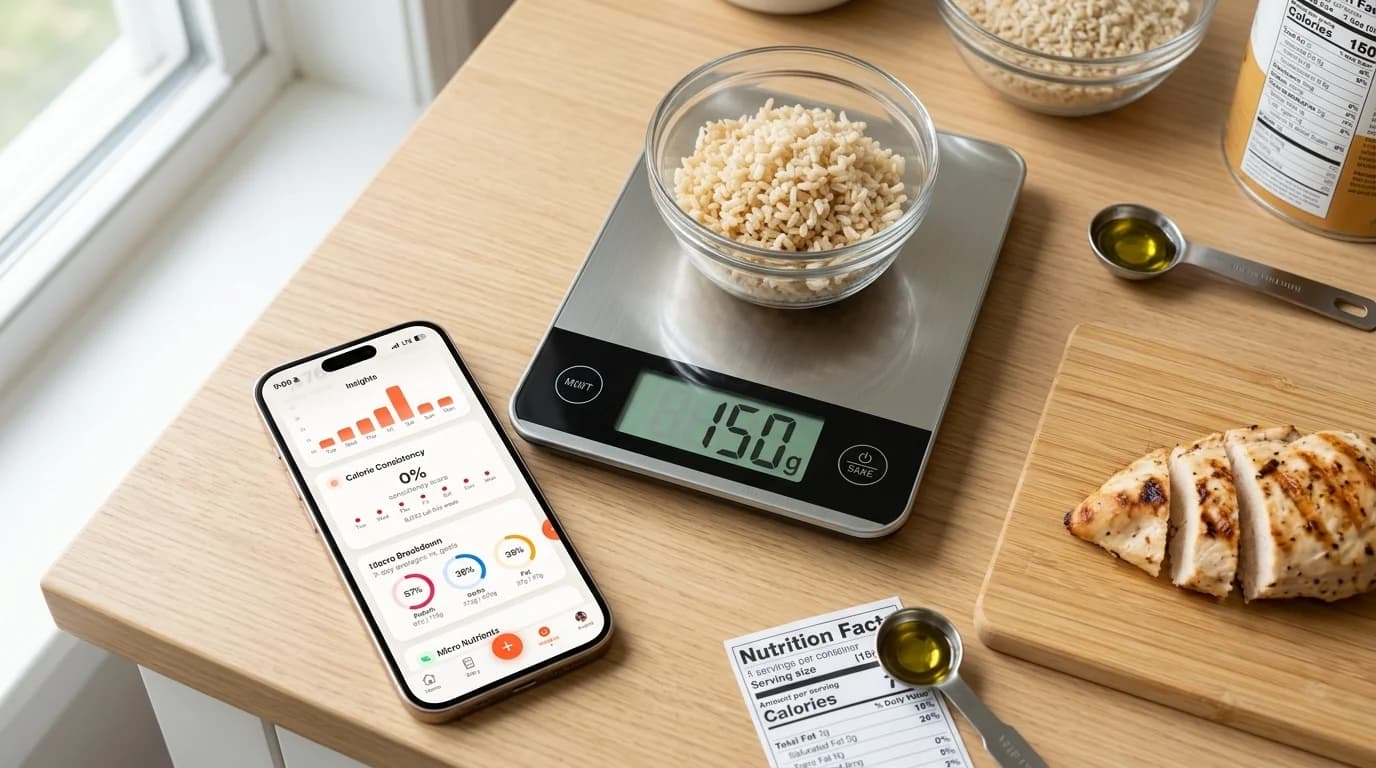
Searching databases and typing ingredient lists is what makes calorie counting feel tedious. CalorieCue eliminates all of that — just snap a photo and move on. The less friction you add, the longer you'll stick with it.
3. Track weekends too
This is where most calorie deficits go to die. Research in the journal Obesity shows that weekend overeating is one of the top predictors of stalled weight loss. Even rough estimates on Saturday and Sunday are better than nothing.
4. Aim for ±100 calories, not perfection
Close enough works. If your target is 1,800 calories, anything between 1,700 and 1,900 is a successful day. Chasing exact numbers leads to burnout — chasing consistency leads to results.
5. Track beverages
Liquid calories are the most commonly forgotten entries. A morning latte (180 cal), afternoon juice (110 cal), and evening beer (153 cal) add up to 443 untracked calories — enough to erase a moderate deficit entirely.
6. Meal prep = predictable calories
When you eat the same meals repeatedly, tracking becomes almost effortless. Prepare 3–4 go-to meals, log them once, and reuse the entries. Same meals mean less tracking effort and more consistent results. For ideas, check out our meal prep for beginners guide.
7. Review weekly averages, not daily numbers
One bad day doesn't matter if the week balances out. If your target is 1,800 calories per day, that's 12,600 per week. Ate 2,200 on Saturday? Eat 1,600 on two other days and you're back on track. Learn how to track without obsessing.
For a complete walkthrough on getting started, read our beginner's guide to counting calories. It covers everything from your first logged meal to building long-term tracking habits.
The Fastest Way to Track
The #1 reason people quit calorie counting is that it takes too long. Searching food databases, weighing ingredients, and manually entering quantities turns a 30-second activity into a 5-minute chore — for every single meal.
CalorieCue solves this completely. Snap a photo of your meal → AI identifies every food on your plate → see calories and macros instantly → done in 3 seconds.
No searching databases. No weighing food. No typing ingredient lists. Just eat, snap, and move on with your day.
Over the course of a day, that's the difference between spending 15 minutes on tracking and spending 15 seconds. And that difference is why people actually stick with it.
Download CalorieCueIf you're comparing tracking apps, our best calorie tracker app guide breaks down what to look for.
Download the Free Cheat Sheet PDF
Everything in this guide — plus a printable 7-day tracking log — in one free, five-page PDF. We'll email it to you, and you can download it instantly. Stick it on your fridge, keep it at your meal-prep station, or save it to your phone.
Get the Free 5-Page Cheat Sheet PDF
Calorie targets, 80+ food calories, high-protein swaps, a restaurant guide, and a printable 7-day tracking log. Enter your email and we'll send you the PDF.
Put the reference into practice with a flexible calorie-counting meal plan. Choose portions that fit your own target and record cooking oils and extras.
Frequently Asked Questions
Do I need to count calories every day?
Not necessarily. Research published in the journal Obesity found that consistency — tracking at least 5 days per week — was a stronger predictor of weight loss success than perfection. If you take weekends off, make sure your weekday habits are strong enough to keep your weekly average on track.
How accurate does my calorie counting need to be?
Within 10–15% is good enough. Even with a margin of error, consistent tracking gives you far better estimates than guessing. Studies show that untracked eating can be off by 30–50%. Aim for ±100 calories of your target and you'll see results.
What's the easiest way to count calories?
AI photo tracking. Apps like CalorieCue let you snap a photo and get an instant calorie and macro breakdown — no database searching, no food weighing, no typing. It takes about 3 seconds per meal, which is why it has the highest long-term adherence rate.
How long should I count calories?
Most people develop strong portion awareness after 2–3 months of consistent tracking. At that point, many transition to intuitive eating with occasional check-ins. Some prefer to track long-term because it removes the guesswork from maintenance.
Can I lose weight without counting calories?
Yes — methods like portion control, mindful eating, and structured meal plans can work. But research consistently shows that people who track their food intake lose significantly more weight and keep it off longer than those who don't. Tracking gives you the data to make adjustments when progress stalls.
Is the cheat sheet really a downloadable PDF?
Yes. When you enter your email, we send you a real, five-page PDF — plus an instant download link — not a webpage you have to print yourself. Save it, print it, or keep it on your phone.
What's included in the printable cheat sheet?
Five pages: calorie targets by weight and goal, the hand-method portion guide, 80+ common foods with calories, high-protein low-calorie foods and smart swaps, a restaurant and fast-food calorie guide, and a blank 7-day tracking log you can fill in by hand.
Start Counting Today
Calorie counting is simpler than the internet makes it seem. You don't need a nutrition degree. You don't need expensive tools. You need a rough calorie target, a basic understanding of portions, and a fast way to log your meals.
This cheat sheet is your quick-start tool. Print it, use it, and download CalorieCue when you're ready for effortless tracking — because the best calorie counting method is the one you'll actually stick with.
Download the PDF. Download the app. Start today.
For more on tracking while eating out or counting macros alongside calories, explore our full library of guides.