On this page
- Step 1 — Find Your Daily Calorie Target
- Step 2 — Learn to Read a Nutrition Label Correctly
- What to Look For
- The Serving Size Trap
- Watch for Misleading Terms
- Step 3 — Weigh Your Food (Not Just for a Week — At Least at First)
- Why Eyeballing Fails
- The Tools You Actually Need
- How Long Do You Need to Weigh?
- Step 4 — Understand Raw vs. Cooked Weights
- The Rules
- Step 5 — Log Every Single Thing That Has Calories
- The Hidden Calorie Hit List
- The Rule
- Step 6 — Handle Mixed Meals and Recipes
- The Recipe Method
- The Component Method
- The AI Photo Method
- Step 7 — Handle Restaurant Meals
- Use Chain Restaurant Data
- Estimate High for Independent Restaurants
- Pre-Decide and Log Before You Arrive
- The 5 Mistakes That Sabotage 80% of Trackers
- 1. Logging After Eating Instead of Before
- 2. Trusting Crowdsourced Database Entries
- 3. Not Accounting for Cooking Losses
- 4. The "Healthy Food Illusion"
- 5. Not Logging the "Bad" Days
- How Accurate Do You Actually Need to Be?
- The Bottom Line
Here's a number most people don't know: according to research cited by Precision Nutrition, even trained nutritionists underestimate calories in meals by an average of 30%. For everyday trackers, the gap is often worse — studies consistently find people underestimate daily intake by 200–400 calories, which is the exact margin between a real weight loss deficit and no deficit at all.
The problem isn't that calorie counting doesn't work. It's that most people were never taught how to count accurately.
If trained nutritionists are off by 30%, the average tracker eyeballing portions is almost certainly worse. The 200–400 calorie daily gap that research consistently finds is exactly the size of a typical weight-loss deficit — which is why so many people track "religiously" and still don't lose weight.
This post is the practical, step-by-step guide. You'll learn how to find your calorie target, read nutrition labels properly, handle raw vs. cooked weights, estimate mixed meals and restaurant food, and avoid the five mistakes that silently sabotage the majority of trackers.
By the end, you'll be counting calories with the kind of accuracy that actually produces results — not the vague, eyeballed estimates that make people wonder why they're not losing weight.
Step 1 — Find Your Daily Calorie Target
Before counting anything, you need a target. Counting without one is like driving without a destination.
Your target is based on your Total Daily Energy Expenditure (TDEE) — the total number of calories your body burns in a day, including your basal metabolic rate (calories to keep you alive) plus activity (everything from walking to working out).
Quick method:
- Use our free TDEE calculator to get your number in about 30 seconds
- Subtract 300–500 calories for steady weight loss of roughly 0.5–1 pound per week
- That's your daily calorie target
Safe minimums to be aware of: calorie intake should generally not fall below 1,200/day for women or 1,500/day for men without medical supervision. Cutting deeper doesn't produce faster results — it produces muscle loss, hunger, and quitting.
For a complete walkthrough of how to calculate your deficit and set realistic expectations, read our guide on how to calculate your calorie deficit. If you're still not sure what your number should be, start with how many calories you should eat.
Step 2 — Learn to Read a Nutrition Label Correctly
Nutrition labels are the most accurate calorie information you'll ever encounter — packaged foods in most countries are legally required to list their energy content. But misreading them is one of the most common counting mistakes.
What to Look For
On every nutrition label, check these three numbers before anything else:
- Serving size — the single most important number on the label
- Servings per container — how many of those servings are in the package
- Calories per serving — the energy content per one serving, not per package
The Serving Size Trap
A pack of chips says "150 calories." You eat the whole bag. Problem solved, right?
Look closer. The label probably says "servings per container: 2.5." That means the bag contains 375 calories (150 × 2.5), not 150. This is the single most common label-reading error, and it's not accidental — serving sizes on packaged foods are often artificially small to make products look lower-calorie than they actually are.
Rule: Always multiply "calories per serving" by the number of servings you actually ate. A "100-calorie" drink that's 2.5 servings is a 250-calorie drink.
Watch for Misleading Terms
- "Zero calories" in the US can legally mean up to 5 calories per serving. Eat 10 servings of "zero-calorie" spray and you've consumed 50 calories.
- "Low fat" doesn't mean low calorie — fat is often replaced with sugar.
- "Multigrain" or "whole grain" doesn't affect calorie count; those are grain-type claims, not energy claims.
Step 3 — Weigh Your Food (Not Just for a Week — At Least at First)
This is where accuracy happens. And where most people cut corners.
According to research from the University of Pittsburgh, people are "generally terrible" at estimating portion sizes — even when shown reference pictures. The only reliable solution is measurement. Their research found that directing attention specifically to portion size (rather than to calorie numbers alone) is what actually improves accuracy.
Why Eyeballing Fails
Common portion-size errors found in research:
- "One tablespoon" of peanut butter: most people use 25–30g (actual tbsp = 16g) — that's an extra 50–80 calories per use
- "A handful" of almonds: ranges from 20g to 50g between people — that's a 100-calorie swing
- "A cup" of rice: restaurant portions are often 1.5–2 cups — that's an extra 100–200 calories
- "A splash" of olive oil: typically 1–2 tablespoons — that's 120–240 calories
If you eyeball three portions in a day and each one is 50–100 calories off, you've already lost your entire calorie deficit without knowing it.
The Tools You Actually Need
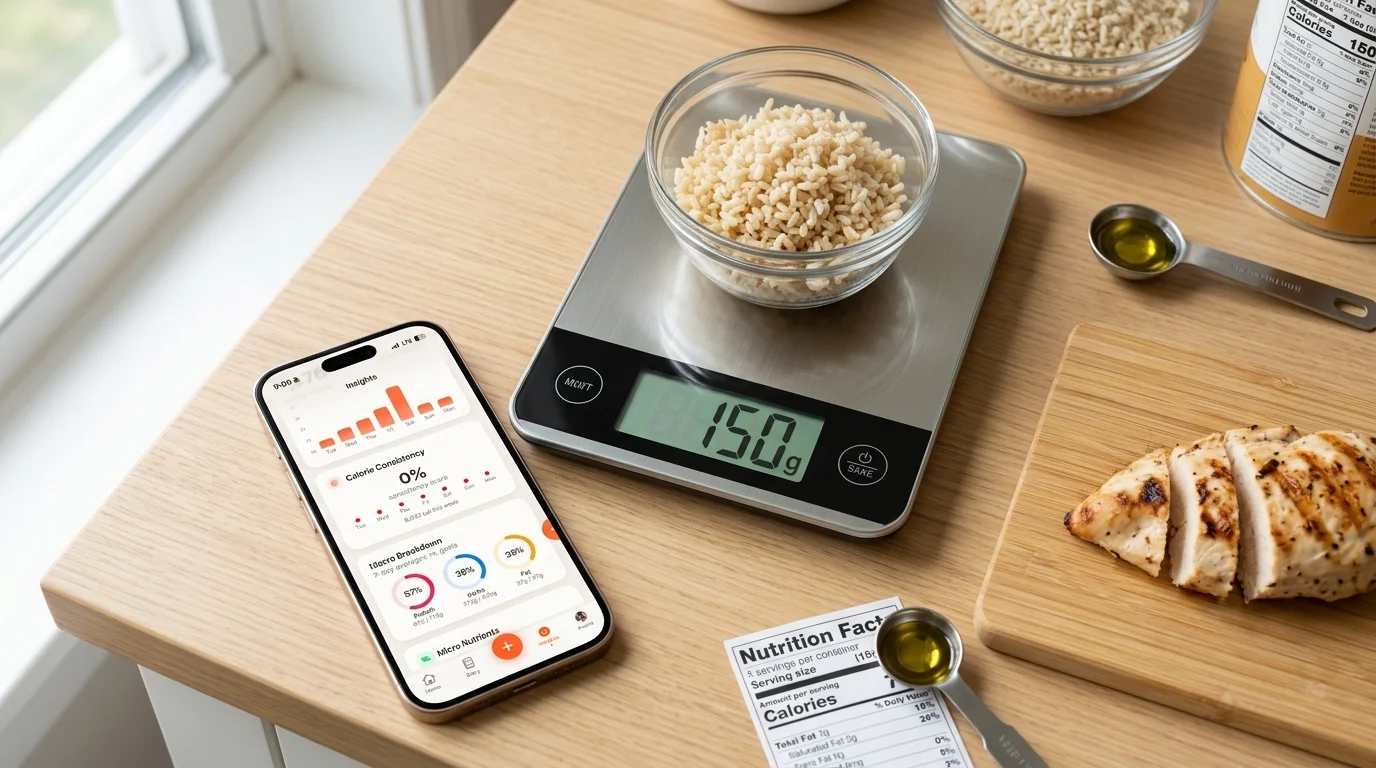
A digital kitchen scale ($10–20). This is the single best investment in calorie counting. Weighing takes 5 seconds per item and is accurate to the gram. Buy one that measures in both grams and ounces, with a "tare" function that lets you zero out the weight of a bowl or plate.
Measuring cups and spoons. Useful for liquids (milk, oil) and soft foods (yogurt, peanut butter) that are awkward to weigh.
That's it. You don't need fancy gadgets. For calorie counting, a scale will serve you 80% of the time.
How Long Do You Need to Weigh?
Not forever. Most people weigh religiously for 4–8 weeks, then transition to visual estimation for familiar foods once they've built portion intuition.
During your "calibration period," weigh everything. After that, continue weighing calorie-dense foods (nuts, oils, cheese, nut butters) but estimate foods you've weighed many times (chicken breasts, bananas, slices of bread). Our portion control guide covers this transition in more detail.
Step 4 — Understand Raw vs. Cooked Weights
This trips up almost every beginner, and even some experienced trackers.
Meat loses water when cooked. 150g of raw chicken breast becomes roughly 120g of cooked chicken — but the calories stay the same (about 165 calories for chicken breast). If you weigh your chicken after cooking and log "150g cooked chicken," you'll overcount your calories.
Grains absorb water when cooked. 100g of dry pasta becomes roughly 300g of cooked pasta. Same calories (about 370). If you weigh cooked pasta and use the calorie data for dry pasta, you'll undercount by a factor of three.
The Rules
| Food Type | Weigh When? | Why |
|---|---|---|
| Meat and poultry | Either raw or cooked, but match your database entry | Loses ~20% weight when cooked |
| Rice, pasta, grains | Preferably dry (more accurate) | Absorbs 2–3x water when cooked |
| Vegetables | Either | Water content changes minimally |
| Fruit | Raw | Not usually cooked |
| Oils and fats | Before cooking | They stay in the pan — measure before adding |
The universal fix: Whatever method you choose, be consistent. If you always weigh chicken raw and use the raw calorie value, your numbers will be consistent. Problems arise when you mix methods.
For a full reference of calorie counts by food category, see our calories in food list — it notes raw vs. cooked values where it matters.
Step 5 — Log Every Single Thing That Has Calories
This sounds obvious. It's not. The single biggest source of "hidden calories" in most people's diets is the stuff they forget to log.
The Hidden Calorie Hit List
These are the most commonly forgotten sources of calories, ranked by how much damage they typically do:
- Cooking oils (1 tbsp = 120 calories). If you cook with 2–3 tablespoons daily, that's 240–360 calories untracked per day. Over a week, this alone can eliminate your entire deficit.
- Salad dressings (2 tbsp = 100–150 calories). A restaurant salad can easily have 300–500 calories of dressing.
- Condiments (1 tbsp mayo = 94 cal, 1 tbsp ketchup = 20 cal). These add up fast, especially on sandwiches and fries.
- Coffee additions (1 tbsp cream = 50 cal, 1 tsp sugar = 16 cal). Two sweetened lattes a day = 400+ untracked calories.
- Alcohol (1 beer = 150 cal, 1 glass wine = 125 cal, 1 cocktail = 200–400 cal). Weekends are where this destroys calorie deficits.
- Bites and tastes while cooking. Tasting the sauce, eating leftover scraps, finishing kids' plates — these feel like "nothing" but can easily add 200+ calories.
- Gum, mints, mouthwash sweeteners. Usually small but accumulates.
The Rule
If it has calories and enters your mouth, log it. Even if it's a rough estimate. Even if the number feels small. The habit of logging everything is what produces accurate counts — selective logging is how most people end up with weight loss stalls that "make no sense."
For more on what to track when eating out, where hidden calories are most extreme, see our guide on how to track calories when eating out.
Step 6 — Handle Mixed Meals and Recipes
Simple single-ingredient foods are easy. "150g grilled chicken — 248 calories." Done.
Mixed meals are where tracking gets harder. A stir-fry, a curry, a casserole, a homemade soup — how do you count those?
The Recipe Method
For home-cooked meals you make regularly:
- Log each ingredient separately before cooking. Weigh them in raw form.
- Sum the total calories of all ingredients.
- Divide by the number of servings the recipe produces.
- Save that recipe in your tracking app so you don't have to re-enter it next time.
Example: Pasta dish with 200g dry pasta (740 cal), 150g ground turkey (370 cal), 200g marinara sauce (80 cal), 20g olive oil (180 cal) = 1,370 calories total. Divide into 3 servings = 457 calories per serving.
This method is accurate because you control every variable. Do this once for each of your regular meals, and logging becomes effortless afterward.
For the complete cooked-weight method, including calories per 100 grams and a calculator for uneven portions, use our guide to calculating calories in homemade food.
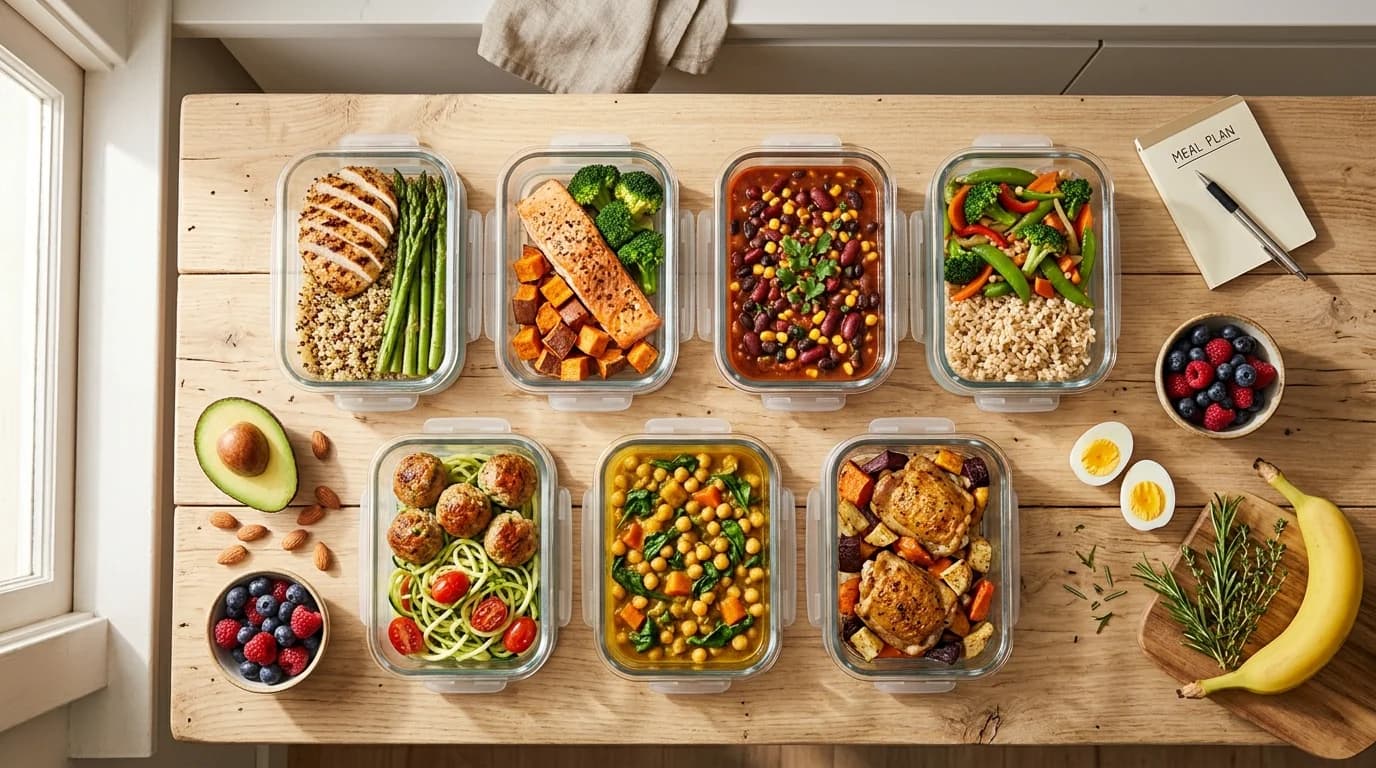
The Component Method
For meals you didn't prepare yourself (meal prep services, family meals, single-serving restaurant dishes):
- Break the meal into visible components: protein, carb, vegetable, fat, sauce
- Estimate each component's portion size using visual references (a deck of cards = 3 oz of meat, a tennis ball = 1 cup, etc.)
- Log each component separately
This is less accurate than the recipe method, but far better than guessing the total.
The AI Photo Method
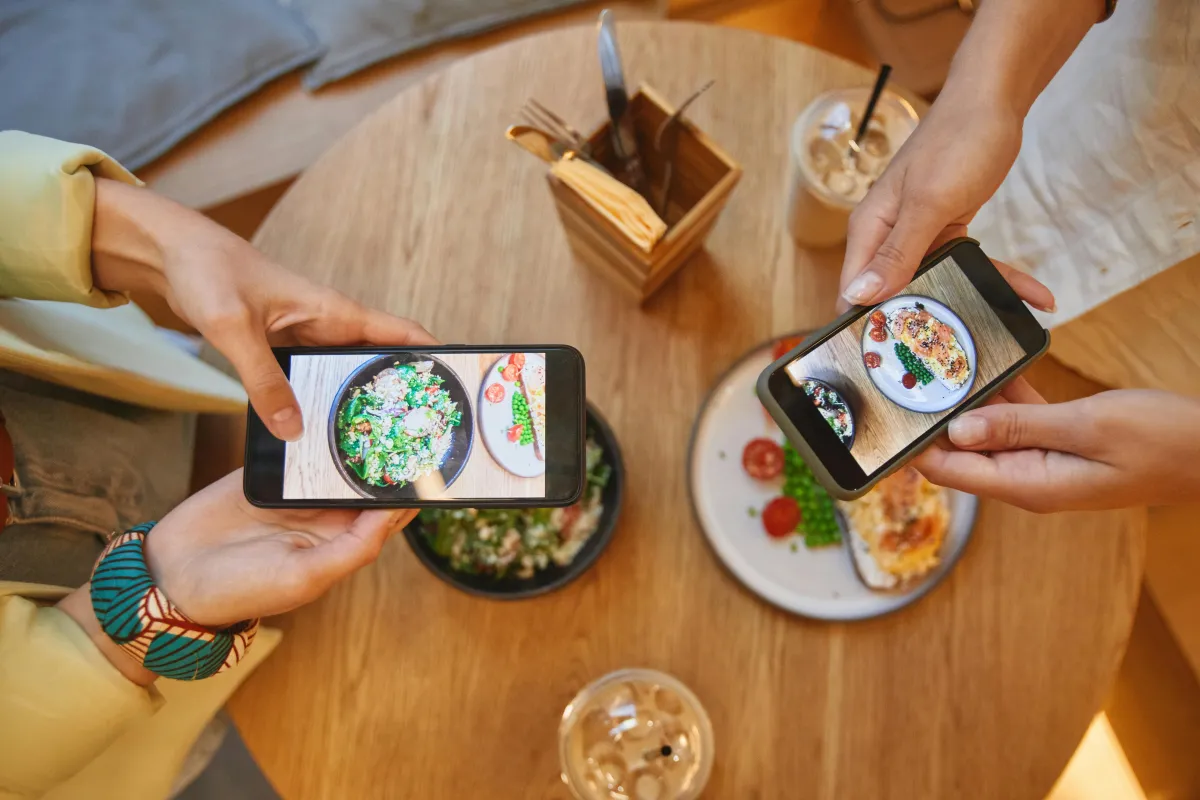
The fastest way to handle mixed meals is to use an AI-powered tracker that analyzes a photo of your plate. Modern photo-based apps can identify individual food items and estimate portions automatically, removing the manual component-by-component work. Accuracy has improved significantly — leading AI trackers are now within 10–25% of lab-measured values for clearly visible meals, which is comparable to the margin of error a human would have manually logging the same meal.
Apps like CalorieCue are built specifically for this — snap a photo, get calories and macros in seconds. Try it on your next mixed meal and see how close it gets.
Download CalorieCueFor the full comparison with other tracking methods, see our guide on how to track calories.
Step 7 — Handle Restaurant Meals
Restaurant meals are the single biggest accuracy challenge for calorie tracking. Research cited earlier in this post found that people underestimate restaurant calories by an average of 216–409 calories per meal — and that error persists even when calorie labels are visible.
Three strategies work:
Use Chain Restaurant Data
In the US, chains with 20+ locations are legally required to publish calorie data. Check the restaurant's website before you arrive, not after you've ordered. Most tracking apps include Chipotle, Starbucks, McDonald's, Subway, Panera, and other major chains in their databases.
Estimate High for Independent Restaurants
If no calorie data exists, assume the meal is at the high end of its category:
- Standard entrée (sandwich, salad with dressing, single protein + side): 700–900 calories
- Pasta or rice dish with protein: 800–1,200 calories
- Burger with fries: 1,000–1,500 calories
- Shared appetizer or dessert: 300–600 calories per person
Better to overcount a restaurant meal by 200 calories than undercount it by 400.
Pre-Decide and Log Before You Arrive
The biggest cause of restaurant calorie blowouts isn't the food — it's the decision-making in the moment, surrounded by options and under social pressure. Pre-decide what you'll order based on the menu online, and log it before leaving the house. By the time you arrive, the choice is already made.
The 5 Mistakes That Sabotage 80% of Trackers
Even people doing everything above can fall into these traps. These are the silent accuracy killers:
1. Logging After Eating Instead of Before
Logging a meal after you eat it is retrospective paperwork. You're recording history.
Logging before (or during) transforms tracking into meal planning. You see the calorie total before committing, which naturally regulates portion sizes. Research consistently shows that pre-logging (prospective tracking) is associated with better weight loss outcomes than retrospective logging.
Fix: For one meal tomorrow, log the food as you prepare or order it — not after.
2. Trusting Crowdsourced Database Entries
Apps like MyFitnessPal rely heavily on user-submitted food entries. The same food — "grilled chicken breast, 100g" — can have 15 different entries ranging from 110 to 220 calories. Pick the wrong one, and your count is off by 100+ calories per meal.
Fix: Prefer entries marked as "verified" or sourced from USDA FoodData Central. For packaged foods, scan the barcode — it pulls the manufacturer's official data.
3. Not Accounting for Cooking Losses
This is subtle. When you bake a potato with skin, you don't eat the whole potato the way you'd log it raw — you eat the cooked, slightly dehydrated version, which has slightly more calories per gram than the raw version.
For most foods, the difference is small enough to ignore. But for deep-fried foods (where oil is absorbed) or heavily reduced sauces (where water evaporates), the calorie-per-gram increases significantly. A "reduction" of a cup of wine and butter is not the same as the original wine and butter; it's concentrated.
Fix: Log deep-fried foods from restaurant-data entries rather than raw ingredients. Log reduced sauces by their final weight, not by summing raw ingredients.
4. The "Healthy Food Illusion"
Research describes a phenomenon called the "negative calorie illusion": when people see a high-calorie food paired with a healthy food (a cheeseburger next to celery sticks), they estimate the entire meal has fewer calories than the cheeseburger alone. The "virtuousness" of the healthy side dish mentally averages out the calorie-dense main.
This isn't just an estimation quirk — it's a predictable cognitive bias that causes people to underestimate calories in seemingly healthy meals.
Fix: Log each component of a meal separately. Don't let "I had salad" make you forget to log the dressing, cheese, croutons, and protein on top.
5. Not Logging the "Bad" Days
When you overeat, the natural instinct is to not log it — either because the number is uncomfortable, or because you plan to "restart" tomorrow.
This is the single biggest pattern that causes people to quit tracking entirely. Not logging a bad day sets up a shame spiral: each skipped day makes the next one easier to skip.
Fix: The day you overeat is the day you must log, even as a rough estimate. You're not punishing yourself — you're collecting data. For more on why this matters, read our guide on how to stay consistent with calorie counting.
How Accurate Do You Actually Need to Be?
Perfect accuracy is neither possible nor necessary.
Even with a digital scale and verified databases, real-world calorie counts vary by 10–20% due to factors you can't control: the exact size of that banana, the specific cut of beef, how much water the rice absorbed, how ripe the avocado was. Nutrition databases themselves have inherent variability.
The realistic standard: if you're within 100–150 calories of your target on most days, you'll achieve the same results as someone tracking with perfect precision — without the mental cost.
What actually matters:
- Consistency (tracking 5–6 days per week, not skipping bad days)
- Directional accuracy (is your calorie-dense food measured? is your oil logged?)
- Trend over time (your weekly and monthly averages, not any single day)
The goal isn't perfection. It's precision good enough to produce real results. If you want a one-page reference to keep near your kitchen, grab our calorie counting cheat sheet.
The Bottom Line
Accurate calorie counting comes down to five things:
- Know your target (use your TDEE calculator)
- Weigh calorie-dense foods rather than eyeballing
- Log everything — including oils, sauces, and "small" extras
- Handle raw vs. cooked weights consistently
- Pre-log meals before eating whenever possible
If you do those five things, you'll be more accurate than 90% of people who track. You don't need perfection — you need a method that produces numbers reliable enough to drive real results.
The friction of traditional counting — searching databases, typing portions, second-guessing entries — is what causes most people to quit. If that's breaking your consistency, CalorieCue lets you snap a photo of any meal and get an instant calorie and macro estimate. No database searching, no manual portions — just a photo.
Stop guessing. Start scanning.
Download CalorieCueWhatever tool you use, the principles in this guide apply. Accurate counting produces accurate results. Everything else is just details.