On this page
- Before Day 1 — Set Up (5 Minutes)
- Day 1 — Just Scan Everything
- Today's Only Goal
- The One Rule
- How to Do It
- Day 2 — Notice the Surprises
- Review Yesterday's Log
- Common Day 2 Surprises
- What to Do With This Information
- Day 3 — Make One Swap
- Pick One Swap
- Easy Swaps That Save 100–300 Calories
- Why Only One Swap?
- Day 4 — Check Your Protein
- Check Your Macros
- Why Protein Matters This Early
- Quick Protein Fixes
- Day 5 — Set Your Calorie Target
- Use Your Data
- How to Set Your Target
- Day 6 — Track a "Hard" Meal
- Log an Imperfect Meal
- Why This Day Matters
- How to Handle It
- Day 7 — Review Your Week
- Look at the Full Picture
- What to Check
- Celebrate
- Decide What Comes Next
- What Makes Week 2 (and Beyond) Easier
- Frequently Asked Questions
- What if I forget to track a meal?
- Do I need to track every single day?
- How accurate does my tracking need to be?
- What if tracking makes me anxious about food?
- When can I stop tracking?
- Your Day 1 Starts With Your Next Meal
You downloaded a calorie tracker. You opened it once. Maybe you scanned a meal. Then life happened, and you forgot about it.
If that sounds familiar, you're not alone. Research on dietary self-monitoring shows that adherence to food tracking drops sharply within the first two weeks — not because people lack motivation, but because nobody gives them a clear plan for what to do after they install the app.
This guide fixes that. It's a simple, day-by-day plan for your first week of calorie tracking. No overwhelm. No perfection required. Just seven days of small steps that build the awareness and habit that lead to real results.
The most important thing to know before you start: This first week is NOT about restricting food or hitting a perfect calorie target. It's about learning what you're actually eating. That awareness alone changes everything.
Before Day 1 — Set Up (5 Minutes)
Before you track a single meal, do these three things:
Enter your basic stats. Open CalorieCue and input your age, height, weight, and general activity level. This takes about 30 seconds.
Get your calorie number. Use the in-app setup or our free TDEE calculator to find your estimated daily calorie burn. This is your starting reference point — not a rigid target (yet). For a full explanation of what this number means, see our TDEE calculator guide.
Set your goal. Are you trying to lose weight, maintain, or build muscle? Select your goal in the app. CalorieCue will suggest a daily calorie target based on your TDEE minus a moderate deficit.
Don't overthink this. You can adjust everything later once you have real data. The goal right now is to get set up and start.
Day 1 — Just Scan Everything
Today's Only Goal
Log every single thing you eat — breakfast, lunch, dinner, snacks, drinks. Everything.
The One Rule
Don't try to change anything. Don't restrict. Don't try to hit your calorie target. Don't judge what you eat. Just log it.
This is the most important rule of Day 1. You're collecting data, not dieting. Think of yourself as a scientist observing your own eating patterns. The data is neutral — there's no good or bad, just information.
How to Do It
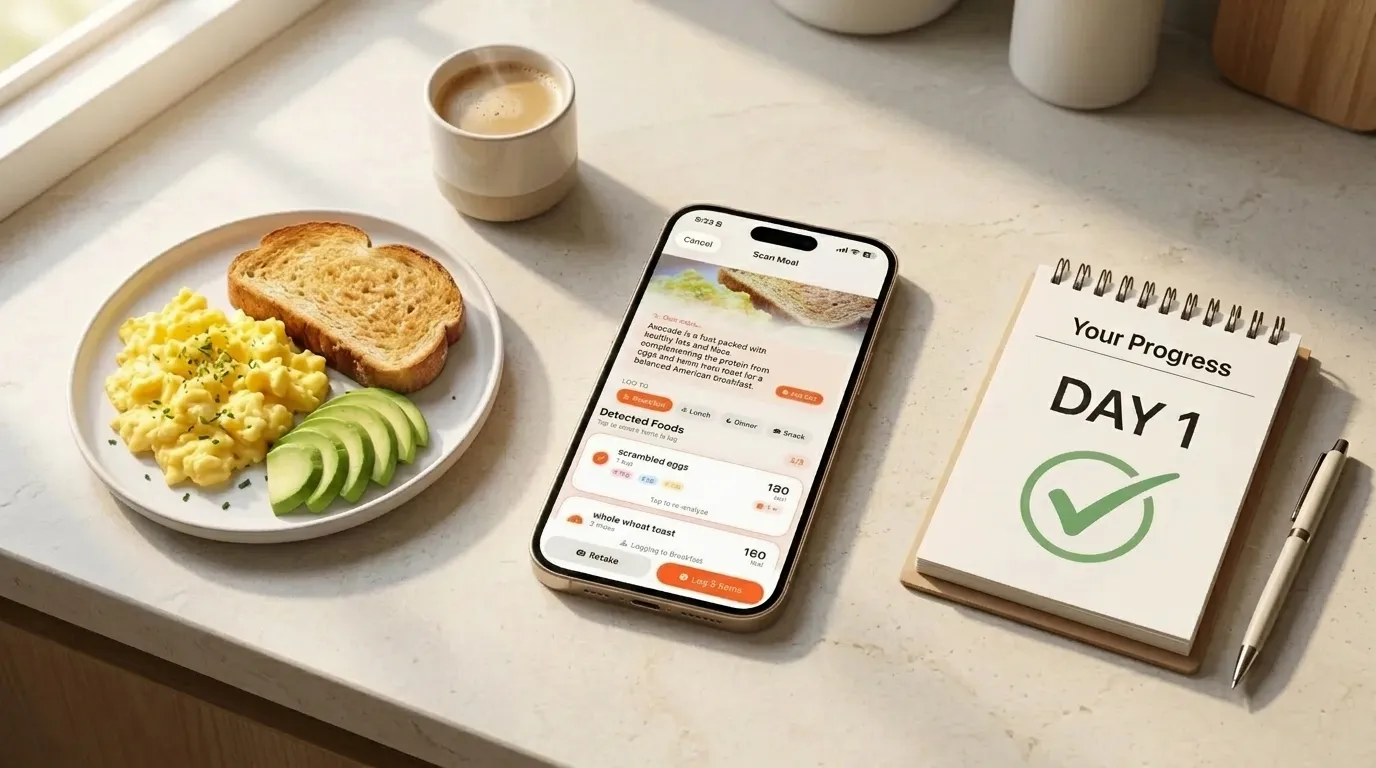
Snap a photo of each meal with CalorieCue before you eat. It takes about 3 seconds per meal. That's 15 seconds of total effort for a full day of tracking.
At the end of Day 1, open CalorieCue and look at your daily total. Most people have a reaction somewhere between "oh, that's not as bad as I thought" and "wait, I ate HOW many calories today?"
Both reactions are useful. The point is that now you know.
A landmark study in the New England Journal of Medicine found that people underestimate their calorie intake by an average of 47%. Day 1 closes that gap. You're already ahead of most people simply by knowing your real number.
Day 2 — Notice the Surprises
Review Yesterday's Log
Look at yesterday's log. Identify the biggest calorie items. Notice what surprised you.
Common Day 2 Surprises
Most people discover the same handful of hidden calorie sources:
- Cooking oils. That "light drizzle" of olive oil was 2–3 tablespoons — 240–360 calories you never counted
- Sauces and dressings. Ranch on your salad added 280 calories. The "healthy" salad was actually 700 calories
- Drinks. Your morning latte was 300 calories. Your afternoon juice was 150. That's 450 calories in liquid form that didn't fill you up at all
- Rice/bread portions. You served yourself 2.5 cups of rice at dinner — 515 calories from rice alone
- "Healthy" snacks. That granola bar was 250 calories. The handful of trail mix was 350
What to Do With This Information
Nothing yet. Just notice. Today you're still observing. Track everything again — same as yesterday. But now you're tracking with awareness. You know where the big numbers come from.
A systematic review published in Public Health Nutrition found that dietary self-monitoring is one of the most consistently effective behavior change techniques for weight management — and the effect comes from awareness, not restriction. You're building that awareness right now.
Day 3 — Make One Swap
Pick One Swap
Pick ONE high-calorie habit from your data and swap it for a lower-calorie alternative.
Easy Swaps That Save 100–300 Calories
Just one. Not five. Not a complete diet overhaul. One swap.
- Flavored latte → black coffee with a splash of milk (save 200+ cal)
- 2 cups of rice → 1 cup (save 206 cal)
- Afternoon chips → apple with peanut butter (save 100 cal)
- Sugary soda → sparkling water with lemon (save 140 cal)
- Ranch dressing → balsamic vinaigrette (save 100 cal)
- Cooking with 3 tbsp oil → using cooking spray + 1 tbsp oil (save 240 cal)
For more swap ideas, check our healthy snacks for weight loss guide.
Why Only One Swap?
Because it works. Research from the POUNDS LOST trial found that participants who made small, consistent dietary changes — combined with regular food tracking — lost significantly more weight than those who attempted dramatic overhauls. Small changes are sustainable. Big changes trigger the restrict-binge cycle that makes people quit.
Keep tracking everything else the same way. You're still building the logging habit.
Day 4 — Check Your Protein
Check Your Macros
Look at your macro breakdown in CalorieCue. Specifically, check how much protein you're eating at each meal.
Why Protein Matters This Early
Protein is the single most impactful macronutrient for weight management. Research published in The American Journal of Clinical Nutrition shows that higher protein intake during calorie restriction preserves muscle mass, increases satiety, and improves body composition — even at the same calorie level.
The target: 25–30 grams of protein per meal.
Most people discover on Day 4 that their breakfast has almost no protein (toast, cereal, fruit = mostly carbs), their lunch is moderate, and dinner carries the entire protein load for the day. This uneven distribution means you're hungry all morning and overeating at night.
Quick Protein Fixes
- Breakfast: Add eggs, Greek yogurt, or a protein shake
- Lunch: Make sure there's a clear protein source (chicken, fish, tofu, beans)
- Snacks: Choose protein-based snacks (cottage cheese, jerky, edamame) over carb-only snacks (crackers, fruit alone)
For a complete breakdown of how to calculate and hit your protein targets, see our macro counting guide. For the best protein-to-calorie ratio foods, see our high-protein, low-calorie foods list.
Day 5 — Set Your Calorie Target
Use Your Data
You now have 4 days of real data. You know your baseline. Today, set your actual calorie target and try to hit it.
How to Set Your Target
Take your TDEE (from the CalorieCue TDEE calculator) and subtract 300–500 calories. That's your daily target for weight loss. For context on whether this is right for your body, see how many calories you should eat per day.
A few guidelines:
- Women: Don't go below 1,200 calories without medical supervision
- Men: Don't go below 1,500 calories without medical supervision
- Aim for a range, not a single number. If your target is 1,700, anything between 1,600 and 1,800 counts as a successful day
- If you go over: Log it honestly and move on. One day over target does not undo four days of progress
Research in the European Journal of Social Psychology by Phillippa Lally at UCL found that missing a single day did not materially affect the habit formation process. What matters is getting back on track the next day — not maintaining a perfect streak.
Day 6 — Track a "Hard" Meal
Log an Imperfect Meal
Intentionally track a meal that's difficult to log — eating out at a restaurant, a social dinner, or food you didn't prepare yourself.
Why This Day Matters
This is where most people abandon calorie tracking. They eat something they can't precisely measure, feel like they've "failed," and never open the app again.
The truth is: an estimated log is infinitely better than no log at all. Research on dietary self-monitoring adherence found that perfect food tracking is not necessary to achieve clinically significant weight loss — tracking just 28.5% of days was enough to predict meaningful results. The habit of logging matters more than the precision of any single entry.
How to Handle It
- At a restaurant: Snap a photo of your plate with CalorieCue. The AI will estimate calories based on the dish. It won't be laboratory-accurate, but it'll be close enough.
- At someone's house: Snap a photo or estimate afterward. "That was probably chicken adobo with rice — around 500 calories" is a perfectly valid entry.
- Ordering delivery: Snap the food when it arrives, before you eat.
For a complete guide to handling restaurant meals, see how to track calories when eating out.
The goal isn't perfection. The goal is showing up. Log the hard meals, accept the estimate, and keep going.
Day 7 — Review Your Week
Look at the Full Picture
Look back at your full 7-day log. Review, reflect, and decide what comes next.
What to Check
Open CalorieCue and review your weekly summary:
- What's your daily average? Compare it to your target. Are you close? Consistently over? Under?
- Which days were highest? For most people, weekends stand out. Research published in the journal Obesity confirms that weekend overeating is one of the top predictors of stalled weight loss
- Where's your protein? Are you hitting 25–30g per meal most days, or is it still uneven?
- What were your biggest hidden calorie sources? Oils, drinks, sauces, portions?
Celebrate
If you made it to Day 7, you've already outlasted the vast majority of people who try calorie tracking. Studies on mobile dietary self-monitoring show that tracking adherence drops sharply within the first 1–2 weeks. You're still here. That matters.
Decide What Comes Next
Based on your week of data:
- Feeling good and losing weight? Keep the same target. Don't change what's working.
- Feeling constantly hungry? Your deficit may be too aggressive. Increase by 100–200 calories and see if hunger normalizes.
- Not losing weight? Your deficit may not be real — recheck portions, hidden oils, and weekend eating. See our guide on why you're not losing weight.
- Feeling obsessive about numbers? Read our guide on tracking calories without obsessing. The goal is awareness, not anxiety.
What Makes Week 2 (and Beyond) Easier
By Day 7, something subtle has already happened: CalorieCue has started learning your patterns. Your common meals show up faster. Repeat breakfasts take one tap instead of a new photo. The friction that made tracking feel like work on Day 1 has already begun to disappear.
Habit formation research by Phillippa Lally at University College London found that new behaviors take an average of 66 days to become automatic — but the biggest gains in automaticity happen in the first few weeks. Each day you log, the behavior gets slightly easier. You're on that curve right now.
Three things that accelerate the habit:
Meal prep makes tracking almost automatic. When you eat the same 3–4 meals regularly, you only need to log them once — then repeat. Less decision fatigue, less tracking effort, better consistency. See our meal prep for beginners guide.
Pair tracking with an existing habit. Don't track "at some point during the meal." Track immediately after you sit down to eat — every time, same trigger, same response. This context-dependent repetition is what research on habit formation identifies as the key mechanism for developing automaticity.
Lower the bar on hard days. Some days you'll log every gram. Other days you'll estimate an entire meal in 5 seconds. Both count. The research is clear: imperfect tracking dramatically outperforms no tracking at all.
Frequently Asked Questions
What if I forget to track a meal?
Track the next one. Missing a single meal — or even an entire day — doesn't reset your progress. Research on habit formation shows that one missed opportunity did not materially affect the habit formation process. The worst thing you can do is interpret a missed log as failure and stop tracking entirely.
Do I need to track every single day?
Not necessarily. Research published in Obesity found that tracking at least 5 days per week predicted weight loss success as effectively as daily tracking. If you take weekends off, make sure your weekday habits are strong enough to keep your weekly average on target.
How accurate does my tracking need to be?
Within 10–15% is good enough for weight loss. Tracking isn't about hitting your target to the exact calorie — it's about creating awareness and catching the big mistakes (uncounted oils, forgotten snacks, weekend overeating). Consistency matters far more than precision.
What if tracking makes me anxious about food?
This is a real concern, and it's worth taking seriously. If tracking triggers guilt, obsessive thoughts, or anxiety around eating, read our guide on tracking without obsessing. The 80/20 method — tracking most of the time but allowing flexibility for social meals and off-days — works for most people. If tracking causes genuine distress despite a flexible approach, consider consulting a healthcare professional.
When can I stop tracking?
Most people develop strong portion awareness after 2–3 months of consistent tracking. At that point, many transition to intuitive eating with occasional check-in weeks. Calorie tracking is a learning tool, not a lifelong obligation. The goal is to reach a point where you can make informed food choices without logging every bite.
Your Day 1 Starts With Your Next Meal
Seven days. That's all it takes to build the foundation of a calorie tracking habit that can change your body, your relationship with food, and your understanding of what you actually eat.
Day 1–2: observe. Day 3–4: optimize. Day 5–7: execute.
The hardest part isn't the tracking itself — it's starting. And if you're reading this, you've either already downloaded CalorieCue or you're about to. Either way, you're closer than you think.
Open the app. Snap your next meal. That's Day 1.
Download CalorieCueFor more on building your nutrition plan, explore our guides on how many calories to eat per day, counting macros, and eating out while tracking.