On this page
- Serving Size vs. Portion Size (They're Not the Same)
- The Hand Method: Your Built-In Portion Guide
- Putting It Together for Different Calorie Targets
- The Plate Method: Half, Quarter, Quarter
- 7 Portion Mistakes That Add Hundreds of Hidden Calories
- 1. Cooking Oils
- 2. Nut Butters
- 3. "Healthy" Granola and Trail Mix
- 4. Cheese
- 5. Rice and Pasta
- 6. Salad Dressings
- 7. Smoothies
- Portion Control When Eating Out
- Portion Control vs. Calorie Counting: Which Is Better?
- Frequently Asked Questions
- How do I control portions without measuring everything?
- What does a proper serving of rice, pasta, or meat look like?
- Can I lose weight with portion control alone?
- How do I portion control at buffets?
- Is portion control the same as eating less?
- The Bottom Line
You can eat the healthiest foods in the world and still gain weight if you eat too much of them.
Olive oil is healthy — but three tablespoons in a pan adds 360 calories before any food hits the plate. Brown rice is nutritious — but doubling the serving doubles the calorie cost. Even "clean eating" falls apart when portions are off.
Here's the uncomfortable truth: the average restaurant meal is 2–3 times larger than a standard serving. Plates at home have grown 44% since the 1980s. Our eyes have adjusted to oversized portions as normal — and our waistlines have followed.
The good news? You don't need to measure every gram or count every calorie to fix this. This guide will give you simple, visual methods to get portions right — no measuring cups required.
Serving Size vs. Portion Size (They're Not the Same)
These two terms sound interchangeable, but confusing them is where most calorie miscounting begins.
A serving size is a standardized amount listed on a nutrition label. It's set by regulatory agencies and used to calculate the nutrition facts you see on packaging. It's a reference point — not a recommendation for how much to eat.
A portion is how much you actually put on your plate and eat.
The gap between these two is where most weight problems hide.
A "serving" of pasta is 2 oz dry — about 200 calories. Most people cook and eat 4–6 oz — that's 400–600 calories before sauce. A serving of cereal is ¾ cup. Pour it into a bowl without measuring and you'll likely pour 2–3 servings. A "serving" of peanut butter is 2 tablespoons — but most people spread 3–4 without thinking.
None of this makes you a bad eater. It makes you normal. Portion distortion is a product of environment, not willpower. But awareness is the first step to fixing it.
If you haven't figured out how many calories your body actually needs, start with our guide on your daily calorie needs — portion control works best when you have a target to aim for.
The Hand Method: Your Built-In Portion Guide
You carry a perfectly calibrated portion-measuring tool with you everywhere: your hand. And here's the elegant part — your hand scales with your body. Bigger people have bigger hands and need bigger portions. Smaller people have smaller hands and need less. It's a self-adjusting system.
Here's how it works:
- Your palm (fingers excluded, thickness of your palm) = 1 serving of protein (~25–30g protein, ~130–180 cal). That's about 4 oz of chicken, fish, or meat.
- Your fist = 1 serving of carbohydrates (~30–40g carbs, ~130–180 cal). About ¾–1 cup of cooked rice, pasta, potatoes, or oats.
- Your thumb (tip to base) = 1 serving of fat (~10–15g fat, ~100–120 cal). About 1 tablespoon of oil, butter, nut butter, or a small handful of nuts.
- Two fists = 1 serving of vegetables (~25–50 cal). Eat these freely — it's nearly impossible to overeat non-starchy vegetables.
Putting It Together for Different Calorie Targets
~1,500 calories/day (fat loss)
- Each meal: 1 palm protein, 1 fist carbs, 1 thumb fat, 2 fists vegetables
- 3 meals per day + 1 small snack
~2,000 calories/day (maintenance for most women / fat loss for larger individuals)
- Each meal: 1.5 palms protein, 1.5 fists carbs, 1 thumb fat, 2 fists vegetables
- 3 meals per day + 1–2 snacks
~2,500 calories/day (maintenance for most men / active individuals)
- Each meal: 2 palms protein, 2 fists carbs, 1.5 thumbs fat, 2 fists vegetables
- 3 meals per day + 1–2 snacks
These aren't exact — they're practical starting points that get you within striking distance of your calorie target without weighing or measuring anything. Not sure what your calorie target should be? Use our free TDEE calculator to find your number in seconds.
The Plate Method: Half, Quarter, Quarter
If the hand method feels like too many things to remember, the plate method simplifies it even further. Every time you fill a plate, follow this ratio:
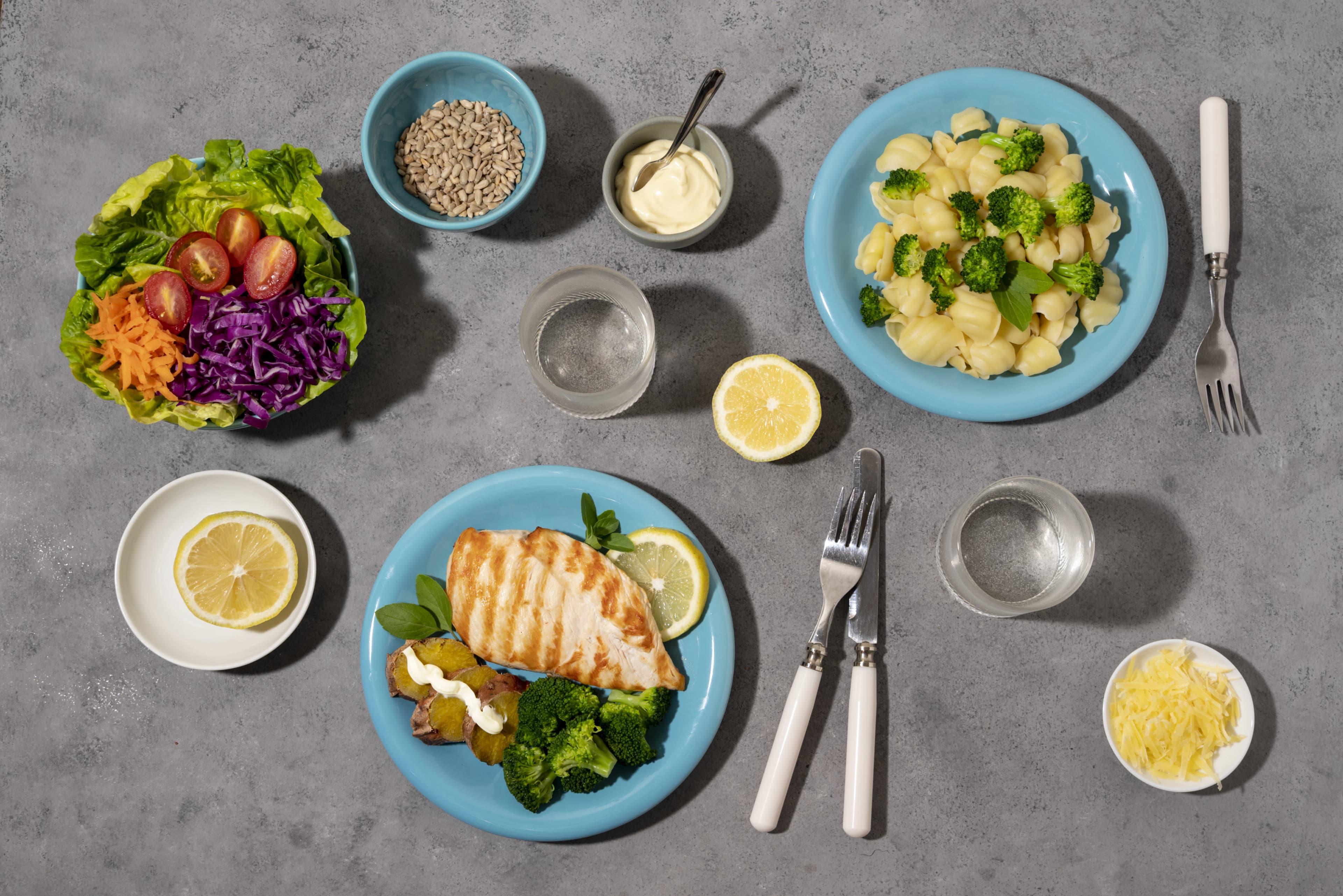
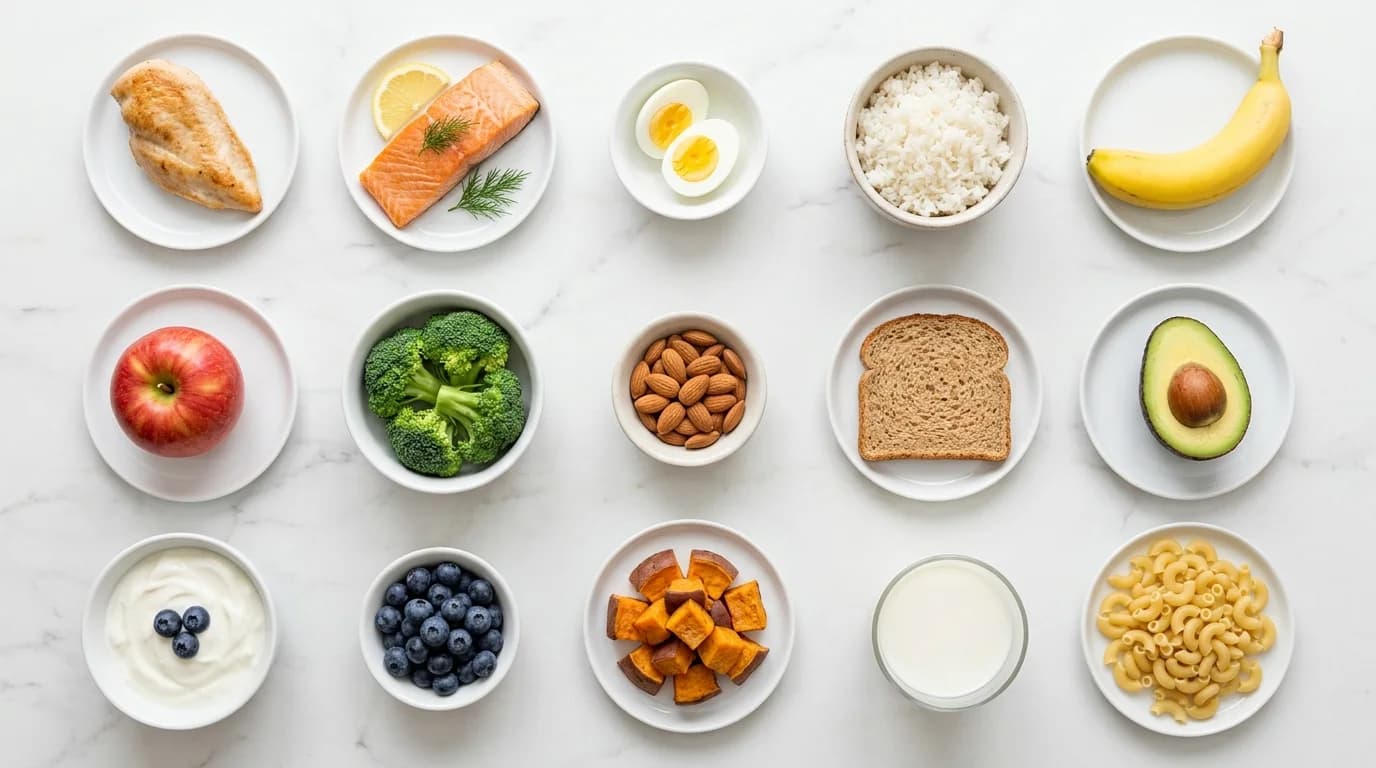
- ½ of your plate: vegetables or salad (non-starchy — greens, broccoli, peppers, tomatoes, cucumbers)
- ¼ of your plate: lean protein (chicken, fish, eggs, tofu, beans)
- ¼ of your plate: complex carbohydrates (brown rice, sweet potato, whole-grain bread, quinoa)
- A small addition: healthy fat — a drizzle of olive oil, a few slices of avocado, or a sprinkle of nuts
This naturally creates meals in the 400–600 calorie range without counting anything. The vegetables provide volume and fiber that fill your stomach. The protein keeps you satisfied for hours. The carbs provide sustained energy. The fat adds flavor and nutrient absorption.
The plate method works at home. It works at restaurants. It works at holiday dinners. And it requires exactly zero math — just a quick visual check of your plate before you eat.
For a deeper look at building macro-balanced meals, check our macro tracking guide.
7 Portion Mistakes That Add Hundreds of Hidden Calories
Even health-conscious eaters make these errors daily. Each one seems small in isolation, but they compound quickly.
1. Cooking Oils
A tablespoon of olive oil is 120 calories. Most people pour — not measure — their cooking oil, and a heavy-handed pour is easily 2–3 tablespoons. That's 240–360 calories added to your meal before you've even started cooking. Try using a spray bottle or measuring spoon until you can eyeball a tablespoon accurately.
2. Nut Butters
A true tablespoon of peanut butter is surprisingly small — about the size of your thumb tip. Spread it freely on toast and you're looking at 3–4 tablespoons: nearly 400 calories of peanut butter on a single piece of bread. Measure it once to calibrate your eyes.
3. "Healthy" Granola and Trail Mix
Granola averages 400–500 calories per cup. Trail mix runs 600–700 calories per cup. A handful that looks modest can easily be 300+ calories. These are calorie-dense foods marketed with a health halo — treat them as calorie-dense additions, not low-calorie snacks.
4. Cheese
A proper serving of cheese is about 1 oz — roughly the size of your thumb or a pair of dice. That's 100–120 calories. Most people slice or grate 2–3x that amount on sandwiches, salads, and pasta. Cheese adds up faster than almost any other food.
5. Rice and Pasta
A single serving of cooked rice or pasta is about the size of your fist. But when you cook a pot of rice and serve yourself, the average portion is 2–3 fists — doubling or tripling the calorie count from 200 to 400–600 calories. Measure your portions a few times to recalibrate what a serving actually looks like.
6. Salad Dressings
Two tablespoons of ranch dressing is 140 calories. Most restaurant salads come with 4–6 tablespoons — that's 280–420 calories of dressing alone. Suddenly your "light salad" is a 700-calorie meal. Ask for dressing on the side and dip your fork before each bite instead of pouring it over.
7. Smoothies
Blending masks portions. A smoothie can easily contain a banana, two cups of fruit, yogurt, milk, nut butter, and honey — totaling 600–800 calories in a single glass. Because you're drinking it, your brain doesn't register the same fullness as eating those ingredients whole. Build smoothies with a protein base and limit calorie-dense add-ins.
CalorieCue's AI scanning catches these portion traps automatically. Snap a photo of your meal and see the real calorie count — including the oils, dressings, and extras your eyes might underestimate.
Portion Control When Eating Out
Restaurants are where portion control goes to die. The economics of dining out incentivize oversized portions — customers feel they're getting "value" when plates arrive loaded with food. A typical restaurant entrée contains 1,000–1,500 calories, compared to the 400–600 you'd serve yourself at home.
Strategies that actually work:
- Box half before you start eating. Ask the server to bring a to-go container with your meal, or physically move half the food to one side of the plate and commit to stopping at the halfway point.
- Order appetizer portions as your main course. Many appetizers are actually closer to an appropriate serving size.
- Split an entrée. Share with a dining partner and order an extra side salad if you're still hungry.
- Avoid the bread basket. Not because bread is bad — because mindless pre-meal eating adds 200–400 calories before your actual food arrives.
- Use CalorieCue to scan your meal. Snap a photo of your restaurant plate and get an instant calorie estimate — it takes the guesswork out of eating out.
The goal isn't to obsess over every restaurant meal. It's to be aware that restaurant portions are systematically oversized — and to have a few simple strategies ready.
Portion Control vs. Calorie Counting: Which Is Better?
Both approaches work. They serve different needs.
Portion control is simpler and more intuitive. You use visual cues — hands, plates, eyeball estimates — to approximate appropriate amounts. There's no tracking app, no food scale, no logging. It's a lower-effort system that works well for people who want general guidance without daily data entry.
The trade-off is precision. Portion control can be off by 200–400 calories in either direction on any given day. For many people, that margin is fine — especially if they're consistent over time.
Calorie counting is more precise but requires more effort. You weigh, log, and track everything. This gives you hard data and tighter control — useful for specific goals, plateaus, or anyone who wants to understand exactly what they're consuming.
The best approach? Use portion control as your daily foundation, and use CalorieCue for spot-checks when precision matters. The hand method and plate method handle 90% of your meals. When you want to verify you're on track — or when you're eating something unfamiliar — snap a photo with CalorieCue and let the AI do the math.
If you want to explore whether calorie counting works for your goals, we break it down in detail.
Frequently Asked Questions
How do I control portions without measuring everything?
Use the hand method — your palm for protein, fist for carbs, thumb for fats, and two fists for vegetables. These visual references scale with your body size and require zero measuring tools. Combine this with the plate method (half veggies, quarter protein, quarter carbs) and you have a reliable system that takes seconds, not minutes.
What does a proper serving of rice, pasta, or meat look like?
A serving of cooked rice or pasta is about the size of your fist — roughly ¾ to 1 cup, or 150–200 calories. A serving of meat is the size and thickness of your palm — about 4 oz cooked, or 25–35g of protein. Most people eat 2–3x these amounts without realizing it.
Can I lose weight with portion control alone?
Yes. If your portions are consistently appropriate for your body's energy needs, you'll naturally create the calorie deficit required for weight loss — without counting a single calorie. Portion control is one of the simplest, most sustainable approaches to weight management.
How do I portion control at buffets?
Survey the full buffet before plating anything. Use a normal-sized plate, not a platter. Follow the plate method: fill half with vegetables or salad first, then add a palm-sized portion of protein and a fist-sized portion of carbs. Eat slowly, wait 15–20 minutes before considering seconds, and focus on the foods you genuinely enjoy rather than taking a bit of everything.
Is portion control the same as eating less?
Not exactly. Portion control means eating the right amount — not necessarily less food. In many cases, it actually means eating more vegetables and protein while reducing calorie-dense items you were over-serving. The goal is appropriate portions, not restriction.
The Bottom Line
Portion awareness is the most underrated skill in weight management. You can eat all the right foods and still overshoot your calories if the amounts are off. And you can enjoy all the foods you love — including the indulgent ones — if portions are kept in check.
You don't need to be perfect. Start with one method:
- The plate method if you want the simplest possible system — just look at your plate and aim for half veggies, quarter protein, quarter carbs
- The hand method if you want more precision without any tools — use your palm, fist, and thumb as built-in guides
Measure a few calorie-dense foods (oils, nut butters, cheese, rice) once or twice to recalibrate your eyes. After that, visual estimation gets remarkably accurate.
And for the moments when you want real numbers — when you're eating out, trying a new recipe, or checking your progress — let CalorieCue do the work. Snap a photo, get instant portion-accurate calorie estimates, and move on with your day.
Download CalorieCue