On this page
- Quick Answer
- Why Tracking Calories Works (The Research)
- Method 1 — AI Photo Scanning (Fastest)
- How It Works
- Accuracy
- Pros
- Cons
- Best For
- Method 2 — Database App with Manual Search (Most Common)
- How It Works
- Accuracy
- Pros
- Cons
- Best For
- Method 3 — Food Scale + Database App (Most Precise)
- How It Works
- Accuracy
- Pros
- Cons
- Best For
- Method 4 — Hand Portion Estimation (No Tools Needed)
- How It Works
- Accuracy
- Pros
- Cons
- Best For
- Method 5 — Paper Food Journal (Lowest Technology)
- How It Works
- Accuracy
- Pros
- Cons
- Best For
- Which Method Should You Use? (Decision Guide)
- 5 Tips That Make Any Tracking Method More Effective
- 1. Track as you eat, not hours later
- 2. Track beverages
- 3. Don't skip weekends
- 4. Measure cooking oils
- 5. Focus on weekly averages, not daily perfection
- Frequently Asked Questions
- How many calories should I track per day?
- How accurate does my calorie tracking need to be?
- How long should I track calories?
- Can I track calories without an app?
- What's the difference between tracking calories and tracking macros?
- Will tracking calories make me obsessive about food?
- Should I track calories if I'm doing intermittent fasting?
- Start Tracking Your Next Meal
Calorie tracking is the most evidence-based tool for weight management — and also the most commonly abandoned one.
Quick Answer
To track calories, set a daily target, choose a logging method you can repeat, estimate portions consistently, log meals before you forget, and review your weekly average instead of chasing perfect daily numbers.
A systematic review published in the Journal of the American Dietetic Association analyzed 22 studies and found that dietary self-monitoring is consistently associated with greater weight loss. People who track their food lose significantly more weight than those who don't. The science is clear.
So why do most people quit within two weeks?
Because the method matters as much as the act. Traditional calorie tracking — manually searching databases, guessing portions, tallying numbers by hand — takes 15–30 minutes per day. That level of friction kills consistency. And without consistency, tracking doesn't work.
This guide compares five methods of tracking calories, from the most precise to the most effortless. The goal isn't to find the "best" method in theory — it's to find the method you'll actually stick with for months. Because research on self-monitoring adherence consistently shows that tracking consistency predicts weight loss outcomes more than tracking precision.
Quick answer: The five main methods are AI photo scanning (fastest, good accuracy), database apps with manual search (most common, moderate accuracy), food scale plus database app (most precise, highest effort), hand portion estimation (no tools needed, rough accuracy), and paper food journaling (lowest technology, lowest adherence). For most people, AI photo scanning offers the best balance of accuracy and sustainability.
Why Tracking Calories Works (The Research)
Before we compare methods, it's worth understanding why tracking works — because it's not just about the numbers.
A 2021 meta-analysis published in Obesity Reviews found that digital self-monitoring of diet and physical activity produced statistically significant weight loss, with an average reduction of 2.87 kg compared to controls. The effect was driven by two mechanisms: awareness and accountability.
Awareness: Most people have no idea how many calories they actually eat. Research in the New England Journal of Medicine found that people underestimate their calorie intake by an average of 47%. Tracking closes this gap — once you see that your morning latte is 300 calories, you can't unsee it.
Accountability: The act of recording what you eat creates a feedback loop. You eat something → you log it → you see where you stand → you make better choices for the next meal. This loop is what behavioral scientists call self-regulation, and it's the core mechanism behind every successful weight loss intervention.
The question isn't whether to track — it's how to track in a way you'll actually sustain.
For more on whether calorie counting works and the science behind it, see our guide on does calorie counting actually work.
Method 1 — AI Photo Scanning (Fastest)
How It Works
Point your phone camera at your plate. The AI identifies the foods, estimates portion sizes, and calculates calories and macros instantly. The entire process takes about 3 seconds.
Accuracy
±10–15% for most meals. A 2024 study published in Nutrients evaluated AI-enabled food image recognition in commercial apps and found that automated food logging is approaching the accuracy of trained dietitians estimating from photos. AI performs best with clearly plated meals and struggles more with mixed dishes, heavily sauced foods, and foods where ingredients are hidden (like a burrito).
Pros
- Speed: 3 seconds per meal, 15 seconds per day total
- Low friction: No searching databases, no typing ingredient lists, no weighing food
- Sustainability: The lower the effort, the longer you'll stick with it. Research on self-monitoring burden shows that reducing tracking friction directly increases long-term adherence
- Works with complex meals: The AI estimates entire plates, not individual ingredients
- Learns your patterns: Apps like CalorieCue recognize repeat meals and improve over time
Cons
- Less precise than weighing food on a scale
- Accuracy depends on photo quality and plate visibility
- Struggles with packaged foods where the label would be more accurate
- Some AI apps are better than others — quality varies significantly
Best For
Most people. Especially anyone who has tried manual tracking and quit, anyone who eats diverse cuisines, and anyone who values consistency over laboratory-grade precision.
CalorieCue uses AI photo scanning as its primary tracking method — snap a photo and get instant calories and macros for your entire plate.
Download CalorieCueMethod 2 — Database App with Manual Search (Most Common)
How It Works
Open a food tracking app (MyFitnessPal, Cronometer, Lose It!, etc.), search for each food you ate, select the matching entry, and specify your portion size. Repeat for every item in the meal.
Accuracy
±15–25% for most users. The accuracy depends heavily on two factors: whether the database entry is correct (crowdsourced databases often contain errors) and whether you estimate your portion size accurately. A focused review published in JMIR mHealth found that while calorie tracking apps showed high consistency for simple foods like a banana (±3.5%), there were large inconsistencies for complex meals — particularly in fat and protein estimates.
Pros
- Large food databases (MyFitnessPal has 14M+ entries)
- Works well for packaged foods with barcodes
- Free tiers available on most apps
- Long track record — this method has decades of research supporting it
Cons
- Time-consuming: 3–10 minutes per meal depending on complexity
- Database errors: Crowdsourced entries are frequently wrong. Research published in Public Health Nutrition found that nutrition tracking apps systematically underestimate nutrients compared to research-grade software, making database accuracy a significant source of calorie tracking errors
- Portion guessing: Without a food scale, most people underestimate portions by 30–50%
- Decision fatigue: Choosing between 50 "chicken breast" entries gets exhausting
- High quit rate: The friction of manual logging is the #1 reason people stop tracking
Best For
People who eat a lot of packaged foods with barcodes, people who want maximum database coverage, and people willing to invest 15–30 minutes per day in tracking.
For a detailed comparison of the most popular tracking apps, see our best calorie tracker app guide.
Method 3 — Food Scale + Database App (Most Precise)
How It Works
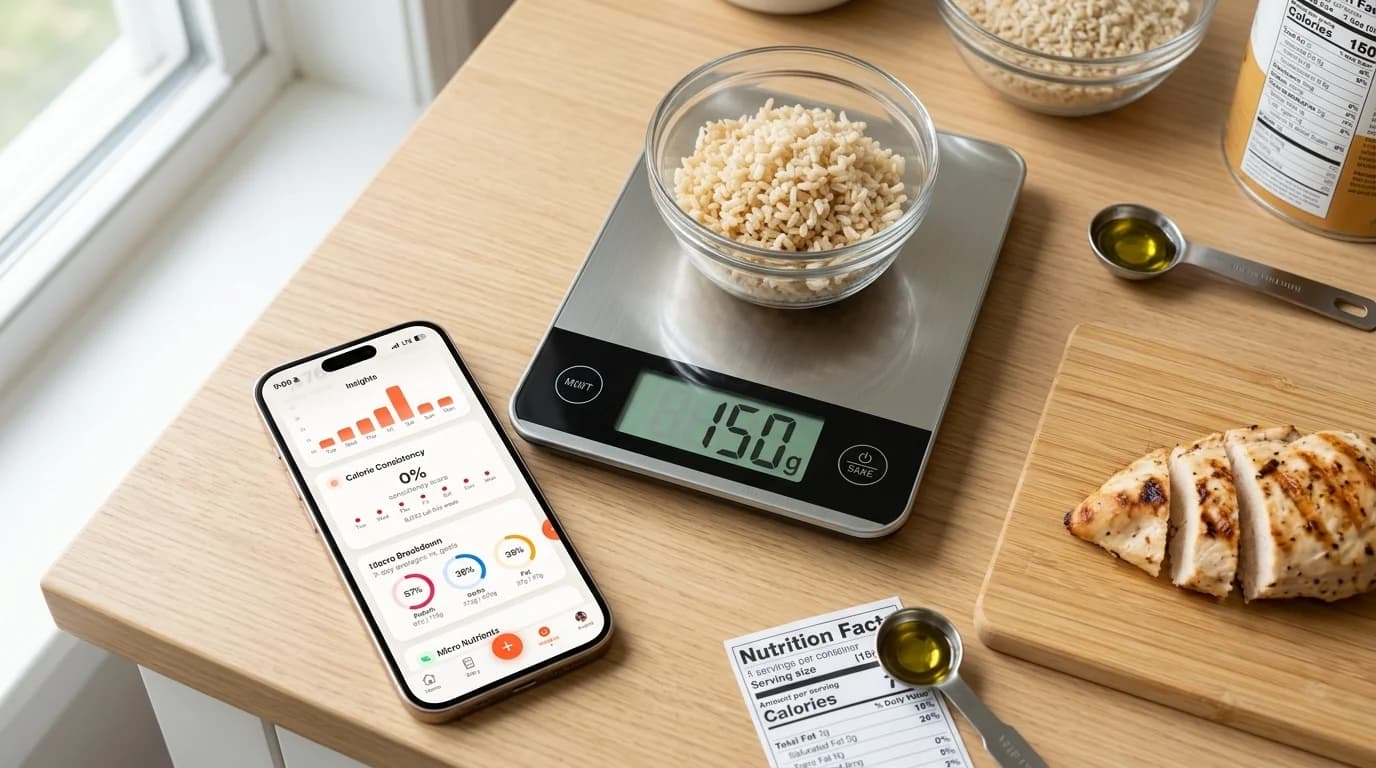
Weigh every food item on a digital kitchen scale before eating. Enter the exact weight in grams into a tracking app with a verified food database (Cronometer is the gold standard for verified data). Calculate calories based on precise weight.
Accuracy
±5% — the highest accuracy of any tracking method. When you know the exact weight and use a verified database entry, there's very little room for error.
Pros
- Most accurate method available to consumers
- Eliminates portion estimation error entirely
- Essential for competitive athletes, bodybuilders, and people preparing for physique competitions
- Verified databases (like Cronometer's) minimize database entry errors
Cons
- Very time-consuming: 5–15 minutes per meal including prep, weighing, and logging
- Impractical for eating out: You can't bring a food scale to a restaurant
- Highest quit rate: The precision comes at the cost of sustainability for most people
- Can foster obsessive behavior: For some people, weighing every gram crosses from helpful to unhealthy. See our guide on tracking calories without obsessing
Best For
Competitive athletes, bodybuilders in competition prep, people with medical conditions requiring precise intake (like kidney disease or diabetes), and anyone who genuinely enjoys the process.
Method 4 — Hand Portion Estimation (No Tools Needed)
How It Works
Use your hand as a built-in measuring tool:
- Your palm = 1 serving of protein (~150–200 cal)
- Your fist = 1 serving of carbs (~150–200 cal)
- Your thumb = 1 serving of fat (~100–120 cal)
- Two fists = 1 serving of vegetables (~50 cal)
Research from the University of Sydney's Boden Institute supports that hand-based portion estimation methods can effectively help people manage their food intake. The system works because hand size roughly scales with body size — larger people have larger hands and need larger portions.
Accuracy
±25–40%. This is the least precise method, but it requires zero tools and zero time. It gives you a rough calorie range rather than an exact number.
Pros
- No app, no scale, no technology required
- Takes zero extra time
- Works everywhere — restaurants, travel, social meals
- Good for maintenance once you've built awareness through more precise tracking
Cons
- Not precise enough for tight calorie deficits (300–500 cal)
- No data record — you can't review your week or identify patterns
- Requires prior knowledge of roughly how many "hand portions" you need per day
- Doesn't account for cooking oils, sauces, and hidden calories
Best For
People in the maintenance phase (after reaching their goal weight), people who find any form of tracking unsustainable, and as a backup method when your phone dies at a restaurant.
For a detailed breakdown of the hand method with visual guides, see our portion control guide.
Method 5 — Paper Food Journal (Lowest Technology)
How It Works
Write down everything you eat in a physical notebook. Optionally look up calorie values from a reference book or website and calculate totals manually.
Accuracy
Highly variable — depends entirely on your effort to look up accurate calorie data. Without calorie lookups, a food journal is just a record of what you ate, not how much energy it contained.
Pros
- No technology required
- The act of writing forces mindfulness about food choices
- Some people prefer the tactile experience of pen and paper
- No app subscriptions, no battery drain
Cons
- Slowest method — looking up calories manually is extremely tedious
- Most people stop within a week. A systematic review in Public Health Nutrition found that adherence to paper-based dietary tracking declines more rapidly than digital methods
- No automatic calculations, no weekly summaries, no macro tracking
- Error-prone — handwritten calorie math is frequently wrong
Best For
People who don't own smartphones (rare in 2026), people who want a mindfulness-focused eating practice without calorie numbers, and people who are tracking food quality rather than quantity.
Which Method Should You Use? (Decision Guide)
The honest answer: the method you'll actually use consistently.
A study published in Obesity found that tracking at least 5 days per week — regardless of method — was a significant predictor of weight loss success. Consistency matters more than precision. A rough daily estimate beats a perfect log three days a week.
Here's a simple decision framework:
Choose AI photo scanning if: You want the fastest possible tracking with good accuracy. You eat diverse foods and home-cooked meals. You've tried manual tracking and quit. You value your time.
Choose a database app if: You eat a lot of packaged foods with barcodes. You want the largest food database available. You don't mind spending 15–30 minutes per day tracking.
Choose a food scale if: You're a competitive athlete or bodybuilder. You need clinical-grade precision for a medical condition. You genuinely enjoy the process of weighing and measuring.
Choose the hand method if: You're in the maintenance phase after reaching your goal. You find all forms of tracking unsustainable. You want a rough framework with zero friction.
You can also combine methods: Use AI photo scanning for most meals, a food scale for recipes you make frequently (to calibrate your estimates), and the hand method when you're at a social event and don't want to pull out your phone.
For a step-by-step plan for your first week of tracking, see our 7-day quick start guide.
5 Tips That Make Any Tracking Method More Effective
These apply regardless of which method you choose:
1. Track as you eat, not hours later
Memory-based tracking is significantly less accurate. Research in the New England Journal of Medicine found that reliance on memory leads to 47% calorie underestimation. Log in real time or within a few minutes.
2. Track beverages
Liquid calories are the most commonly forgotten entries. A latte (300 cal), a juice (110 cal), and a beer (153 cal) add up to 563 untracked calories — enough to erase a moderate deficit. For more on this, see our calorie counting cheat sheet.
3. Don't skip weekends
Research in JMIR mHealth and uHealth shows that weekend overeating is one of the top predictors of stalled weight loss. Even rough weekend tracking is better than a weekend blackout.
4. Measure cooking oils
One tablespoon of oil = 119 calories. Most people pour 2–3 tablespoons without measuring. That's 240–360 invisible calories per meal that never make it into the log.
5. Focus on weekly averages, not daily perfection
One bad day doesn't determine outcomes — the weekly average does. If your target is 1,800 per day and you eat 2,200 on Saturday, eat 1,600 for two days and your weekly average is intact.
Frequently Asked Questions
How many calories should I track per day?
That depends on your body and goals. Use our free TDEE calculator to find your daily calorie burn, then subtract 300–500 calories for weight loss. For a full breakdown, see how many calories should I eat per day.
How accurate does my calorie tracking need to be?
Within 10–15% is good enough for weight loss. You don't need laboratory precision — you need consistent awareness of what you're eating. Even rough tracking is dramatically more effective than no tracking at all.
How long should I track calories?
Most people develop strong portion awareness after 2–3 months of consistent tracking. At that point, many transition to intuitive eating with occasional check-in weeks. Tracking is a learning tool, not a lifelong obligation.
Can I track calories without an app?
Yes — using the hand portion method or a paper journal. However, research consistently shows that digital tracking methods have higher adherence rates and produce better weight loss outcomes than paper-based methods, primarily because they reduce the effort required.
What's the difference between tracking calories and tracking macros?
Tracking calories means monitoring your total daily energy intake. Tracking macros means monitoring the breakdown of that energy into protein, carbohydrates, and fat. Macro tracking is more detailed and useful for body composition goals (building muscle while losing fat). Most calorie tracking apps, including CalorieCue, show both. For a complete guide, see how to count macros.
Will tracking calories make me obsessive about food?
For most people, no — it creates awareness, not anxiety. However, if you notice guilt, obsessive thoughts, or anxiety around eating, that's a signal to adjust your approach. Try the 80/20 method: track most meals but allow flexibility for social eating and off-days. For more on finding the balance, see how to track without obsessing.
Should I track calories if I'm doing intermittent fasting?
It depends on your results. Intermittent fasting controls when you eat; calorie counting controls how much. If you're losing weight on IF alone, tracking isn't required. But if you've stalled or want precise control over body composition, combining both is the fastest path forward. See our breakdown of intermittent fasting and calorie counting for when each tool is enough on its own and when you need both.
Start Tracking Your Next Meal
Every method in this guide works — when you use it consistently. The difference between the method that works and the method that doesn't is whether you're still using it two weeks from now.
If you've tried manual tracking and quit, that's not a failure of willpower — it's a signal that the method didn't fit your life. AI photo scanning exists specifically to solve this problem: reduce the friction to 3 seconds per meal so that tracking feels like nothing.
Your next meal is your starting point. Snap a photo. See your calories. Build the habit.
Download CalorieCueFor more on getting started, explore our beginner's guide to counting calories, our calorie counting cheat sheet, and our 7-day quick start guide.