On this page
- Do You Actually Need to Count Calories?
- What You Need Before You Start
- A calorie target
- A tracking method
- A realistic mindset
- The 4-Week Calorie Counting Kickstart Plan
- Week 1 — Just Observe (Don't Change Anything)
- Week 2 — Set Your Target and Make 1–2 Swaps
- Week 3 — Dial in Protein and Portions
- Week 4 — Build Consistency, Not Perfection
- 7 Tips That Make Calorie Counting 10x Easier
- 1. Log as you eat, not hours later
- 2. Use AI photo tracking
- 3. Meal prep for predictable calories
- 4. Round, don't obsess
- 5. Track weekends too
- 6. Front-load protein at breakfast
- 7. Don't drink your calories
- Common Beginner Mistakes
- 1. Starting with too aggressive a deficit
- 2. Only tracking "bad" meals
- 3. Ignoring cooking methods
- 4. Eating "zero-calorie" foods that aren't
- 5. Comparing your calories to someone else's
- Frequently Asked Questions
- How long should I count calories?
- Do I need a food scale?
- What's the easiest way to track calories?
- Should I count calories on weekends?
- Can I eat whatever I want as long as I'm in a deficit?
- How accurate does my calorie counting need to be?
- Start This Week, Not Monday
The first time I counted calories, I lasted exactly 3 days. I downloaded an app, obsessively searched for every ingredient in my lunch, spent 10 minutes logging a single meal, and burned out before the week was over.
The second time, I used a completely different approach — and it changed everything.
The difference wasn't willpower. It was strategy. Instead of trying to overhaul my eating overnight, I followed a gradual plan that built the habit in layers. And instead of manually searching a database for every bite, I used AI photo tracking that took 3 seconds per meal.
If calorie counting sounds tedious, complicated, or unsustainable — I get it. But modern tools have made it surprisingly simple. This guide gives you a 4-week plan that builds the habit gradually, so you don't burn out in week 1.
Do You Actually Need to Count Calories?
Not everyone needs to count calories — and that's perfectly okay.
Calorie counting works best for people who:
- Have unclear eating patterns — you genuinely don't know how much you're eating day to day
- Tend to underestimate intake — you eat "healthy" but the scale isn't moving
- Have specific weight goals — you want to lose, gain, or maintain a precise amount
- Have hit a plateau — you were making progress but it stalled
It's less ideal for people with a history of disordered eating. If tracking food triggers anxiety or obsessive behavior, working with a registered dietitian or therapist is a better path. There's no shame in that — calorie counting is one tool among many, not the only one.
For everyone else, calorie counting works — and it works well. The key is approaching it with the right mindset and the right method.
What You Need Before You Start
You don't need much to get started, but these three things make a real difference:
A calorie target
You need to know roughly how many calories to aim for. Use our free TDEE Calculator to find your Total Daily Energy Expenditure, then subtract 300–500 calories for a moderate calorie deficit. If you want a deeper walkthrough, check out our guide on finding your daily calorie target.
A tracking method
An app is the easiest option by far — it does the math for you and stores your history. Pen and paper or a spreadsheet work too, but they require more effort and are harder to maintain long term.
A realistic mindset
Perfection isn't the goal. Awareness is. You will forget to log meals. You will estimate portions wrong. You will have days where you go over your target. None of that means you've failed — it means you're learning.
What you do NOT need: a food scale (helpful but optional), special foods, a gym membership, or a nutrition degree. You can start with nothing more than your phone and your next meal.
The 4-Week Calorie Counting Kickstart Plan
This plan is designed to build the habit in stages. Each week adds one layer — so by week 4, tracking feels natural instead of forced.
Week 1 — Just Observe (Don't Change Anything)
This is the most important week, and the one most people skip.
For the next 7 days, track everything you eat — but don't try to hit a calorie target. Eat exactly as you normally would. The only goal is to log it.
Why? Two reasons:
- It removes pressure. When there's no target to hit, there's no way to "fail." You're just collecting data.
- It reveals your real baseline. Most people are genuinely surprised by what they discover — hidden calorie sources they never considered.
The things that surprise people most: cooking oils (a tablespoon of olive oil is 120 calories), drinks (a large latte is 250+ calories), sauces and dressings (ranch dressing adds 150 calories to a "healthy" salad), and mindless snacking (the handful of nuts while cooking, the few bites of your kid's leftovers).
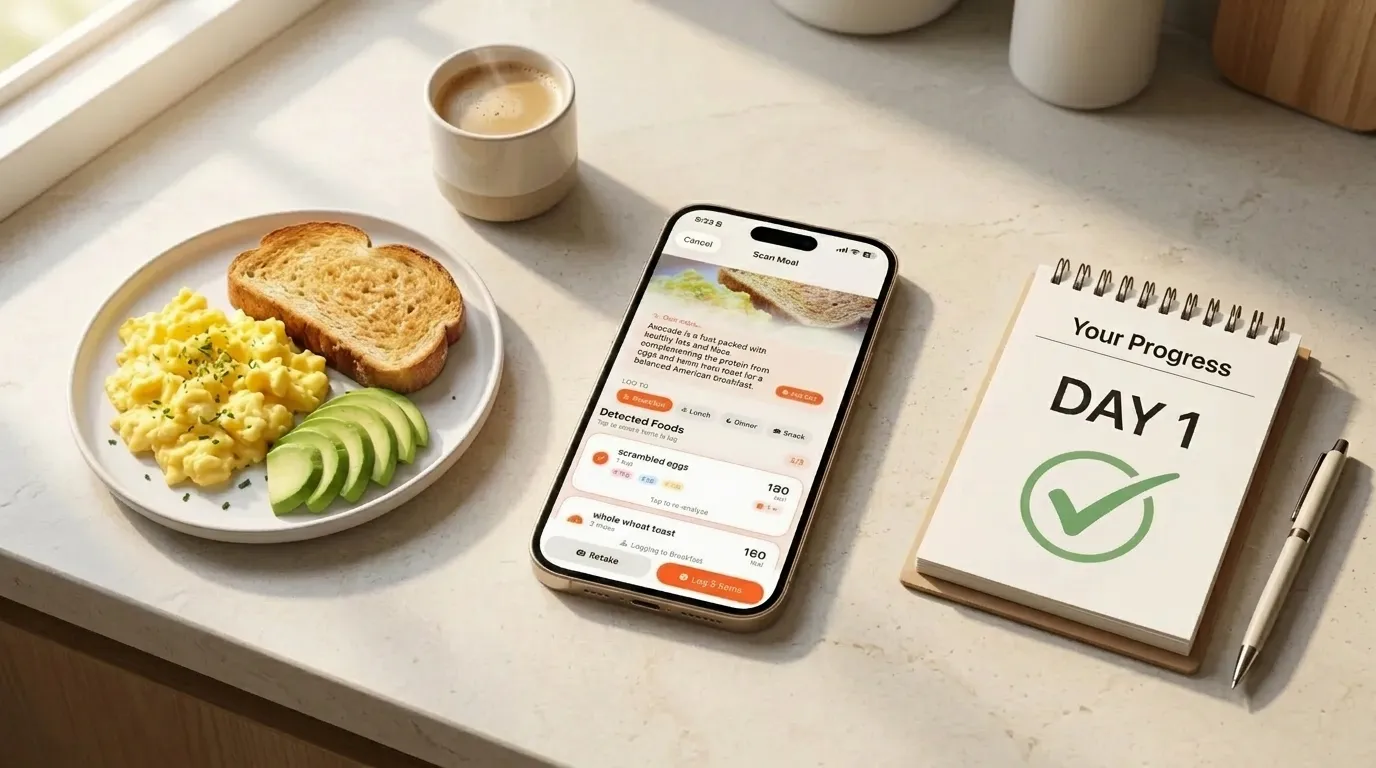
How to log: Snap a photo of every meal with CalorieCue. It takes 3 seconds — no searching, no manual entry. Just photograph and move on. At the end of the week, you'll have a complete picture of your real eating habits.
Don't judge what you see. Just observe.
Week 2 — Set Your Target and Make 1–2 Swaps
Now you know your baseline. Time to set a direction.
Take your TDEE and subtract 300–500 calories for a moderate deficit. This is your daily target — not a hard ceiling, but a general aim.
Here's the key: don't overhaul your entire diet. Pick just 1–2 high-calorie habits from your Week 1 data and make simple swaps:
- Swap sugary coffee for black coffee — save 200+ calories per drink
- Swap chips for popcorn as an afternoon snack — save 150 calories
- Use cooking spray instead of pouring oil — save 200+ calories per meal
- Swap soda for sparkling water — save 150–250 calories per drink
- Use mustard instead of mayo on sandwiches — save 100+ calories
These aren't dramatic changes. They're painless swaps that bring you closer to your target without feeling deprived. Keep tracking everything — the numbers will start to shift.
Week 3 — Dial in Protein and Portions
By week 3, you'll have two weeks of data showing your patterns. Now it's time to fine-tune.
Focus on protein first. Most people don't eat enough of it. Aim for 0.7–1g of protein per pound of body weight. Protein keeps you full longer, preserves muscle during a deficit, and has a higher thermic effect (your body burns more calories digesting it). For a deeper dive, check out our guide on tracking macros.
Then look at portions. Use your tracking data to find where you consistently overshoot. Maybe your dinner portions are too large, or your snacks are adding up more than you realized. You don't need to measure everything — just adjust the areas where the data shows consistent overshooting. Our portion control guide has visual references that make estimating easier.
Use CalorieCue's macro breakdown to check your protein, carbs, and fat distribution. You'll start to see patterns — meals that fill you up for hours vs. meals that leave you hungry an hour later.
Week 4 — Build Consistency, Not Perfection
You're not aiming for a flawless week. You're aiming for 5 out of 7 days logged.
That's the threshold where tracking becomes a habit rather than a chore. Here are the rules for week 4:
- Missed a meal? Log the next one. Don't retroactively try to reconstruct what you ate — just pick up where you left off.
- Had a bad day? Don't compensate the next day by eating dramatically less. Just return to your normal target.
- Going out to eat? Estimate and move on. A rough log is infinitely better than no log.
At the end of week 4, review your weekly averages, not daily numbers. Daily calorie intake naturally fluctuates — that's normal. What matters is whether your weekly average is roughly in line with your target.
If you've made it through 4 weeks of consistent tracking, congratulations — you've built the habit. Most people who make it past the first month continue successfully long term.
The 80% rule: If you're logging at least 80% of your meals, you're getting enough data to make progress. Don't let the occasional missed entry derail your entire effort.
7 Tips That Make Calorie Counting 10x Easier
1. Log as you eat, not hours later
Memory is unreliable. By the end of the day, you'll forget the cooking oil, the handful of nuts while cooking, the bite you took off your partner's plate. Log each meal within a few minutes of eating it — or better yet, snap a photo before your first bite.
2. Use AI photo tracking
Searching databases manually is the #1 reason people quit calorie counting. It's slow, tedious, and kills motivation. AI food scanning eliminates this entirely — photograph your meal and get an instant breakdown. The speed difference is the difference between a habit that sticks and one that doesn't.
3. Meal prep for predictable calories
When you eat similar meals throughout the week, you only need to log once and repeat. Meal prep doesn't mean eating chicken and broccoli 7 days straight — it means having 3–4 go-to meals with known calorie counts, so you're not starting from scratch every day.
4. Round, don't obsess
1,847 calories and 1,850 calories are the same thing. Don't weigh your broccoli to the gram or agonize over whether that apple was medium or large. Directional accuracy matters. Decimal-point precision doesn't.
5. Track weekends too
The 5-day-perfect, 2-day-chaotic pattern is the most common reason calorie deficits fail. A 500-calorie deficit on weekdays means nothing if Saturday and Sunday add 1,500 extra calories. You don't need to be strict on weekends — just aware. Log your meals, check the total, and make it work within your weekly average. If you're frustrated with stalled progress, this is often the culprit — read more about common weight loss stalls.
6. Front-load protein at breakfast
A high-protein breakfast (30–40g of protein) reduces hunger and cravings for the rest of the day. Eggs, Greek yogurt, cottage cheese, or a protein smoothie — any of these set you up to eat less later without trying. It's one of the easiest "hacks" that actually works.
7. Don't drink your calories
Liquid calories are easy to forget and surprisingly significant. A large mocha is 400+ calories. A glass of orange juice is 110. Two beers are 300+. Track beverages as diligently as food — they're often the hidden gap between your target and your actual intake.
Common Beginner Mistakes
1. Starting with too aggressive a deficit
Cutting 1,000+ calories from day one feels motivated — for about 72 hours. Then the hunger kicks in, energy crashes, cravings spike, and you end up bingeing. A moderate deficit of 300–500 calories is sustainable. Aggressive deficits are not.
2. Only tracking "bad" meals
Some people skip logging when they eat "healthy" meals, assuming those don't need tracking. But a large salad with avocado, nuts, cheese, and olive oil dressing can easily hit 800+ calories. You need the full picture, not just the meals you're suspicious of.
3. Ignoring cooking methods
A grilled chicken breast and a deep-fried chicken breast start with the same base — but the fried version has 300+ more calories. How food is prepared matters as much as what the food is. Pay attention to oils, batters, sauces, and cooking fats.
4. Eating "zero-calorie" foods that aren't
Cooking sprays list "0 calories" per serving — but a serving is a 1/3-second spray. A realistic spray is 5–10 servings (50–100 calories). Similarly, black coffee is near-zero, but the cream and sugar you add aren't. Read labels carefully and track what you actually consume, not the marketing.
5. Comparing your calories to someone else's
Your daily calorie target is based on your body size, activity level, age, and goals. A 6'2" active man and a 5'4" sedentary woman have wildly different needs. Seeing someone else eat 2,500 calories and lose weight doesn't mean you can too. Stick to your numbers. For more on breaking patterns that hold you back, see our guide on overeating habits.
If you are tempted to rush the process, review the trade-offs in our fast-weight-loss guide before choosing a more aggressive target.
Frequently Asked Questions
How long should I count calories?
Most people benefit from 2–3 months of consistent tracking to build solid awareness of portion sizes and calorie content. After that, many can estimate accurately without logging every meal. Some prefer to track indefinitely as a maintenance tool, while others cycle on and off. There's no single right answer — count for as long as it's helping you, and take a break if it starts feeling counterproductive.
Do I need a food scale?
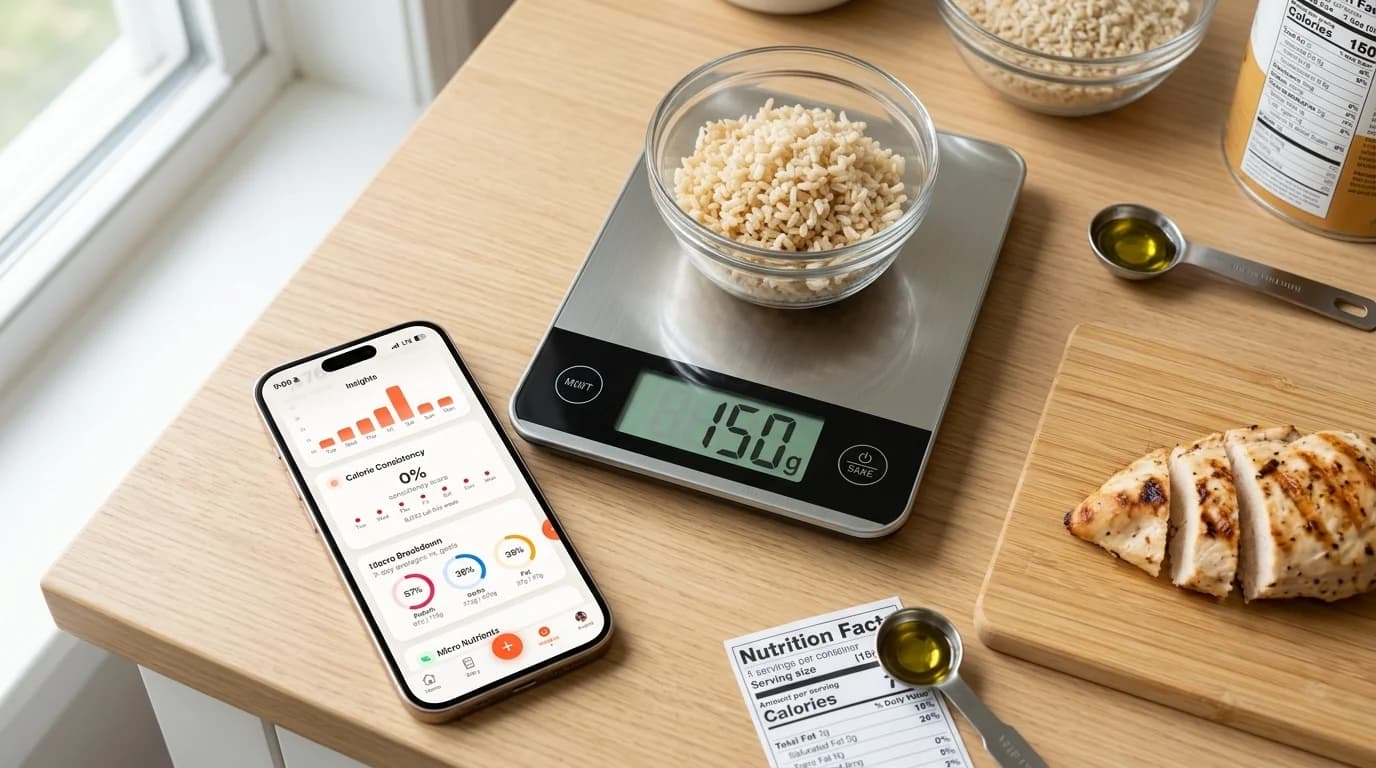
No — especially not when you're starting out. Visual portion estimates (a palm for protein, a fist for carbs, a thumb for fats) get you within 80–90% accuracy. If you hit a plateau after several weeks, a food scale can help you spot where your estimates are off. But don't let not having one stop you from starting today.
What's the easiest way to track calories?
AI photo tracking. Snap a picture, get your calories and macros instantly. No database searches, no manual entry, no reading labels. CalorieCue is built around this — it takes 3 seconds per meal and eliminates the friction that makes people quit.
Should I count calories on weekends?
Yes. Weekends are where most deficits fall apart. People consistently underestimate weekend intake by 30–50%. You don't need to be as rigid — but logging your meals gives you the awareness to make informed choices instead of blind ones.
Can I eat whatever I want as long as I'm in a deficit?
Technically, a deficit is a deficit. But food quality affects how you feel. 1,800 calories of whole foods will keep you full, energized, and nourished. 1,800 calories of processed snacks will leave you hungry, tired, and craving more. Aim for 80% nutrient-dense foods, 20% whatever you enjoy.
How accurate does my calorie counting need to be?
Within 10–20% is good enough. Even nutrition labels have a legal 20% margin of error. Consistent, rough tracking will always beat perfect tracking that lasts three days. Focus on logging every meal — even if the numbers aren't exact — rather than getting the numbers perfect but only sometimes.
Start This Week, Not Monday
Calorie counting doesn't need to be complicated, obsessive, or permanent. It's a skill — and like any skill, it gets easier with practice.
Here's your entire action plan:
- Week 1: Observe and log everything without trying to change anything
- Week 2: Set your target and make 1–2 simple swaps
- Week 3: Optimize protein and adjust problem portions
- Week 4: Build consistency — aim for 5 of 7 days logged
The right tool removes 90% of the friction. When logging a meal takes 3 seconds instead of 3 minutes, the habit practically builds itself.
Start your Week 1 today — download CalorieCue free and snap your first meal.
Download CalorieCue