On this page
- When Calorie Counting Becomes a Problem
- The 80/20 Tracking Method
- 6 Rules for Sustainable Calorie Tracking
- 1. Set a Range, Not an Exact Number
- 2. Never Compensate for "Bad" Days
- 3. Keep Social Meals Sacred
- 4. Use the Simplest Logging Method Available
- 5. Take Tracking Breaks
- 6. Know When to Stop
- CalorieCue's Approach: Track in 3 Seconds, Not 3 Minutes
- Calorie Counting vs. Intuitive Eating: Do You Have to Choose?
- Frequently Asked Questions
- Is calorie counting bad for mental health?
- Can calorie counting cause eating disorders?
- How long should I count calories before stopping?
- What if I can't track accurately at restaurants?
- Is it okay to skip tracking some days?
- How do I know if calorie counting is becoming unhealthy for me?
- Track to Learn. Stop When You've Learned Enough.
Here's something most calorie tracking apps won't tell you: the goal isn't to count calories forever. It's to learn enough about your eating patterns that you eventually don't need to.
That might sound strange coming from an app that helps you track calories. But it's the truth — and it's the difference between a healthy relationship with tracking and an obsessive one.
Let's be honest: calorie counting CAN become obsessive. That's a real risk, and anyone who dismisses it isn't being straight with you. But obsessive tracking isn't caused by tracking itself. It's caused by a rigid, perfectionistic approach to tracking — the kind where every gram matters, every number must be exact, and going 50 calories over your target feels like a failure.
There's a better way. A sustainable framework that gives you the benefits of tracking — awareness, control, results — without the downsides: anxiety, rigidity, and food guilt.
When Calorie Counting Becomes a Problem
Before we talk about healthy tracking, let's name what unhealthy tracking looks like. You might have crossed the line if:
- You refuse to eat anything you haven't pre-logged. Spontaneous meals feel impossible because you "can't track them properly."
- You feel anxiety or guilt when you go over your target. A number on a screen controls your emotional state.
- You avoid social meals. Dinner with friends feels stressful because you can't weigh or measure what's on your plate.
- You weigh every gram and panic about imprecision. The difference between 142g and 150g of chicken keeps you up at night.
- Your mood is dictated by whether you're "on track." A good day means hitting your number. A bad day means exceeding it.
If some of these sound familiar, this post offers a healthier framework. But if tracking causes genuine distress — if it's triggering disordered eating patterns or making you miserable — please speak with a professional. There's no shame in that. Calorie counting is one tool among many, and it's not the right tool for everyone.
The core distinction is this: there's a difference between being aware of what you eat and being controlled by what you eat. Awareness is empowering. Control is exhausting.
The 80/20 Tracking Method
The philosophy is simple: track to learn, not to control.
Here's what that looks like in practice:
- Track 80% of the time. Take weekends off, or skip logging on social occasions. You don't need a perfect record — you need enough data to see patterns.
- Aim for plus or minus 100 calories, not exact numbers. 1,750 and 1,850 are the same result over time. Stop chasing precision that doesn't matter.
- Log meals, not individual ingredients. "Chicken stir-fry with rice" is good enough. You don't need to weigh each vegetable separately.
- Use weekly averages, not daily scores. One day over your target doesn't matter if the week balances out. Your body doesn't reset at midnight.
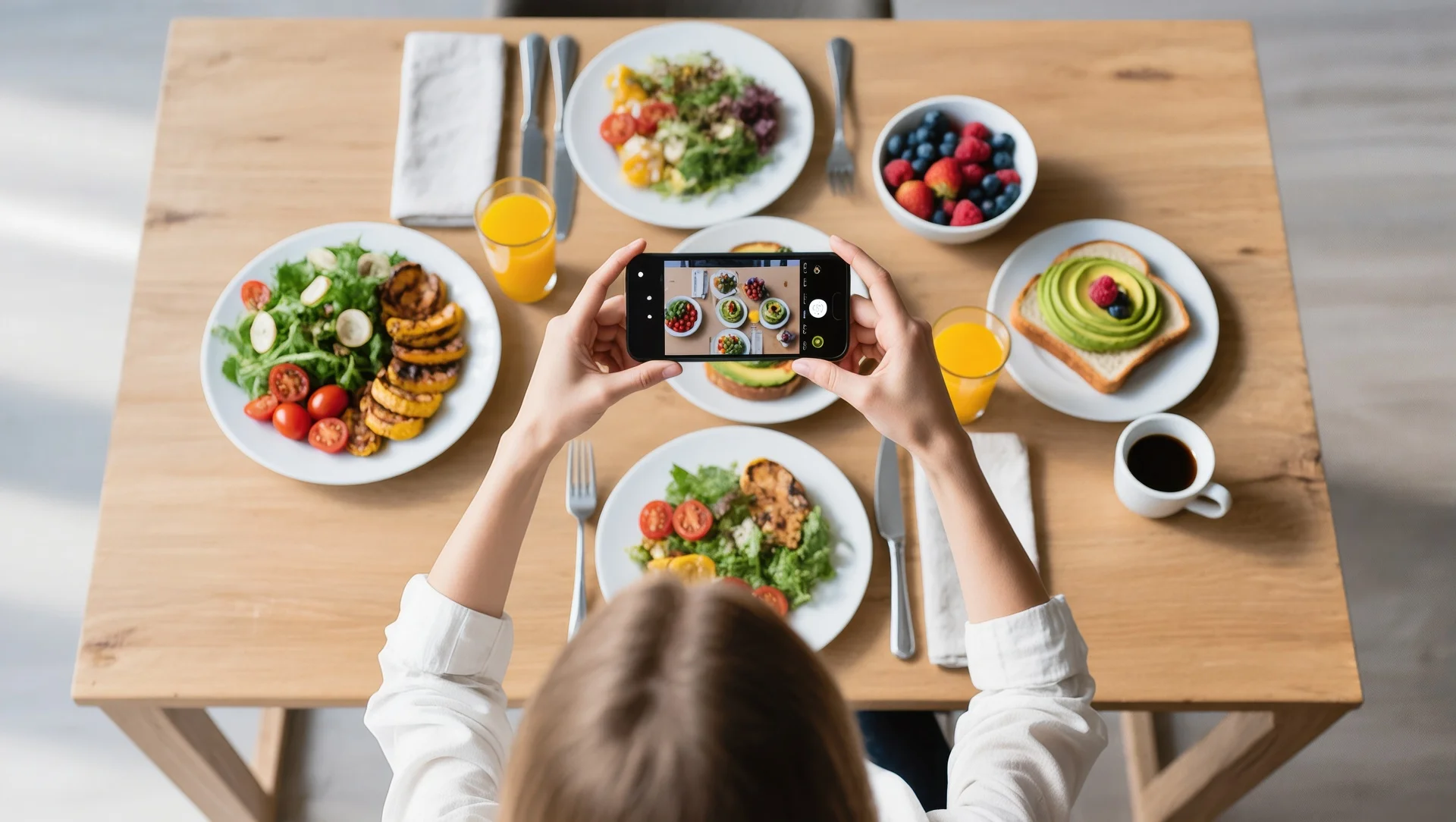
This is where CalorieCue's photo-based approach makes a real difference. Snap a photo of the full plate, get an estimate, and move on with your life. No searching through databases, no weighing portions, no stress. The entire process takes 3 seconds — which means tracking barely registers as a task in your day.
CalorieCue is built for this approach. Quick photo, instant estimate, zero tedium. See how AI photo tracking works.
6 Rules for Sustainable Calorie Tracking
1. Set a Range, Not an Exact Number
Instead of "1,800 calories today," target 1,700–1,900.
Ranges eliminate the pass/fail mentality that causes anxiety. When your target is a single number, you either hit it (success) or miss it (failure). When your target is a range, you're almost always within it — because that's how ranges work.
Your body doesn't operate on exact 24-hour cycles anyway. Hormones, activity, sleep, and stress all influence your energy needs from day to day. Weekly trends matter far more than daily totals. If you don't know where to start, our guide on finding your daily calorie range walks through the math.
2. Never Compensate for "Bad" Days
Ate 2,500 instead of 1,800? Log it honestly and move on.
Don't eat 1,100 the next day to "make up for it." This creates restriction/binge cycles — you under-eat, then you're starving, then you overeat, then you feel guilty, then you restrict again. It's a trap, and it's one of the fastest paths to an unhealthy relationship with food.
One day does not determine your results. Thirty days does. A single 700-calorie overshoot spreads out to just 100 extra calories per day over a week — barely noticeable in the bigger picture. If overeating is a recurring pattern rather than an occasional blip, our guide on breaking the restriction-binge cycle can help.
3. Keep Social Meals Sacred
Out with friends? Eat mindfully, but don't pull out your phone to log every bite.
Food is social, cultural, and emotional — not just fuel. The person photographing and weighing every item at a dinner party isn't building a healthy habit. They're building a cage.
Estimate afterward if you want. "That dinner was probably around 800 calories." Log that rough number and move on. A ballpark estimate entered after the fact is infinitely better than ruining a meal with anxiety about precision.
4. Use the Simplest Logging Method Available
Here's a pattern most people don't recognize: the more friction in tracking, the more mental energy it consumes, and the more obsessive it feels.
Manual database searching — scrolling through hundreds of options to find "chicken breast, grilled, skinless, 4 oz" — is high friction. It takes 3–5 minutes per meal. It dominates your headspace. It turns every eating occasion into a data entry task.
AI photo scanning is low friction. Point, snap, done. Three seconds. When logging takes less time than unlocking your phone, it stops feeling like an obligation and starts feeling effortless. That difference in friction is the difference between tracking that dominates your thoughts and tracking you barely notice.
This is why CalorieCue's approach is fundamentally different from older tracking apps. It's not just faster — it's psychologically lighter.
5. Take Tracking Breaks
After 4–8 weeks of consistent tracking, take a 1–2 week break.
You'll be surprised how much portion awareness you've internalized. After a month of seeing calorie estimates for your regular meals, you'll naturally start eyeballing portions more accurately — even without the app open.
If your weight stays stable during the break, congratulations — you've learned what you needed to learn. You've built the internal awareness that tracking was designed to develop.
You can always resume if you need to dial things in again. Tracking isn't all-or-nothing. It's a tool you pick up when it's useful and put down when it's not.
6. Know When to Stop
Calorie counting is a learning tool, not a lifestyle sentence.
Most people need 3–6 months of tracking to develop lasting portion awareness. After that, the skill is internalized. You know what 500 calories looks like on a plate. You know which meals keep you full and which leave you hungry an hour later. You know your patterns.
Signs you're ready to stop tracking:
- You can eyeball portions with reasonable accuracy
- You know roughly what a day of eating "looks like" in calories
- You can maintain your weight without logging
- Tracking feels redundant rather than informative
When you reach that point, put the app down. You've graduated.
CalorieCue's Approach: Track in 3 Seconds, Not 3 Minutes
Most tracking-related anxiety comes from the process being tedious.
When logging takes 3–5 minutes per meal — database searching, portion selecting, manual entry — it dominates your headspace. Three meals plus two snacks means 15–25 minutes per day spent on data entry. That's enough mental energy to make tracking feel like a second job.
CalorieCue was designed to reduce tracking to a single action: snap a photo. Photo, AI identification, calorie and macro estimate — done. No database searching. No portion weighing. No scrolling through 50 results to find the right "chicken breast" entry.
The less time you spend tracking, the less it takes over your thoughts. And the less it takes over your thoughts, the healthier your relationship with it stays.
Try CalorieCue free for 7 days — track your meals in seconds, not minutes. See the difference low-friction tracking makes.
Calorie Counting vs. Intuitive Eating: Do You Have to Choose?
Short answer: no. They're not opposites — they're a spectrum.
Intuitive eating means listening to your body's hunger and fullness cues to guide how much you eat. Calorie counting means using external data to guide how much you eat. They sound contradictory, but they actually work together.
Here's how: calorie counting builds the awareness that intuitive eating relies on. Most people can't "eat intuitively" because they have no baseline — they don't know what appropriate portions look like, so their intuition is miscalibrated. Tracking recalibrates it.
The best approach for most people: use tracking as training wheels, then remove them when you've built the skill. Start by counting to learn your patterns. Once you understand your portions, your calorie-dense triggers, and your hunger rhythms, transition to intuitive eating with that knowledge as your foundation.
Neither approach works if it makes you miserable. Sustainability matters more than methodology. If you want to understand how calorie counting delivers results, we've broken down the research — but only pursue it if it works for your life, not against it.
Frequently Asked Questions
Is calorie counting bad for mental health?
Not inherently. Calorie counting is a neutral tool — how you use it determines its impact. A flexible, range-based approach supports healthy habits without creating anxiety. However, if you have a history of disordered eating or find that tracking triggers obsessive thoughts, it may not be the right tool for you. The key is using a low-friction method, targeting ranges instead of exact numbers, and being willing to take breaks or stop entirely if it stops serving you.
Can calorie counting cause eating disorders?
Calorie counting does not cause eating disorders — eating disorders are complex mental health conditions with genetic, psychological, and environmental factors. However, rigid, perfectionistic tracking can reinforce harmful patterns in people who are already predisposed. If you notice signs like refusing to eat untracked food, extreme anxiety about exceeding your target, or compensating for "bad" days with restriction, step back and speak with a healthcare professional. Healthy tracking should feel informative, not controlling.
How long should I count calories before stopping?
Most people develop solid portion awareness after 3–6 months of consistent tracking. Signs you're ready to stop: you can eyeball portions accurately, you know roughly what a day of eating "looks like" in calories, and you can maintain your weight without logging. Some people prefer to track indefinitely as a light maintenance tool, while others cycle on and off. There's no fixed timeline — stop when you've learned what you need to learn.
What if I can't track accurately at restaurants?
You don't need to. Estimate afterward — "that was probably around 800 calories" — and move on. A rough estimate is infinitely more useful than no entry at all. Over time, your estimates will improve as your portion awareness develops from regular tracking. Don't avoid social meals because you can't log perfectly — that's exactly the kind of rigidity this approach avoids.
Is it okay to skip tracking some days?
Absolutely. In fact, intentionally skipping some days is part of a healthy approach. The 80/20 method — tracking most of the time but taking breaks on weekends, social occasions, or holidays — prevents tracking from becoming rigid or all-consuming. What matters is your weekly and monthly patterns, not whether every single day is logged.
How do I know if calorie counting is becoming unhealthy for me?
Watch for these signs: refusing to eat anything you haven't pre-logged, anxiety or guilt when you exceed your target, avoiding social meals because you can't track accurately, your mood being dictated by your daily numbers, or spending excessive time planning and logging food. If tracking is creating more stress than it's relieving, take a break. A healthy relationship with tracking means it serves you — not the other way around.
Track to Learn. Stop When You've Learned Enough.
Calorie tracking should give you more freedom, not less. It should make eating easier, not harder. It should answer questions about your diet, not create anxiety about every meal.
The right approach — flexible, range-based, forgiving — and the right tool — fast, simple, no-hassle — make all the difference. Track to learn. Adjust to grow. And stop when you've learned enough.
If you're ready to try tracking the way it should be done — quick, effortless, and completely free of tedium — CalorieCue's 7-day free trial is waiting.
Download CalorieCue