On this page
- How many grams is 100 calories?
- What 100 calories looks like: 40 everyday foods
- Fruit
- Vegetables and potatoes
- Grains, bread and snacks
- Protein foods
- Dairy
- Nuts, fats and chocolate
- Want this on one page?
- Why 100 calories can weigh 11g or 667g
- Four 100-calorie snack combinations
- How to work out 100 calories of any food
- Avoid these 100-calorie portion mistakes
- Log the meal, then check the portion
- Sources and calculation method
- Frequently asked questions
- How many grams is 100 calories?
- What does 100 calories of fruit look like?
- What is a good 100-calorie snack?
- Why is 100 calories of oil so small?
- Should I weigh food raw or cooked for these portions?
- How do I work out 100 calories from a nutrition label?
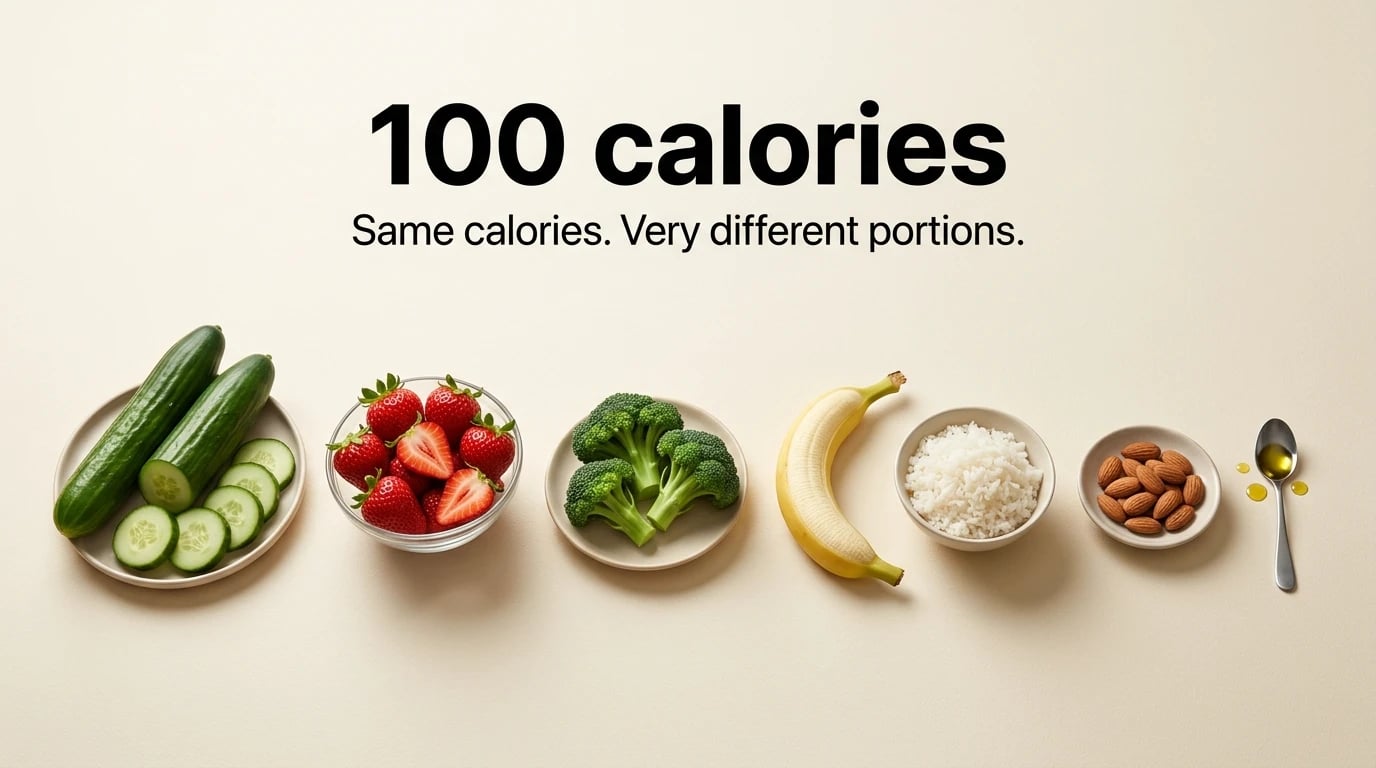
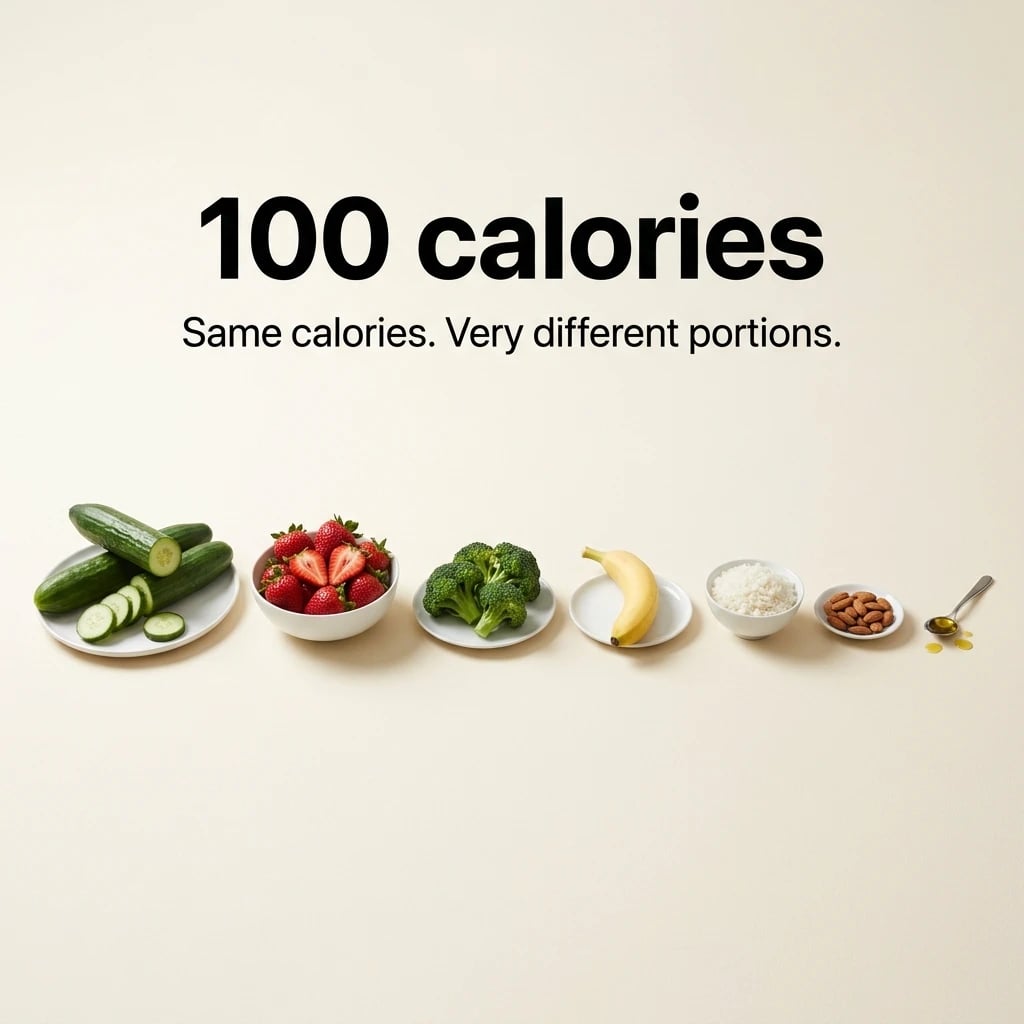
100 calories is about 667g of raw cucumber, 313g of strawberries, 112g of banana, 77g of cooked white rice, 61g of roasted chicken breast, 17g of almonds or 11g of olive oil. The same number of calories can fill a large bowl or barely cover a spoon.
That gap is the useful part. Once you can picture 100-calorie portions of the foods you eat often, you can estimate a plate faster and see where most of a meal's calories come from.
Below, you can compare 40 everyday foods by weight and household measure, see why the portions differ so much, try four 100-calorie snack combinations, and work out 100 calories for any food from its label.
Nutrition references checked October 25, 2026 against USDA FoodData Central's SR Legacy dataset. Values are reference averages, not measurements of your food. Household measures are approximate guides; the gram weights are the calculation basis.
How many grams is 100 calories?
There is no single answer, because calories come from the protein, carbohydrate, fat and alcohol in a food, not from its total weight. In their pure form, each reaches 100 calories at a different weight:
| Energy source | Calories per gram | Grams for 100 calories |
|---|---|---|
| Protein | 4 | 25g |
| Carbohydrate | 4 | 25g |
| Fat | 9 | 11.1g |
| Alcohol | 7 | 14.3g |
Real food is never pure protein or pure fat. It also contains water, fiber and minerals, which add weight but few or no calories. That is why 100 calories of strawberries weighs more than 300g, while 100 calories of almonds weighs 17g. For the full 4-4-9-7 explanation, see our calories per gram guide.
What 100 calories looks like: 40 everyday foods
Each portion below provides about 100 calories for the listed food only. Oil, butter, dressing, sauce and toppings are extra. Grams are rounded to the nearest gram and ounces to one decimal place.
Use grams as your reference. Cups and "medium" sizes are rough orientation cues: produce varies in size, and chopped food packs differently in a cup.
Fruit
| Food (state) | 100 calories | Ounces | Roughly |
|---|---|---|---|
| Watermelon (raw) | 333g | 11.7 oz | About 2¼ cups diced |
| Strawberries (raw) | 313g | 11.0 oz | About 2 cups halved |
| Orange (raw, peeled) | 213g | 7.5 oz | About 1½ medium oranges |
| Apple (raw, with skin) | 192g | 6.8 oz | 1 medium-large apple |
| Blueberries (raw) | 175g | 6.2 oz | A little over 1 cup |
| Mango (raw) | 167g | 5.9 oz | About 1 cup pieces |
| Grapes (raw) | 145g | 5.1 oz | About 1 cup (roughly 30 grapes) |
| Banana (raw, peeled) | 112g | 4.0 oz | Just under 1 medium banana |
Watery fruit gives the largest portions. Banana is denser, so 100 calories is a little less than one fruit. Weigh fruit after removing peel, pits and cores, because the values describe the edible part only.
Vegetables and potatoes
| Food (state) | 100 calories | Ounces | Roughly |
|---|---|---|---|
| Cucumber (raw, with peel) | 667g | 23.5 oz | About 2 large cucumbers |
| Broccoli (raw) | 294g | 10.4 oz | About 3¼ cups chopped |
| Carrots (raw) | 244g | 8.6 oz | About 4 medium carrots |
| Sweet potato (baked in skin, flesh only) | 111g | 3.9 oz | About 1 medium sweet potato |
| Potato (baked, flesh and skin) | 108g | 3.8 oz | About ⅔ of a medium potato |
Most non-starchy vegetables are so low in calories that the portion becomes larger than you would usually eat in one sitting. Potatoes and sweet potatoes are starchier, so 100 calories is closer to a single side serving. The values are for plain baked potatoes; butter, sour cream or frying oil add their own calories.
Grains, bread and snacks
| Food (state) | 100 calories | Ounces | Roughly |
|---|---|---|---|
| White rice (long-grain, cooked) | 77g | 2.7 oz | About ½ cup cooked |
| Pasta (cooked) | 63g | 2.2 oz | A scant ½ cup cooked |
| Whole-wheat bread | 40g | 1.4 oz | About 1 large slice; check your label |
| Rolled oats (dry) | 26g | 0.9 oz | About ⅓ cup dry |
| Popcorn (air-popped, plain) | 26g | 0.9 oz | About 3¼ cups popped |
Rice and pasta absorb water as they cook. The cooked values above do not apply to dry rice or pasta: 100 calories of dry white rice is only about 27g. Bread slices vary widely by loaf, so use the label's serving weight when you can.
Popcorn shows how volume can differ from weight. At 26g, plain air-popped popcorn fills about three cups, while the same 100 calories of dry oats fits in a third of a cup.
Protein foods
| Food (state) | 100 calories | Ounces | Roughly |
|---|---|---|---|
| Egg whites (raw) | 192g | 6.8 oz | About 6 large egg whites |
| Plain nonfat Greek yogurt | 169g | 6.0 oz | One 170g single-serve container |
| Cottage cheese, 1% | 139g | 4.9 oz | A heaping ½ cup |
| Shrimp (cooked) | 101g | 3.6 oz | About 3½ oz cooked |
| Light tuna (canned in water, drained) | 86g | 3.0 oz | A little over 3 oz drained |
| Lentils (boiled) | 86g | 3.0 oz | A scant ½ cup |
| Edamame (prepared, shelled) | 83g | 2.9 oz | About ½ cup beans |
| Firm tofu (uncooked, calcium-set) | 69g | 2.4 oz | About ⅙ of a 400g block |
| Whole eggs (hard-boiled) | 65g | 2.3 oz | About 1⅓ large eggs |
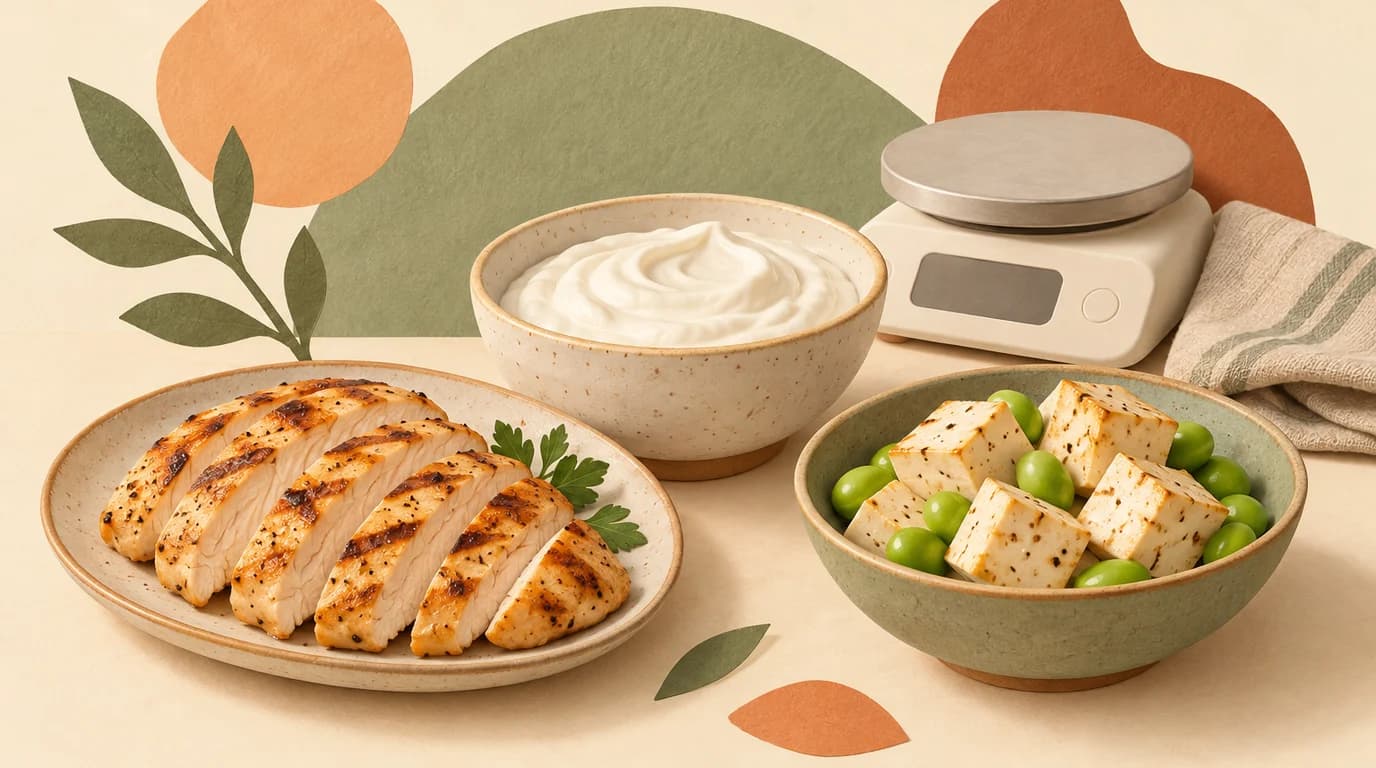
| Chicken breast (roasted, skinless) | 61g | 2.2 oz | A scant ½ cup chopped |
| Chickpeas (boiled) | 61g | 2.2 oz | A little over ⅓ cup |
| Salmon (Atlantic, farmed, cooked) | 49g | 1.7 oz | About 1¾ oz cooked |
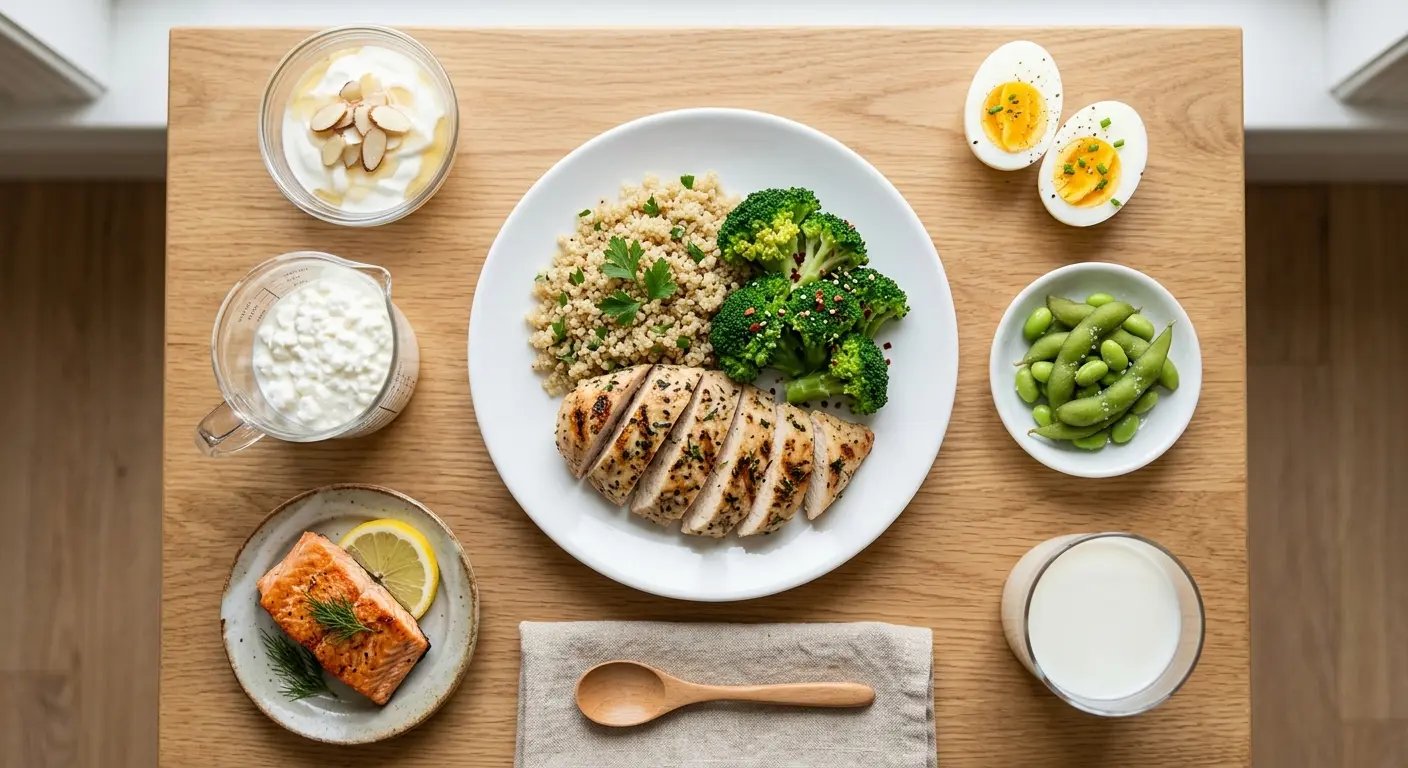
Lean, watery protein foods like egg whites and nonfat Greek yogurt give the largest 100-calorie portions. Salmon's portion is smaller because it contains more fat, which is not a reason to avoid it. This chart compares calories only. If you want to compare how much protein each food provides for its calories, use our protein-per-calorie chart. To see portions built around protein, see what 30g of protein looks like.
One large hard-boiled egg (50g edible weight) provides about 78 calories in this reference, so 100 calories is one egg plus about a third of another.
Dairy
| Food (state) | 100 calories | Ounces | Roughly |
|---|---|---|---|
| Nonfat (skim) milk | 294g | 10.4 oz | About 1¼ cups |
| Whole milk (3.25%) | 164g | 5.8 oz | About ⅔ cup |
| Cheddar cheese | 25g | 0.9 oz | A little under 1 oz |
Fat content changes the dairy portions dramatically. 100 calories of nonfat milk fills a large glass; the same calories of whole milk is about two-thirds of a cup, and cheddar is a small slice.
Nuts, fats and chocolate
| Food (state) | 100 calories | Ounces | Roughly |
|---|---|---|---|
| Avocado (raw, flesh) | 63g | 2.2 oz | About ⅓ to ½ an avocado, depending on size |
| Almonds | 17g | 0.6 oz | About 14 almonds |
| Peanut butter (smooth) | 17g | 0.6 oz | About 1 level tablespoon |
| Dark chocolate (70–85% cacao) | 17g | 0.6 oz | About ⅙ of a 100g bar |
| Walnuts | 15g | 0.5 oz | About 7 halves |
| Butter | 14g | 0.5 oz | About 1 tablespoon |
| Olive oil | 11g | 0.4 oz | About ¾ tablespoon |
These are the foods where small measuring errors matter most. A heaped tablespoon of peanut butter can weigh noticeably more than a level one, and a "drizzle" of oil is easy to underestimate. They are not foods to avoid; they are foods worth measuring when your log needs to be accurate.
Want this on one page?
The free CalorieCue calorie-counting cheat sheet is a 5-page printable PDF with portion sizes, calories for 80+ common foods, high-protein swaps, a restaurant guide and a 7-day tracking log. Keep it on your fridge or phone while you learn your usual portions.
Get the Free 5-Page Cheat Sheet PDF
Calorie targets, 80+ food calories, high-protein swaps, a restaurant guide, and a printable 7-day tracking log. Enter your email and we'll send you the PDF.
Why 100 calories can weigh 11g or 667g
Three things decide how big a 100-calorie portion looks:
- Water adds weight and volume without calories. Cucumber, watermelon and strawberries are mostly water, so their 100-calorie portions are large.
- Fat packs the most calories into the least space. At about 9 calories per gram, fat is more than twice as energy-dense as protein or carbohydrate. Oil, butter and nuts reach 100 calories quickly.
- Fiber adds bulk with fewer usable calories. Vegetables, fruit, legumes and whole grains contain fiber, which contributes to the size of the portion.
The heaviest portion in this guide (cucumber, 667g) weighs about 60 times as much as the lightest (olive oil, 11g). That is the idea behind volume eating: building meals around foods with low calorie density so your plate looks fuller for the same calories.
Low calorie density is not the same as "better." Nuts, olive oil, salmon and avocado are calorie-dense and can still fit a balanced eating pattern. The chart is a way to see what you are eating, not a ranking of good and bad foods.
Four 100-calorie snack combinations
Single-food portions are useful for learning. In practice, a snack usually combines two foods. These four combinations use the same USDA reference values as the chart:
| Combination | Calories |
|---|---|
| 100g plain nonfat Greek yogurt + 70g blueberries | 99 |
| 1 large hard-boiled egg (50g) + 150g cucumber slices | 100 |
| 70g 1% cottage cheese + 155g strawberries | 100 |
| 90g apple slices + 9g peanut butter (just over ½ tablespoon) | 101 |
Totals are calculated from unrounded values. Each pairs a protein or fat source with a watery fruit or vegetable, which makes a 100-calorie snack look bigger on the plate.
Whether 100 calories is enough depends on your appetite, your daily calorie target and when your next meal is. For more ideas at a slightly higher budget, see our healthy snacks under 200 calories.
How to work out 100 calories of any food
When your food is not in the chart, you can calculate the portion yourself.
From a "per 100g" value (USDA database, many international labels):
Grams for 100 calories = 10,000 ÷ calories per 100g.
For example, a food with 250 calories per 100g: 10,000 ÷ 250 = 40g.
From a nutrition label serving:
Grams for 100 calories = 100 ÷ calories per serving × serving weight in grams.
Suppose a fictional granola label lists 150 calories per 40g serving. The calculation is 100 ÷ 150 × 40 = about 27g. Use the label of the product you actually eat; two granolas with similar names can differ a lot.
There is no need to weigh to the exact gram. Labels are rounded and reference foods are averages. What matters for useful tracking is choosing the right food entry and recording a realistic amount.
Avoid these 100-calorie portion mistakes
- Mixing raw and cooked weights. 77g of cooked rice is about 100 calories; 77g of dry rice is about 280. Weigh food in the state its nutrition entry describes.
- Counting inedible parts. The fruit values are for edible flesh. Banana peel, mango pit and apple core are not included.
- Forgetting the cooking fat. Roasted vegetables, eggs and chicken are listed plain. Each tablespoon of olive oil adds about 119 calories.
- Trusting "medium" sizes too much. One large banana or apple can provide noticeably more than one small one. When it matters, weigh it once and remember the result.
- Measuring spreads by eye. A heaped spoon of peanut butter or butter can be much more than a level one. A quick weigh-in for calorie-dense foods improves accuracy more than weighing every vegetable.
If you do not own a scale, our guide to counting calories without a food scale covers practical alternatives.
Log the meal, then check the portion
Use the chart to estimate one food, then log the meal you actually ate. A full plate usually combines several foods, and the calorie-dense additions are the easiest to miss.
CalorieCue can use a meal photo as a starting estimate. Review the identified foods and portions, then add any oil, butter or dressing the photo could not see. A photo cannot confirm that a portion contains exactly 100 calories. When the amount matters, use a weight or the package label to correct the estimate.
The photo food-logging guide walks through the review step. To see how individual portions add up across a full day, see what 1,500 calories looks like.
Sources and calculation method
All portions use per-100g energy values from the USDA FoodData Central SR Legacy April 2018 download, checked October 25, 2026. They are established reference data, not new laboratory tests.
For each food, we divided 10,000 by its calories per 100g to find the grams that provide 100 calories, then rounded to the nearest gram. Ounces use 28.35g per ounce, rounded to one decimal place. Snack totals use unrounded values. Household measures are approximate and based on typical USDA reference portion weights.
USDA reference foods used: watermelon, strawberries, oranges, apples with skin, blueberries, mangos, grapes and bananas (all raw); raw cucumber with peel, raw broccoli and raw carrots; sweet potato baked in skin and potato baked with skin, both without salt; enriched long-grain white rice, cooked; enriched pasta, cooked without salt; commercially prepared whole-wheat bread; dry rolled oats; air-popped popcorn; raw egg white; plain nonfat Greek yogurt; 1% cottage cheese; cooked shrimp; light tuna canned in water without salt, drained; boiled lentils and boiled chickpeas without salt; prepared frozen edamame; raw firm tofu prepared with calcium sulfate; hard-boiled whole egg; roasted skinless chicken breast; cooked farmed Atlantic salmon; nonfat milk; whole milk (3.25%); cheddar cheese; raw avocado; almonds; smooth peanut butter without salt; dark chocolate (70–85% cacao); English walnuts; salted butter; and olive oil.
Brands, varieties and preparation can differ. Use your product's label for a closer match.
Frequently asked questions
How many grams is 100 calories?
It depends on the food. Pure protein or carbohydrate provides 100 calories in 25g, pure fat in about 11g and alcohol in about 14g. In whole foods, the range in this guide runs from about 11g of olive oil to about 667g of raw cucumber.
What does 100 calories of fruit look like?
About 313g of strawberries (roughly 2 cups halved), 175g of blueberries, 145g of grapes (about 30 grapes), 192g of apple (one medium-large apple) or 112g of peeled banana (just under one medium banana).
What is a good 100-calorie snack?
Try 100g plain nonfat Greek yogurt with 70g blueberries, one large hard-boiled egg with 150g cucumber, 70g 1% cottage cheese with 155g strawberries, or 90g apple with 9g peanut butter. Whether 100 calories is enough depends on your appetite and daily plan.
Why is 100 calories of oil so small?
Oil is almost entirely fat, at about 9 calories per gram, with almost no water. 100 calories of olive oil is about 11g, or three-quarters of a tablespoon. A full tablespoon is about 119 calories.
Should I weigh food raw or cooked for these portions?
Match the state shown in the chart. Rice, pasta, legumes, meat, fish, potatoes and eggs use cooked weights; oats use dry weight; fruit and most vegetables are raw.
How do I work out 100 calories from a nutrition label?
Divide 100 by the calories per serving, then multiply by the serving weight in grams. For a label listing 150 calories per 40g serving, 100 ÷ 150 × 40 = about 27g.