On this page
- Raw or cooked? Use this quick decision chart
- Why does food weigh differently after cooking?
- Rice: cooked grams need a cooked entry
- A pot-of-rice example
- Pasta: check whether the serving is dry or prepared
- Chicken and beef: match the cut, state and cooking method
- Bones, skin and shells
- Meal prep: weigh the batch once, then weigh your portion
- How to measure your own cooking yield
- Five mistakes worth checking
- A simple workflow for your next meal
- Common questions
- Should I weigh food raw or cooked for calorie tracking?
- Do you weigh rice before or after cooking?
- Is pasta serving weight dry or cooked?
- Should I weigh chicken before or after cooking?
- How do I convert raw weight to cooked weight?
- Does cooking change the calories in food?
- Sources and calculation notes
You can weigh food raw or cooked. The important part is matching the weight on your scale to the state described by the nutrition entry.
If your bowl contains 150g of cooked rice, select cooked rice. If you weigh 60g of dry pasta before it goes into the pot, use the dry-pasta label. Mixing those states can make a carefully weighed meal look much higher or lower in calories than it is.
You do not need to weigh every ingredient twice. Choose the method that fits the meal, check the entry, and use it consistently.
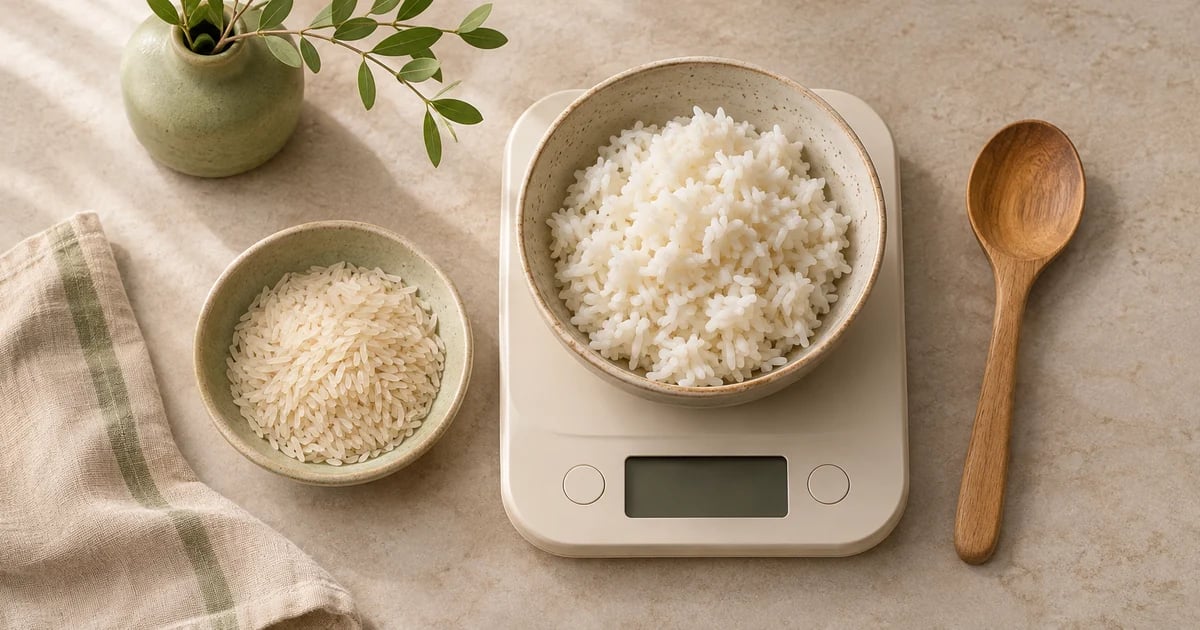
References checked November 3, 2026. USDA values below are reference averages, not measurements of your meal. Batch weights and the pasta label example are hypothetical teaching examples. The featured image is AI-generated and does not demonstrate measured quantities.
Raw or cooked? Use this quick decision chart
Start with the food you can weigh now. Then find the matching description on the package or in your tracker.
| Food or situation | Weight to use | Entry or calculation to match |
|---|---|---|
| Rice, pasta or oats before cooking | Dry weight | The dry product's label or a matching dry entry |
| Plain rice or pasta already cooked | Cooked edible weight | A cooked entry with the appropriate preparation |
| Chicken, beef or fish before cooking | Raw edible weight | The matching raw cut, fat level and skin status |
| Meat already cooked | Cooked edible weight | A cooked entry matching the cut and method as closely as possible |
| Raw vegetables | Raw edible weight | A raw entry; exclude parts you will discard |
| Boiled or roasted vegetables | Cooked edible weight | The matching cooked entry; check whether added fat is included |
| Canned food after draining | Drained edible weight | A drained entry or label that explicitly uses drained weight |
| A homemade mixed dish | Your share of the finished batch | A recipe total divided by finished edible weight |
Check three things before saving: food, preparation state, and amount. “Chicken, raw, meat only” and “chicken, roasted, meat only” are different entries even when you type the same number of grams.
If you are new to tracking, our calorie-counting guide explains the wider workflow. Here, we will focus on getting the weighing step right.
Why does food weigh differently after cooking?
Rice absorbs water. Meat often loses water and some fat. Roasting can remove moisture from vegetables. A scale measures all of that weight; it does not distinguish water from energy-containing ingredients.
USDA's cooking-yield tables describe changes from moisture loss, water absorption, and fat gains or losses. Those changes help explain why a raw entry and a cooked entry can have different calories per 100g.
Water itself adds no calories. However, that does not mean every recipe retains exactly the same calorie total through cooking. Added butter or oil contributes energy; discarded fat, breading or sauce can remove it from the portion you eat.
This is why “everything loses 25% of its weight” is an unreliable shortcut. USDA notes that meat yields vary with the food and cooking conditions. The useful number is your batch's yield, when you have measured it.
Rice: cooked grams need a cooked entry
Here is a simple example using USDA SR Legacy records for white, long-grain enriched rice:
| Reference food | Calories per 100g | Calories when logging 150g |
|---|---|---|
| Raw rice | 365 | 548 |
| Cooked rice | 130 | 195 |
The 548-calorie value is rounded from 547.5. If you actually ate 150g of cooked rice, entering 150g against the raw record would produce a much higher estimate: about 353 extra logged calories with these references.
That does not mean cooking removed those calories from the same portion. 150g dry rice and 150g cooked rice are different amounts of rice solids and water. These two database records are not a measured before-and-after experiment, so do not divide their calorie values to invent a precise cooking conversion.
For a single serving, either weigh the dry rice you cook for yourself or weigh the cooked rice and use the cooked entry. For a shared pot, the batch method below lets you use your own dry-rice label and finished weight.
A pot-of-rice example
Suppose you cook 200g dry rice in water, with no oil, and your finished edible rice weighs 600g. Those weights are an example, not a promise that rice always triples.
Using the raw reference above:
- Estimate the batch calories: 200 ÷ 100 × 365 = 730 calories.
- Weigh your cooked serving: 150g.
- Find its share: 150 ÷ 600 = one quarter.
- Log one quarter of the batch: 730 × 0.25 = about 183 calories.
This estimate assumes you eat the rice solids and have no meaningful calorie-containing losses. Rice rinsed or drained after cooking, different products, and different water absorption introduce variation. Use your own package and actual finished weight when available.
Why is this example 183 calories rather than the generic cooked entry's 195? One is a calculation using a hypothetical batch's measured yield; the other uses an average cooked-food composition. Pick one coherent method for your meal instead of combining pieces of both.
Pasta: check whether the serving is dry or prepared
A serving listed on a dry-pasta package should not automatically be treated as the weight of a bowl of cooked pasta. Read the serving description and any preparation notes first. The FDA explains that label calories refer to the stated serving size.
Imagine a label that states 200 calories per 56g dry pasta. This is a fictional label for arithmetic, not a claim about every brand.
You cook 112g dry pasta in water and the drained pasta weighs 280g. If your serving is 140g cooked, it is half the batch:
2 dry servings × 200 calories × 140 ÷ 280 = 200 calories.
Entering the cooked 140g as dry pasta would instead log 140 ÷ 56 × 200 = 500 calories. That is the mismatch to avoid.
The batch calculation is still an estimate: some starch can leave in discarded cooking water. Add sauce, cheese, butter and oil according to the amount you eat. If you only have cooked leftovers and no batch information, choose a matching cooked-pasta entry rather than guessing the original dry weight.
Chicken and beef: match the cut, state and cooking method
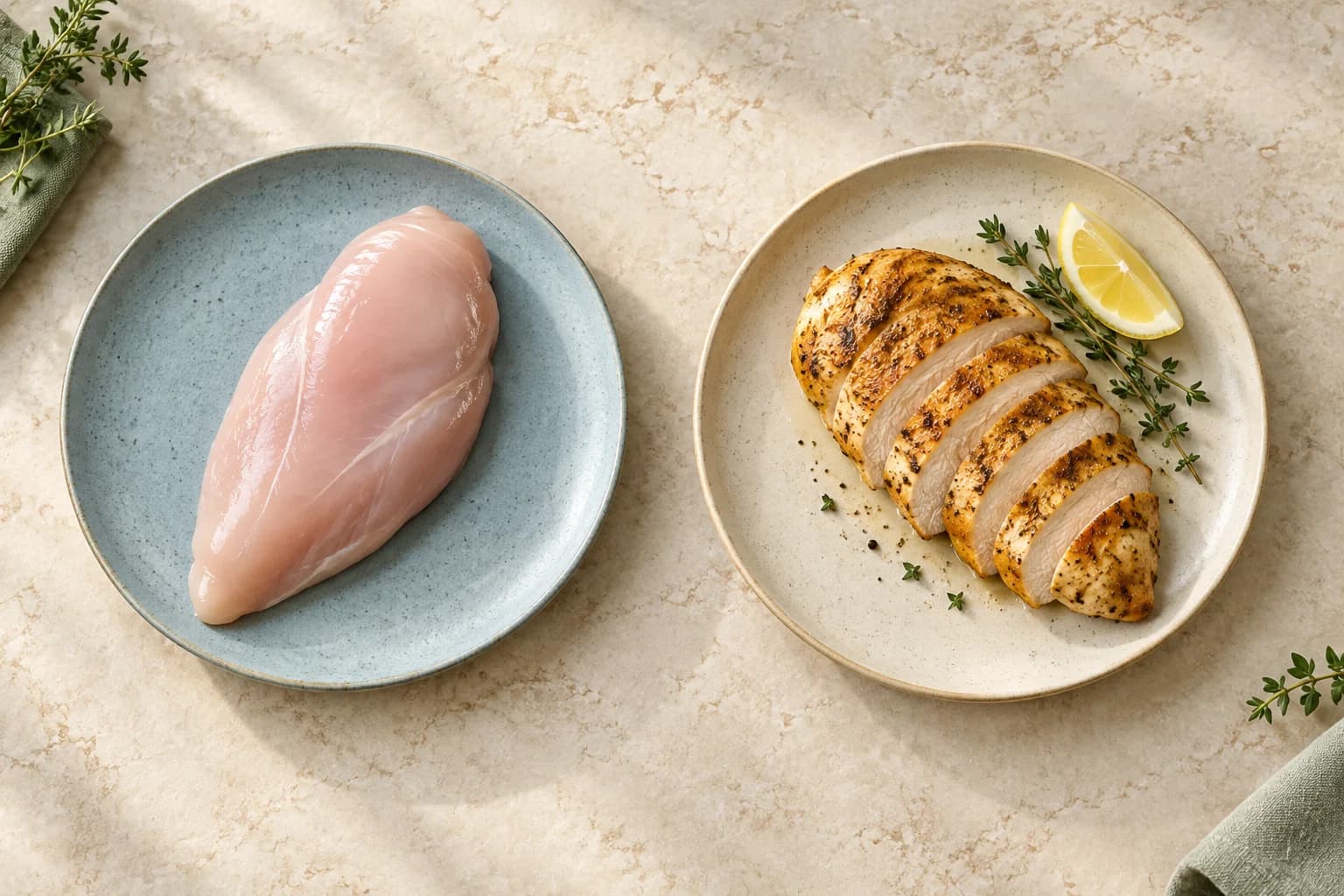
For chicken, the error can run in the opposite direction from rice. USDA's raw skinless, boneless breast reference provides 120 calories per 100g, while its roasted breast, meat-only reference provides 165 calories per 100g.
If you weigh 150g of roasted breast meat, the cooked reference estimates about 248 calories. Logging those same 150g against the raw reference gives 180 calories. The selected record changes the estimate by about 68 calories, before any separately added oil or sauce.
Again, these are separate reference foods, not evidence that a specific raw breast becomes a specific cooked weight. For more portions and preparation details, see our chicken breast calorie and protein table.
For beef, match the cut and fat level as well. Ground beef labeled 90% lean is not interchangeable with every other mince entry. If you brown and drain it, a cooked entry that describes that preparation can be more suitable than logging the raw total as though you ate all the drippings.
Bones, skin and shells
Use the part the nutrition entry describes. A meat-only entry should not include the weight of a discarded bone. If you eat the skin, choose an entry that includes it. For shell-on seafood, weigh the edible portion or use an appropriate yield estimate; our shrimp guide explains that distinction.
Meal prep: weigh the batch once, then weigh your portion
For a mixed dish, the useful question is often: what fraction of the finished recipe am I eating?
First total the edible ingredients using matching labels or entries. Include calorie-containing cooking fats, sauces and toppings that remain in the food. Then weigh the finished batch without the pot or container.
Portion calories = estimated batch calories × portion weight ÷ finished batch weight.
For example, a hypothetical dish contains 1,600 calories and weighs 1,000g after cooking. A 250g portion is one quarter of the batch, so it contains an estimated 400 calories.
| Portion from that example batch | Share of the 1,000g batch | Estimated calories |
|---|---|---|
| 200g | 20% | 320 |
| 250g | 25% | 400 |
| 300g | 30% | 480 |
This works best when ingredients are distributed reasonably evenly. A scoop with most of the chicken and little rice will not have the same calories per gram as a scoop with mostly rice. For separately arranged meal-prep boxes, portion and log the components separately when that is practical.
Use the homemade-food calorie calculator for the full ingredient calculation. Save the finished weight for that batch; next week's version may absorb more water or contain a different amount of sauce.
How to measure your own cooking yield
If you want to understand how much a food changes weight in your kitchen, record its edible weight before and after cooking:
Yield factor = cooked edible weight ÷ raw edible weight.
For a hypothetical 800g raw batch that finishes at 600g, the yield factor is 0.75, or 75%. A 150g cooked portion is one quarter of that batch, corresponding to one quarter of its starting raw amount: 200g.
That correspondence helps you divide a batch. It does not prove that the serving retained every calorie in 200g of raw food. If fat or other calorie-containing material was discarded, account for the preparation using a suitable cooked reference or an adjusted recipe estimate.
For repeat meals, a measured yield is more useful than a universal online conversion. Record the food, method, and any draining, so you know what the number describes.
Five mistakes worth checking
- Using a dry entry for cooked rice or pasta. Check the description before entering grams.
- Using a raw entry for a cooked meat portion. A familiar-looking food name can hide the preparation state.
- Weighing the container. Put the empty bowl on the scale and press tare, or subtract its empty weight.
- Counting oil twice—or missing it entirely. Check whether the selected prepared-food entry or saved recipe already includes it before adding a separate entry. When retention is unknown, counting all oil added is a practical conservative estimate, not a measurement of oil eaten.
- Reusing an old batch weight. More or less water changes calories per gram. Recheck the finished weight when you make a new batch.
For canned tuna or beans, also check whether the label uses drained weight. Our canned tuna guide covers water, oil and discarded liquid.
A simple workflow for your next meal
Before cooking, use the package or raw entry if you are weighing ingredients. After cooking, use matching cooked entries or the finished-batch method. At either stage, account for the edible portion and extras.
If you start a log from a meal photo in CalorieCue, review the identified foods and estimated portions before saving. A photo does not reliably reveal the original raw weight, how much oil stayed in the pan, or the exact ingredients in a sauce. See how photo food logging works for the review step.
Download CalorieCueWant a reference you can keep nearby? The free Calorie Counting Made Simple guide includes food references and a printable tracker. For a complete menu with preparation states specified, see what 2,000 calories can look like.
The habit to remember is simple: match what you weigh to what you log. You can get a useful estimate without finding a perfect conversion for every food.
Common questions
Should I weigh food raw or cooked for calorie tracking?
Either can work. Use a raw or dry nutrition entry for a raw or dry weight, and a cooked entry for a cooked weight. Match the food type, edible portion and cooking method too. Weighing before cooking is convenient for recipes; cooked entries are useful when the food is already prepared.
Do you weigh rice before or after cooking?
Use the dry weight with a dry-rice label or entry, or the cooked weight with a cooked-rice entry. For a shared pot, you can calculate calories from the dry rice, weigh the finished cooked batch, and log your portion's share. Include oil, butter or other additions.
Is pasta serving weight dry or cooked?
Read the package's serving description. If it specifies dry pasta, weigh the pasta before cooking. If it specifies prepared pasta, follow that preparation basis. For cooked leftovers, use a matching cooked entry or your saved recipe's finished-weight calculation.
Should I weigh chicken before or after cooking?
Both methods can work when the entry matches. For a cooked breast portion, select an appropriate cooked chicken entry and weigh the edible meat. Do not enter that weight as raw chicken. Match skin, bone removal and preparation method, and account for added oil or sauce.
How do I convert raw weight to cooked weight?
Measure your own batch: cooked edible weight divided by raw edible weight gives its yield factor. That describes the weight change for that batch, not a universal multiplier or a complete calorie adjustment. Added fat and discarded drippings can change its energy content.
Does cooking change the calories in food?
Water gain or loss changes weight and calories per gram without itself adding calories. Cooking can also change what remains in the food: oil may be added and fat or cooking liquid may be discarded. Use a matching cooked entry or a recipe calculation that reflects the ingredients actually eaten.
Sources and calculation notes
- USDA FoodData Central, SR Legacy: raw long-grain enriched rice, FDC 168877; cooked rice, FDC 168878; raw skinless, boneless chicken breast, FDC 171077; roasted breast meat, FDC 171477. Energy values were checked against the official downloadable dataset, SR Legacy April 2018 edition. These are historical reference averages, not newly measured foods.
- USDA Agricultural Research Service: Table of Cooking Yields for Meat and Poultry, Release 2, September 2014. Background on moisture and fat changes during cooking.
- USDA Food and Nutrition Service: Food Buying Guide: Meats/Meat Alternates. Factors affecting cooked yields.
- FDA: How to Understand and Use the Nutrition Facts Label. Serving sizes and scaling label values to the amount eaten.
Calculations use unrounded values, then round displayed calories to the nearest whole number. The pasta label, batch weights, mixed-dish calorie total and 75% yield are teaching assumptions, not tested recipes or universal conversion factors. Food brands, preparation and leftovers can change real-world results.