On this page
- Chicken breast calories and protein at a glance
- Chicken breast serving-size chart: grams and ounces
- Why cooked chicken has more calories per 100 g
- Should you weigh chicken raw or cooked?
- A worked meal-prep example
- Why your package label may show a different number
- Grilled, baked, air-fried, or breaded: choose the matching entry
- How chicken breast fits into a protein-focused meal
- Common questions
- How many calories are in one chicken breast?
- How much protein is in 4 oz of chicken breast?
- Does chicken breast have carbs?
- Can I use a palm-sized portion instead of a scale?
- How long can I keep cooked chicken for meal prep?
- Put the right portion in your food log
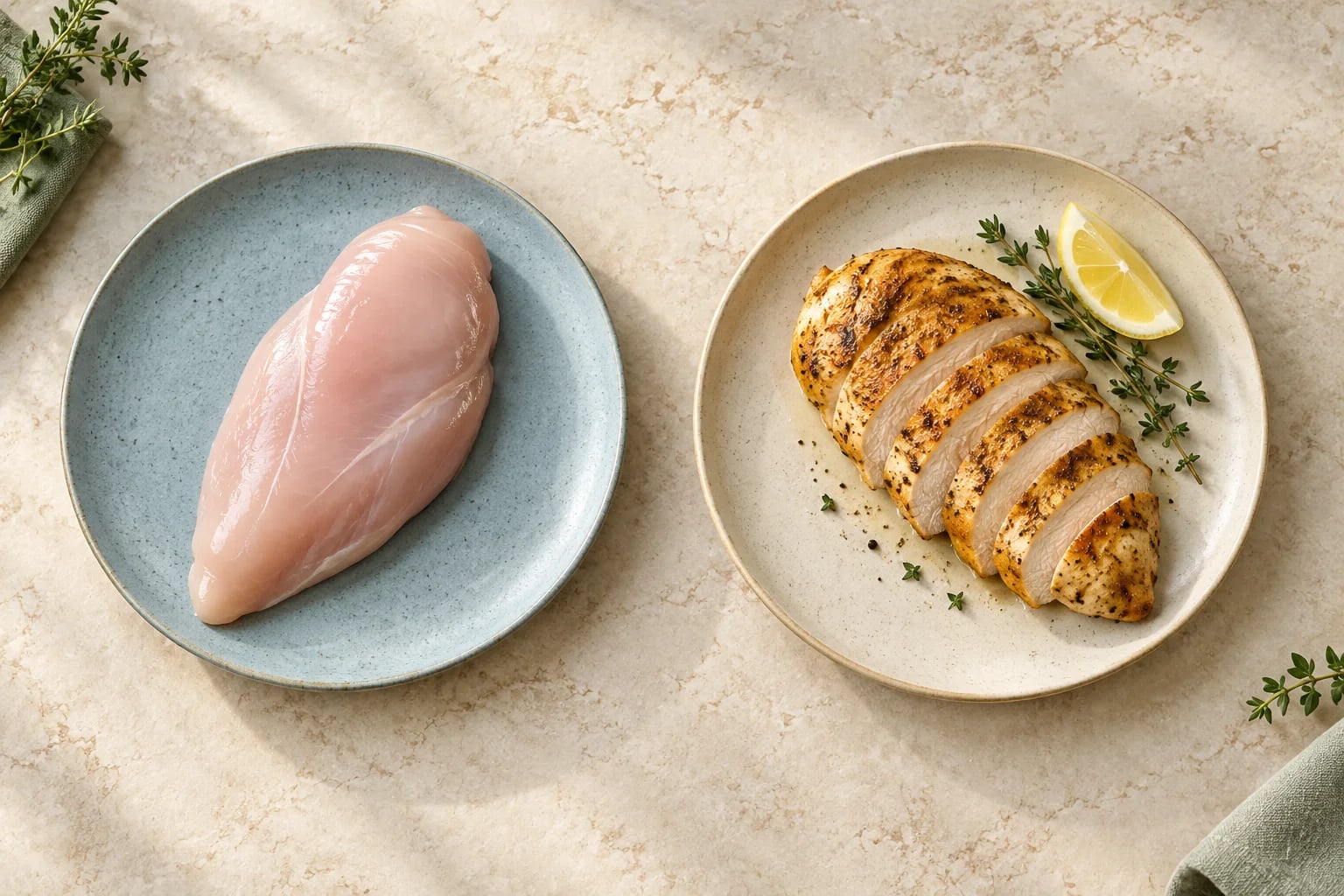
Plain roasted chicken breast contains about 165 calories and 31 g of protein per 100 g. Raw, skinless, boneless chicken breast contains about 120 calories and 22.5 g of protein per 100 g. These USDA reference values describe different preparation states, so choose the one that matches when you weighed your food. USDA raw chicken reference, USDA roasted chicken reference.
That distinction explains why two seemingly reasonable food entries can give you different totals for dinner. A portion weighed before cooking belongs with a raw entry. A portion weighed after cooking belongs with a matching cooked entry—or with a recipe you calculated for that batch.
Here is how to choose the right number, account for your serving size, and log a meal without confusing chicken weight with the weight of the whole dish.
Chicken breast calories and protein at a glance
These figures cover the edible meat, without skin or bones. They do not include breading, sauce, or oil you add during preparation.
| Per 100 g | Raw, skinless, boneless breast | Cooked, roasted breast, meat only |
|---|---|---|
| Calories | 120 kcal | 165 kcal |
| Protein | 22.5 g | 31.0 g |
| Fat | 2.6 g | 3.6 g |
| Carbohydrate | 0 g | 0 g |
About the data: this guide uses two named USDA FoodData Central SR Legacy records: 171077, raw, and 171477, roasted. They are established reference entries, not newly collected measurements or exact values for every product. A package label or a more closely matched food record may differ.
Chicken breast serving-size chart: grams and ounces
Find your measured weight, then use the raw or cooked columns as appropriate.
| Weight on your scale | Raw calories | Raw protein | Roasted calories | Roasted protein |
|---|---|---|---|---|
| 100 g | 120 | 22.5 g | 165 | 31.0 g |
| 3 oz, about 85 g | 102 | 19.1 g | 140 | 26.4 g |
| 4 oz, about 113 g | 136 | 25.5 g | 187 | 35.2 g |
| 150 g | 180 | 33.8 g | 248 | 46.5 g |
| 6 oz, about 170 g | 204 | 38.3 g | 281 | 52.7 g |
| 200 g | 240 | 45.0 g | 330 | 62.0 g |
| 8 oz, about 227 g | 272 | 51.0 g | 374 | 70.3 g |
Calculated from the USDA records above. Ounce calculations use 28.3495 g per ounce before rounding. Calories are rounded to whole numbers and protein to one decimal place; this is calculation precision, not a claim that food composition is exact.
Each row compares equal weights in two different states. It does not show what a raw portion will contain after cooking. For example, 4 oz of raw chicken usually will not still weigh 4 oz when it comes out of the oven.
For a weight not listed, use:
Your portion’s nutrition = grams weighed ÷ 100 × the matching per-100-g value.
If your plain roasted portion weighs 125 g, the calculation is 1.25 × 165 = about 206 calories, and 1.25 × 31 = about 38.8 g protein.
Why cooked chicken has more calories per 100 g
Cooking changes the weight of chicken. Moisture escapes, and some fat and juices can leave the meat. A cooked portion therefore has a different composition per gram from a raw portion. USDA cooking-yield research accounts for these changes in moisture and fat. USDA cooking-yield methods.
The higher cooked value does not mean heat created extra calories or protein. It means you are comparing 100 g of raw meat with 100 g of cooked meat, rather than following the same piece through cooking.
There is also no universal raw-to-cooked multiplier. Yield varies with the product and cooking method, time, and temperature. USDA Food Buying Guide.
Do not divide 120 by 165 and treat the result as your chicken’s exact cooking yield. Those numbers come from separate food records. If you need a conversion for meal prep, weigh your own batch before and after cooking.
Should you weigh chicken raw or cooked?
Either can be useful. The important part is matching the weight to the entry.
| Your situation | A practical way to log it |
|---|---|
| You weigh plain chicken before cooking | Use the matching raw entry or the package’s raw/as-sold nutrition information. |
| You weigh plain chicken after cooking | Use a cooked entry that matches the cut, skin, and preparation. |
| You cook several portions together | Calculate the batch from its ingredients, then allocate it by the finished weight or equal servings. |
| You buy ready-cooked chicken | Use that product’s label and serving instructions when available. |
| You eat restaurant chicken | Use the restaurant’s nutrition information when available, checking what the stated portion includes. |
For cooking at home, weighing raw can be convenient because you can use the package information before adding ingredients. Weighing cooked can be more convenient when serving leftovers or assembling lunch.
What causes trouble is mixing the two: weighing a cooked portion and entering that number of grams under “raw chicken breast.” Check the description before saving the entry, especially when search results simply say “chicken breast.”
A worked meal-prep example
Imagine preparing chicken for four lunches. These are illustrative measurements, not a cooking test or a prediction of how much your batch will shrink.
You start with:
- 800 g raw chicken breast, using a reference of 120 calories and 22.5 g protein per 100 g.
- A measured amount of oil whose label gives 120 calories, counted entirely in the recipe.
- A finished, edible chicken-and-oil batch that weighs 600 g.
The ingredient-based estimate is:
| Ingredient | Calories | Protein |
|---|---|---|
| 800 g raw chicken | 960 | 180 g |
| Measured oil | 120 | 0 g |
| Whole batch | 1,080 | 180 g |
A 150 g serving is one quarter of the 600 g finished batch:
150 ÷ 600 = 0.25 of the recipe.
That serving is logged as approximately 270 calories and 45 g protein, before rice, vegetables, or other additions.
This method allocates an ingredient-based recipe estimate. It assumes the oil is retained and reasonably evenly distributed; it does not precisely measure nutrients lost in discarded juices or fat. If substantial oil or drippings remain in the pan, counting every ingredient will overstate what you ate. Avoid inventing an exact absorption percentage to compensate.
Use the batch calculation or an appropriate cooked-food entry for that portion. Adding both would count the chicken twice. For meals with several ingredients, our guide to calculating calories in homemade food explains how to build and divide the whole recipe.
Why your package label may show a different number
Before deciding that a label or database entry is wrong, check whether it describes the same food:
- Preparation state: raw, roasted, grilled, or ready to eat.
- Edible parts: meat only, meat with skin, or a serving that includes bone weight.
- Added ingredients: a solution, marinade, breading, or sauce.
- Serving basis: per 100 g, per ounce, or per listed serving.
Use the label for the specific product when it matches what you are weighing. Read whether the information is for the food as sold or as prepared; do not assume a ready-cooked product needs a raw-food entry.
For example, if a label gives nutrition per 112 g and your matching portion weighs 168 g, you have 1.5 label servings. Multiply the label’s calories and protein by 1.5. There is no need to replace those values with the generic table just because they differ.
Grilled, baked, air-fried, or breaded: choose the matching entry
The cooked column in this guide is specifically for roasted breast meat. It is not a measured value for every cooking method.
For grilled or air-fried chicken, choose a matching entry where available, or calculate your own batch from its ingredients. If you use roasted chicken as the closest available reference for a plain cooked portion, treat it as an approximation.
Breading, skin, butter, oil, and sauces need their own consideration. For example, if a sauce label lists 50 calories per serving and you use two servings, add 100 calories to the food you are logging. If the selected product or recipe entry already includes that sauce, do not add it again.
For a bone-in breast, weigh the edible meat separately when practical. A “meat only” entry is not intended for the combined weight of meat and bone.
How chicken breast fits into a protein-focused meal
Using the roasted reference, chicken breast provides about 18.8 g protein per 100 calories: 31 ÷ 165 × 100. That makes it a useful option when you want to add protein while keeping track of the meal’s total energy.
The ratio is a comparison tool, not a complete meal plan. You can build around chicken with rice, potatoes, beans, vegetables, and a sauce you enjoy, adjusting portions to your appetite and goals. Log the complete plate rather than treating the chicken total as the meal total.
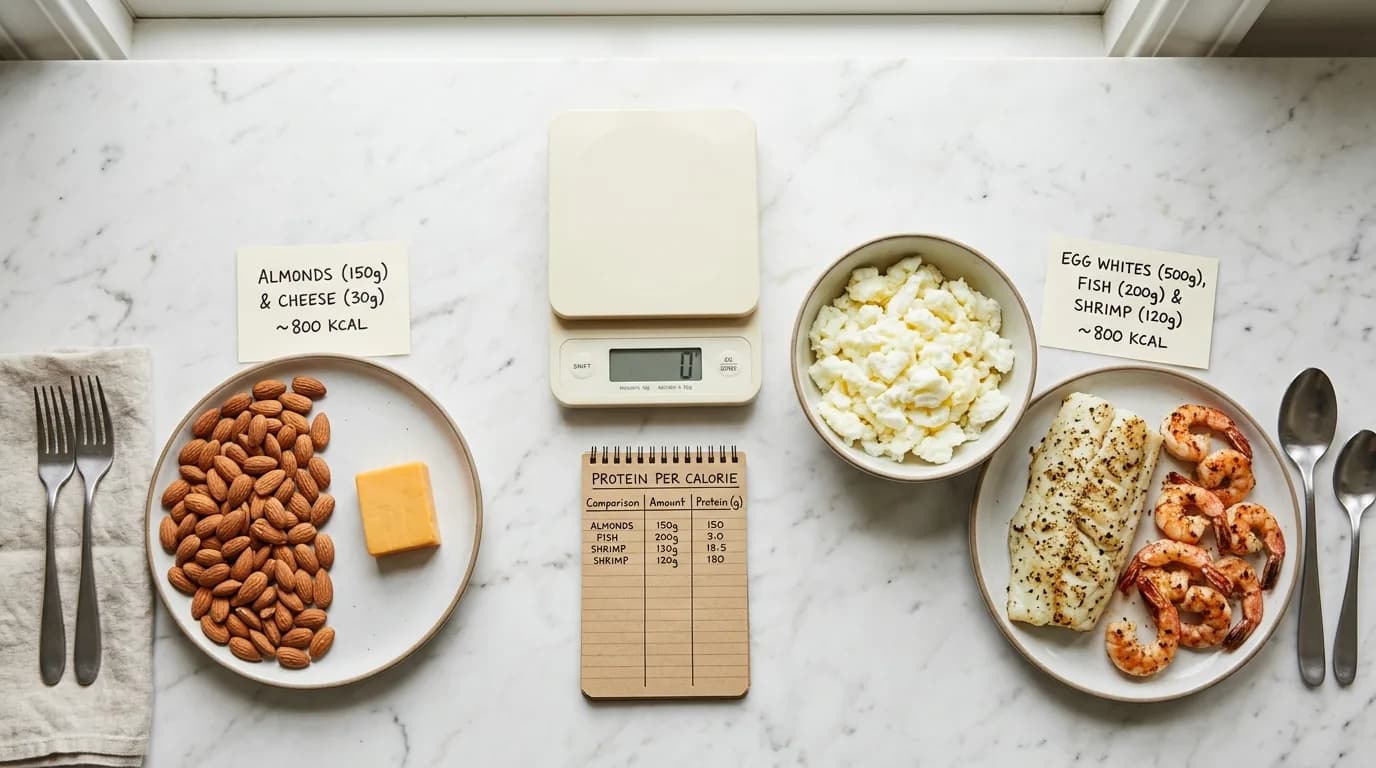
For other options, see the protein-per-calorie chart and our shrimp calories and protein guide. For meal combinations, explore high-protein meals under 500 calories; the right meal size for you may be different.
Common questions
How many calories are in one chicken breast?
There is no single dependable number because breasts vary in size. Weigh the edible portion and match its preparation state. A hypothetical 200 g raw breast is about 240 calories using this guide’s raw reference; a portion weighing 200 g after roasting is about 330 calories. Those are two different portions, not a before-and-after pair.
How much protein is in 4 oz of chicken breast?
About 25.5 g if weighed raw, or 35.2 g if weighed after roasting, using the references in this guide. Four ounces of cooked meat is not the same starting portion as four ounces of raw meat.
Does chicken breast have carbs?
The plain raw and roasted USDA references list zero carbohydrate. A breaded, glazed, or sauced product can contain carbohydrates, so check its label or recipe.
Can I use a palm-sized portion instead of a scale?
You can use a visual estimate when weighing is inconvenient, but it will be less precise: thickness and hand size vary. Choose a reasonable portion entry and recognize the uncertainty. An occasional estimated meal does not require reconstructing every gram afterward.
How long can I keep cooked chicken for meal prep?
USDA recommends cooking poultry to 165°F (74°C), checked with a food thermometer. Refrigerate promptly in shallow containers, keep the refrigerator at 40°F (4°C) or below, and use most cooked leftovers within 3–4 days or freeze them. Reheat leftovers to 165°F. USDA food-safety guidance.
Put the right portion in your food log
Before saving your meal, check three things: the preparation state, the edible weight, and the added ingredients. Those details make a food entry more useful than choosing whichever search result happens to appear first.
Use CalorieCue to keep track of your meals, and return to the serving chart whenever you need a quick chicken reference.
Download CalorieCue