On this page
- Shrimp calories and protein at a glance
- Shrimp serving-size chart: grams and ounces
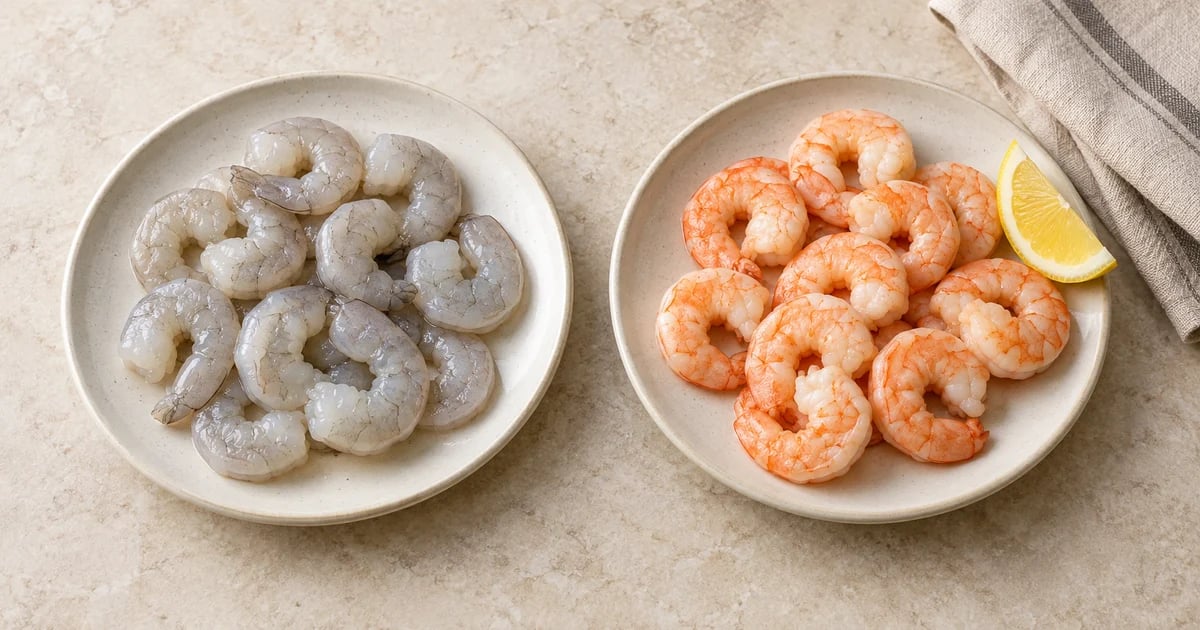
- Raw vs cooked shrimp: why the numbers change
- Why your shrimp label may show a different number
- Shell-on, tail-on, and frozen shrimp: what to weigh
- Shells, heads, and tails
- Frozen shrimp and surface ice
- Counting pieces
- Butter, oil, breading, and sauce change the meal
- A worked logging example
- Shrimp's protein-to-calorie ratio
- Log the shrimp you actually ate
- Frequently asked questions
- How many calories and how much protein are in 100 g of shrimp?
- How much protein is in 3 oz of cooked shrimp?
- Should I weigh shrimp raw or cooked to count calories?
- How many calories are in one shrimp?
- What is shrimp's protein-to-calorie ratio?
- Do I include shrimp shells and tails when weighing?
Plain cooked shrimp has about 99 calories and 24 grams of protein per 100 grams. A 3 oz cooked portion—about 85 grams—has roughly 84 calories and 20.4 grams of protein.
Those numbers are useful only when the food entry matches your plate. Raw shrimp, cooked shrimp, and shrimp covered in garlic butter are three different things to log.
This guide makes that distinction practical: choose the right entry, find your portion in the chart, and account for what went into the pan.
Shrimp calories and protein at a glance
The reference values below come from two specific USDA FoodData Central records: Crustaceans, shrimp, raw and Crustaceans, shrimp, cooked. Both are SR Legacy entries, checked September 10, 2026.
| Per 100 g of edible shrimp | Raw | Cooked |
|---|---|---|
| Calories | 85 | 99 |
| Protein | 20.1 g | 24.0 g |
| Fat | 0.51 g | 0.28 g |
| Carbohydrate | 0 g | 0.20 g |
The cooked record contains 23.98 g protein; this guide rounds that to 24 g when a whole-number answer is more useful. Neither column includes added butter, cooking oil, breading, or sauce.
For a packaged product, start with its own label. Use the USDA reference when you need a generic entry for plain shrimp. Species, processing, retained moisture, and preparation can produce different nutrition values.
Shrimp serving-size chart: grams and ounces
Find the weight you actually measured, then use the matching raw or cooked column.
| Edible portion | Raw calories | Raw protein | Cooked calories | Cooked protein |
|---|---|---|---|---|
| 3 oz ≈ 85 g | 72 | 17.1 g | 84 | 20.4 g |
| 100 g ≈ 3.5 oz | 85 | 20.1 g | 99 | 24.0 g |
| 4 oz ≈ 113 g | 96 | 22.7 g | 112 | 27.1 g |
| 150 g ≈ 5.3 oz | 128 | 30.2 g | 149 | 36.0 g |
| 6 oz ≈ 170 g | 145 | 34.2 g | 168 | 40.8 g |
| 200 g ≈ 7.1 oz | 170 | 40.2 g | 198 | 48.0 g |
Calculated from the two USDA records above using the displayed gram weights. Calories are rounded to whole numbers and protein to one decimal place. Ounce equivalents are approximate. These are lookup portions, not prescribed serving sizes.
For a weight that is not listed, the calculation is:
Your amount in grams ÷ 100 × the per-100-g value
For example, 125 g of cooked shrimp gives you:
- Calories: 125 ÷ 100 × 99 = about 124 calories
- Protein: 125 ÷ 100 × 23.98 = about 30 g protein
For other ingredients on the plate, use our calories in food list.
Raw vs cooked shrimp: why the numbers change
Cooking changes the weight and water content of food. When shrimp loses water, the remaining food can contain more protein and calories per 100 grams, even though cooking has not created extra protein.
The two USDA entries illustrate the difference: the raw entry contains 78.45 g water per 100 g, while the cooked entry contains 74.33 g. They are separate reference records, not a before-and-after experiment on your batch.
That distinction matters. You cannot divide 85 by 99 and use the result as a reliable raw-to-cooked weight conversion. Cooking time, moisture treatment, and how thoroughly you drain the shrimp all affect the final weight. Some nutrients can also leave with discarded cooking liquid.
Match the state, not just the name. If you weighed peeled shrimp before cooking, choose a raw entry. If you weighed the cooked shrimp on your plate, choose a cooked entry. You do not need to weigh it twice to make a useful log.
Suppose you measure 150 g of cooked, peeled shrimp. In this guide's cooked entry, that is about 149 calories and 36 g protein. Selecting the raw entry for that same cooked weight would give you a different estimate because it describes a different food state.
If you cook a whole recipe and divide it into several portions, log its ingredients once and divide the finished dish. Our homemade-food calorie guide walks through that calculation.
Why your shrimp label may show a different number
“Shrimp” is not one uniform product. A plain raw product, a precooked product with retained moisture, and a breaded frozen product need different entries.
Even official references are not interchangeable. The FDA's cooked seafood chart lists 100 calories and 21 g protein for its 84 g shrimp serving. This guide's USDA cooked record yields about 84 calories and 20.4 g protein for 85 g. Those are different reference values, not a rounding adjustment you should try to average away.
For daily logging, use this order:
- The exact product's nutrition label, matching its serving size and preparation instructions.
- A database entry that describes that product and preparation, if the label is unavailable.
- A clearly identified generic reference, such as the plain-shrimp entries used here.
Once you have a suitable entry, use it consistently for that product. Picking whichever result has the fewest calories makes your log less useful.
Shell-on, tail-on, and frozen shrimp: what to weigh
The serving chart refers to the edible portion. A shell-on package includes material you may throw away.
Shells, heads, and tails
Weigh the peeled meat when practical. Exclude heads, shells, and tails you do not eat. Avoid applying a fixed shell-loss percentage: the amount discarded depends on what you bought and how you prepare it.
If you only know the weight of a whole shell-on bag, do not enter that full amount as peeled shrimp. Measure the edible portion after preparation, or use a product label with clear instructions for the portion it describes.
Frozen shrimp and surface ice
Follow the package's stated basis when using its nutrition panel. When using a generic raw entry, thaw and drain the shrimp before weighing the peeled edible portion; do not count loose surface ice or discarded thawing liquid as shrimp meat.
For safe thawing, the FDA recommends refrigerating seafood overnight. For faster thawing, it describes a sealed bag in cold water, or microwave defrosting when the seafood will be cooked immediately.
Counting pieces
“Ten shrimp” is not a dependable calorie portion without some idea of their size. Ten small shrimp and ten large shrimp can weigh very different amounts.
If one peeled, cooked shrimp weighs 10 g, this guide's reference gives it about 10 calories and 2.4 g protein. That is an example, not a standard shrimp size. Weigh a few from your usual bag if you want a reusable estimate for that product.
Butter, oil, breading, and sauce change the meal
The shrimp itself may be straightforward to log. The additions are often where the estimate goes wrong.
| What you ate | How to log it |
|---|---|
| Plain cooked shrimp | Use a matching cooked entry and edible weight. |
| Shrimp sautéed in oil or butter | Log the shrimp and the cooking fat allocated to your portion. |
| Breaded or fried shrimp | Use the product label or a matching breaded/fried entry, rather than the plain-shrimp chart. |
| Shrimp with a separate dipping sauce | Log the shrimp and the amount of sauce eaten. |
| Shrimp in curry, pasta, or a rice bowl | Count the full dish's ingredients or use a suitable recipe estimate. |
For shared dishes, divide the added fats and sauces among the portions instead of assigning the whole pan's amount to one plate. If you cannot measure what remained in the pan, treat your allocation as an estimate rather than claiming exact absorption.
A worked logging example
Imagine your plate contains 150 g plain cooked shrimp, plus one teaspoon of oil and a portion of sauce. For this example, assume the oil's label gives 40 calories per teaspoon and the sauce's label gives 20 calories for the amount you ate.
| Item | Calories |
|---|---|
| Cooked shrimp, 150 g | 149 |
| Oil, using the example label | 40 |
| Sauce, using the example label | 20 |
| Total, rounded | 209 |
The shrimp contributes about 36 g protein. Any additional protein comes from the specific sauce or other foods you add. Rice, noodles, vegetables, and drinks are separate parts of the meal; they are not included in this example.
Use your actual labels in place of these illustrative oil and sauce values. If you want a complete meal idea, our high-protein meals under 500 calories guide includes a shrimp-and-vegetable stir-fry with its other ingredients counted.
Shrimp's protein-to-calorie ratio
Using the cooked USDA record:
23.98 g protein ÷ 99 calories = about 0.24 g protein per calorie
Expressed another way, that is about 24.2 g protein per 100 calories. It explains why plain shrimp appears near the top of our protein-per-calorie chart.
The ratio describes the plain ingredient. Adding oil raises the calorie total without adding protein, while breading or a creamy sauce changes the dish again. For a meal, calculate the ratio from the whole meal's protein and calories, not just the shrimp.
A good ratio is useful when you want more protein within a calorie target. It does not tell you whether a meal contains enough fiber, variety, or food to satisfy you. Pair shrimp with the foods that make the meal work for you, and count those foods too. For alternatives, see our high-protein, low-calorie food guide.
Log the shrimp you actually ate
Before saving a shrimp meal, check three things:
- Preparation: does the entry say raw, cooked, or breaded?
- Portion: does the weight describe edible shrimp rather than shells or ice?
- Additions: have you included the oil, butter, sauce, and sides?
CalorieCue lets you start a food log from a photo. Review the estimated portion and preparation, then add or adjust ingredients the image cannot establish, such as cooking oil or sauce mixed into the dish. A photograph is a starting point for an estimate, not a measurement of hidden ingredients.
Download CalorieCueFrequently asked questions
How many calories and how much protein are in 100 g of shrimp?
The USDA entries used in this guide list 85 calories and 20.1 g protein for 100 g of raw shrimp, and 99 calories and about 24 g protein for 100 g of cooked shrimp. These values refer to edible shrimp, not a breaded or sauced dish.
How much protein is in 3 oz of cooked shrimp?
A 3 oz portion, rounded to 85 g, has about 20.4 g protein and 84 calories using the cooked USDA entry in this guide. Use the nutrition label instead when it describes your specific product.
Should I weigh shrimp raw or cooked to count calories?
Either works if the food entry matches the state you weighed. Log peeled raw weight with a raw entry, or cooked edible weight with a cooked entry. Do not apply a raw value to a cooked weight or use a universal shrinkage percentage.
How many calories are in one shrimp?
It depends on the edible weight and preparation. Using this guide's cooked reference, a peeled cooked shrimp weighing 10 g would have about 10 calories and 2.4 g protein. That is a calculation example, not a standard weight for every shrimp.
What is shrimp's protein-to-calorie ratio?
Using the cooked USDA entry, 23.98 g protein divided by 99 calories is about 0.24 g protein per calorie, or 24.2 g per 100 calories. Butter, oil, breading and sauces change the ratio of the finished dish.
Do I include shrimp shells and tails when weighing?
For an edible-portion food entry, exclude shells, heads and any tails you do not eat. Weigh the peeled shrimp when practical. Do not treat a whole bag's shell-on weight as the amount of shrimp meat you ate.