On this page
- Your Weight Isn't One Number — It's a Range
- It's Not Fat — Here's the Proof
- Water From Sodium
- Water From Carbohydrates
- Food Still in Transit
- Hormones and Other Factors
- The "Whoosh" — When the Scale Suddenly Drops
- Weigh Daily, But Track the Trend
- How to Actually Use the Scale
- When You Should Actually Worry
- Frequently Asked Questions
- How much should my weight fluctuate in a day?
- Why did I gain weight overnight when I ate well?
- Why does the scale go down after a cheat meal or carb day?
- Should I weigh myself every day or once a week?
- Is water weight bad?
- What's the best time to weigh myself?
- The Bottom Line
Let's start with a fact that should take a weight off your shoulders, even if the scale disagrees: you did not gain 3 pounds of fat overnight. You couldn't have, even if you tried.
To store 3 pounds of actual body fat, you'd need to eat roughly 10,500 calories over your maintenance level — in a single evening. For most people, that means consuming somewhere around 13,000 calories in a day. That's not a big dinner. That's not even a bad cheat day. That's a physical near-impossibility involving deliberate, sustained, all-day eating that you would absolutely remember doing. (Not sure what your maintenance level even is? Estimate it with the CalorieCue TDEE calculator, or read our guide on how many calories you should eat.)
So when you step on the scale and it's up 2 or 3 pounds from yesterday, here's what didn't happen: you didn't get fatter. Here's what did happen: water, food, hormones, and timing conspired to produce a number that has almost nothing to do with body fat.
The problem is that nobody explains this clearly, so people see a scale jump, assume they failed, and quit a diet that was actually working. They abandon real progress over what amounts to last night's salty pasta and a glass of water. This post is about what daily weight fluctuation actually is, why it happens, and how to read the scale without letting it run your emotions.
Your Weight Isn't One Number — It's a Range
The first mental shift: you don't have a weight. You have a weight range that you move through every single day.
According to the Cleveland Clinic, the average adult's weight fluctuates by about 5 to 6 pounds in a single day — roughly 2 to 3 pounds in either direction from your "true" baseline. That's not a sign of anything wrong. That's normal physiology doing its job.
This means the number you see depends enormously on when and how you weigh yourself. Weigh in first thing in the morning after using the bathroom, and you'll see your lowest number of the day. Weigh in at night after dinner and a few glasses of water, and you might be 4 pounds heavier — having gained zero fat in between.
So the question "what do I weigh?" doesn't have a single answer. It has a range. And any single reading is just a snapshot of where you are in that range at that exact moment, heavily influenced by water and food that will pass through your system within a day or two.
It's Not Fat — Here's the Proof
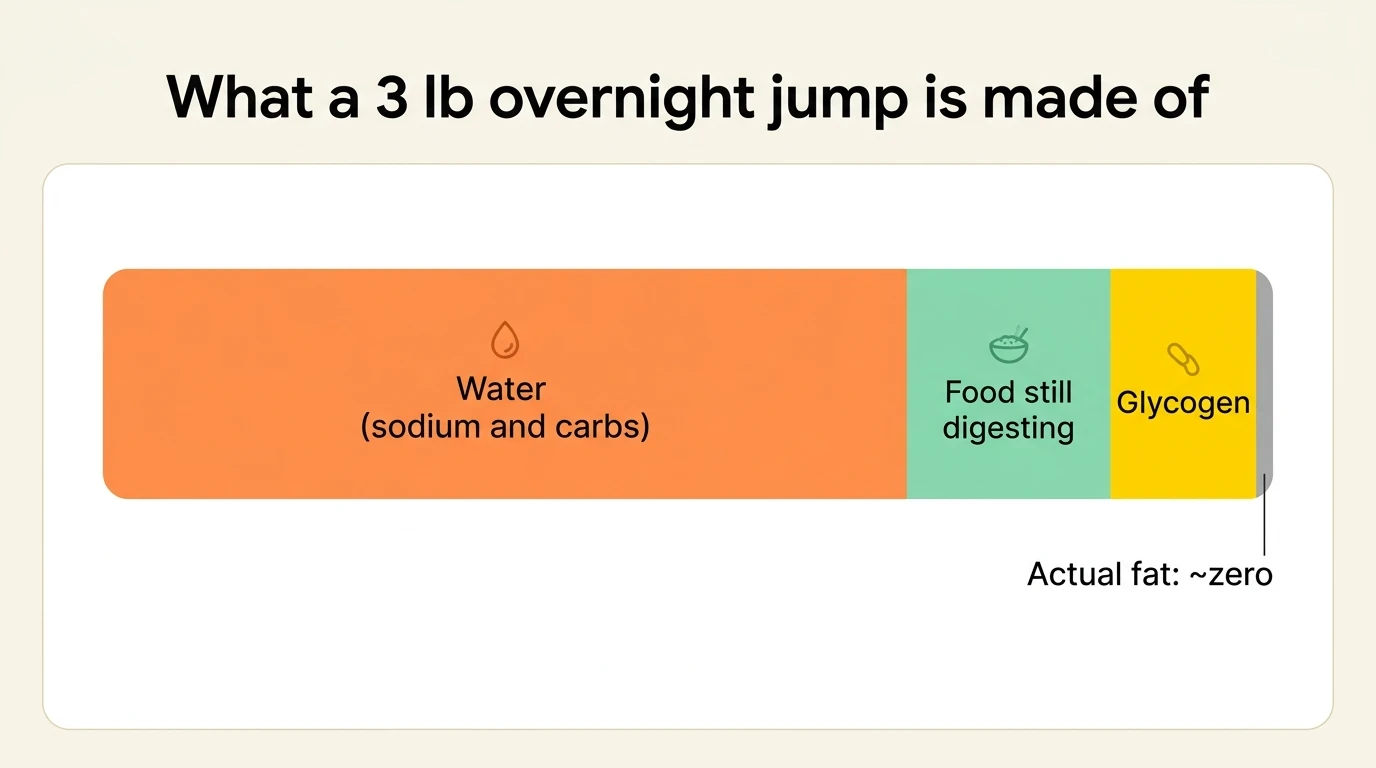
Let's break down what an overnight "gain" is actually made of, because once you see the components, the fat explanation falls apart completely.
Water From Sodium
Sodium causes your body to retain water — it's one of the body's core balancing mechanisms. Eat a salty restaurant meal (and most restaurant food is loaded with sodium), and your body holds onto extra water to keep your sodium concentration stable. That water has weight. A single high-sodium meal can show up as 1–3 pounds on the scale the next morning, all of it water that will flush out over the following day or two as your sodium balance normalizes.
This is why your weight spikes after eating out, after Chinese takeout, after pizza, after anything salty. It's not the calories showing up as fat overnight — it's the sodium pulling water into your tissues. (Staying well-hydrated actually helps your body let that water go rather than hold onto it; for more on that, see what to drink to lose weight.)
Water From Carbohydrates
Here's one most people don't know: your body stores carbohydrates as glycogen, and every gram of glycogen is stored with roughly 3 grams of water. Your muscles and liver can hold a few hundred grams of glycogen, which means the associated water alone can account for several pounds.
This is the entire reason low-carb diets produce dramatic "weight loss" in the first week — you burn through your glycogen stores, dump the associated water, and the scale plummets. It's also why that weight comes right back the moment you eat carbs again. It was never fat. It was glycogen and water.
So a big pasta or rice meal refills your glycogen and pulls in water, and the scale goes up the next day. Again — not fat. Water bound to stored carbs.
Food Still in Transit
This one is almost too obvious to mention, but people forget it constantly: the food you ate yesterday has weight, and it's still inside you. A large dinner eaten late doesn't fully clear your digestive system by morning. You are, quite literally, weighing the food before your body has finished processing it. This is pure transit weight that has nothing to do with fat storage.
Hormones and Other Factors
Hormonal shifts (especially around the menstrual cycle) cause water retention that can swing the scale several pounds. Hard workouts cause temporary water retention from muscle inflammation and repair. Stress raises cortisol, which promotes water retention. Even poor sleep and alcohol affect how much water your body holds — and sleep does far more to your weight than the scale lets on, as we cover in how sleep affects weight loss. None of these change your body fat — they all change the scale.
Add these together — sodium water, carb water, food in transit, hormonal water — and a 2–4 pound overnight swing isn't just possible, it's expected. The fat explanation was never on the table.
The "Whoosh" — When the Scale Suddenly Drops
The flip side of all this is one of the most satisfying experiences in dieting: the "whoosh."
You're dieting carefully. The scale won't budge for a week, maybe two. You're doing everything right and getting nothing. Then one morning you wake up and you're suddenly 2–3 pounds lighter, seemingly overnight.
What happened? The same water mechanics, in reverse. You were losing fat the whole time, but your body was holding onto water that masked it on the scale — often driven by cortisol from the stress of dieting, or just normal retention. Then something prompts your body to release that retained water all at once, and the fat loss that was hidden underneath suddenly shows up on the scale in a single dramatic drop.
Interestingly, the whoosh often happens after a higher-calorie or higher-carb day. People report a plateau breaking right after a refeed or a "cheat" meal — not because the meal caused fat loss, but because it lowered cortisol or shifted water balance enough to release the retained water that was hiding their progress.
The practical lesson: a stalled scale during consistent dieting usually doesn't mean stalled fat loss. It often means water is masking real progress that will reveal itself in a whoosh. If you'd quit during the plateau, you'd have quit right before the payoff. For more on this, see our guide on how to break a weight loss plateau. (And if your scale has genuinely stalled for weeks under conditions you're sure of, water isn't the only suspect — work through why your calorie deficit isn't working next.)
Weigh Daily, But Track the Trend
So if the daily number is mostly noise, should you stop weighing yourself? No. You should weigh yourself — you just need to read it correctly.
The single most important skill in scale-watching: weigh daily, but only ever react to the 7-day average.
Any single day's weight is a chaotic mix of water, food, and timing. But when you average seven days together, the random water fluctuations cancel out and the real signal — your actual fat trend — emerges. One day might be up 2 pounds and the next down 3, but the 7-day average moves slowly and honestly in the direction your body composition is actually going.
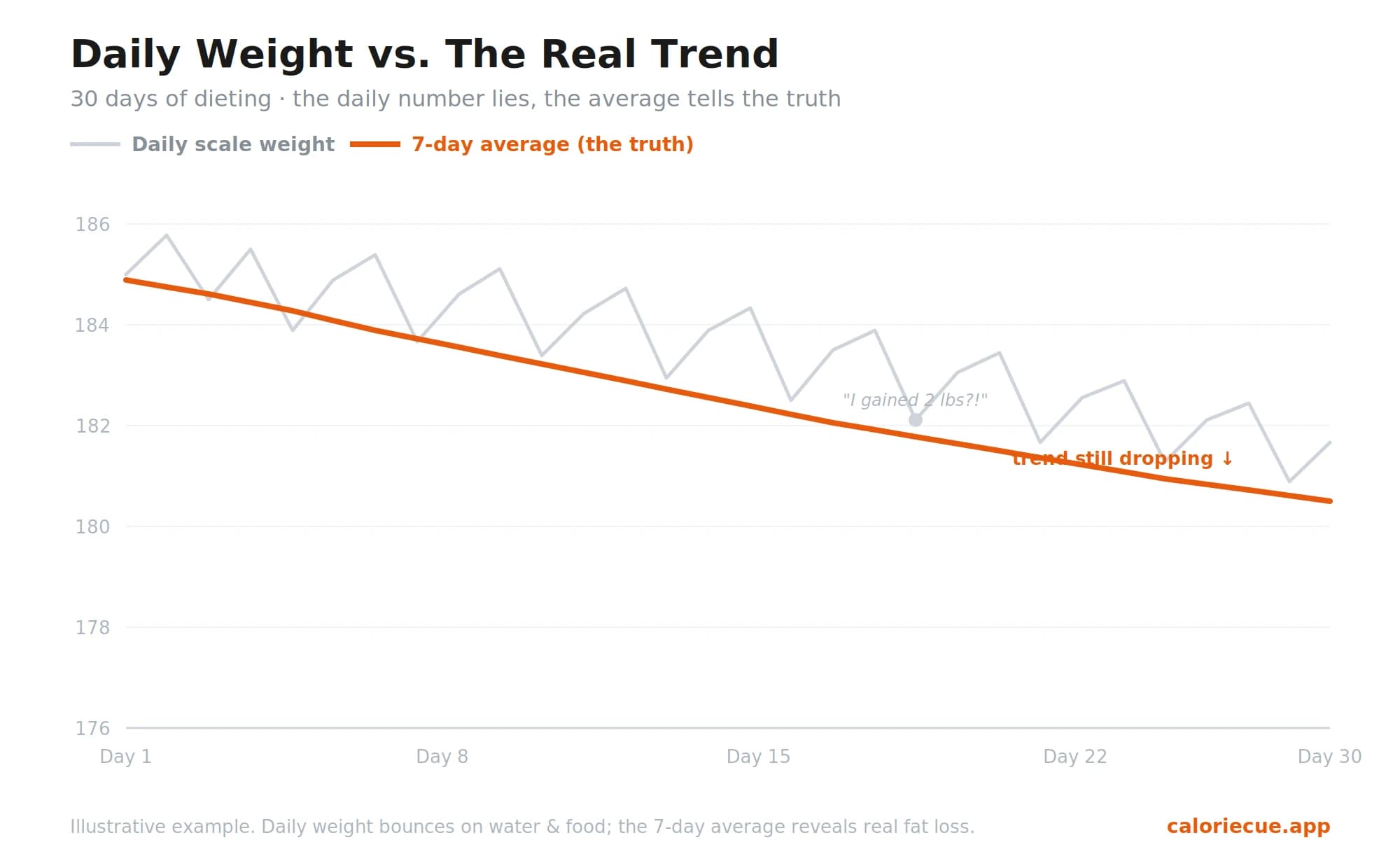
Look at the difference. The daily line bounces around like a heart monitor — up, down, up, up, down — and if you reacted to each day you'd be on an emotional rollercoaster. But the smooth average line tells the real story: a steady, gradual decline. The daily chaos is noise. The trend is the truth.
This is why getting attached to daily numbers is so destructive. A person can be losing fat beautifully — trend line steadily down — and still have three "gain" days in a row that make them feel like a failure. If they only look at the daily number, they quit. If they look at the average, they keep going and succeed. Same data, opposite outcomes. The only difference is which number they chose to trust.
Most modern tracking tools, including CalorieCue, show your weight trend over time rather than just today's reading — precisely because the trend is the number that matters. For more on staying sane while tracking, see our guide on tracking calories without obsessing.
Stop reacting to a number that was never real. CalorieCue shows your weight trend over time right alongside what you ate, so you can see the smooth line under the daily chaos. Snap a photo of any meal to log it in seconds. Download CalorieCue free on the App Store.
How to Actually Use the Scale
If you're going to weigh yourself, do it in a way that produces useful data instead of emotional chaos.
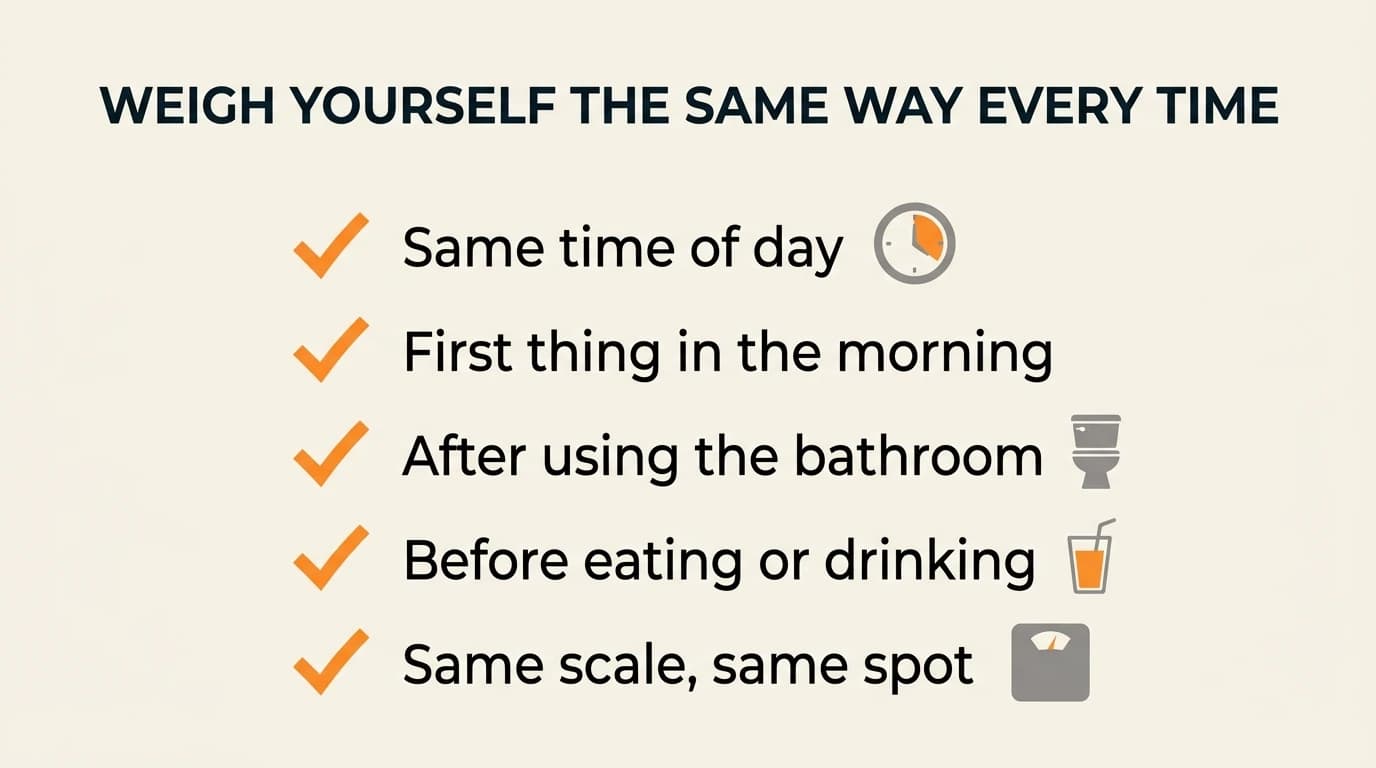
The rules, per guidance echoed by both the Cleveland Clinic and Healthline:
- Same time of day, every time. Morning is best.
- First thing after waking, before the day's food and water complicate things.
- After using the bathroom.
- Before eating or drinking anything.
- Same scale, same spot on the floor. Different scales and uneven floors produce different readings.
Consistency is the entire game. It doesn't actually matter what time you weigh in, as long as it's the same conditions every day — because you're not trying to capture your "true" weight (which doesn't exist as a single number). You're trying to capture a consistent measurement so the day-to-day comparison is apples to apples and the trend is meaningful.
And then — this is the hard part — you look at the number, you log it, and you do not react to it. You react to the weekly average only. The daily number is data for the average, not a verdict on your worth or your progress.
When You Should Actually Worry
Daily fluctuation is normal. But there are situations where a weight change is worth paying attention to.
Worth a doctor's visit:
- Rapid, unexplained weight gain — several pounds in a few days that don't resolve and aren't explained by food, salt, or your cycle. Sudden persistent fluid retention can signal heart, kidney, liver, or thyroid issues.
- Rapid, unexplained weight loss — losing weight without trying is a symptom worth investigating, not celebrating.
- Swelling along with the weight — puffiness in the legs, ankles, or abdomen accompanying weight gain can indicate fluid retention from a medical cause.
- Weight changes after starting a medication — some medications (certain antidepressants, beta-blockers, steroids, and others) cause weight or fluid changes worth discussing with your prescriber.
The key distinction: normal fluctuation resolves. Water weight from a salty dinner is gone in a day or two. If the scale is up and stays up for a week or more with no dietary explanation — or if it's accompanied by swelling or other symptoms — that's the kind of change worth a conversation with your doctor rather than a tweak to your diet.
For everyday dieting, though, the daily swings are just water and food doing what water and food do. They are not a referendum on your progress.
Frequently Asked Questions
How much should my weight fluctuate in a day?
The average adult fluctuates by about 5–6 pounds across a single day — roughly 2–3 pounds in either direction from baseline. Larger swings can happen after very salty meals, big carb-heavy meals, hard workouts, or around the menstrual cycle. This is all normal and almost entirely water and food, not fat.
Why did I gain weight overnight when I ate well?
Almost always water and food, not fat. A high-sodium meal pulls water into your tissues. A high-carb meal refills glycogen, which holds water. Food eaten late is still in your digestive system in the morning. "Eating well" often means eating more (bigger volume, more vegetables, more water-rich foods), which can temporarily show up as weight while passing through.
Why does the scale go down after a cheat meal or carb day?
The "whoosh effect." A higher-calorie or higher-carb day can lower cortisol and shift water balance, prompting your body to release retained water it was holding. The fat loss you'd been making all along suddenly becomes visible. It's water release revealing existing progress, not the meal causing fat loss.
Should I weigh myself every day or once a week?
Daily is actually better — if you track the 7-day average and ignore the individual days. More data points make the average more accurate and reliable. The mistake isn't weighing daily; it's reacting to the daily number. Weigh daily, react weekly.
Is water weight bad?
No. Water weight is just temporary fluid your body is holding for normal reasons (sodium balance, glycogen storage, hormones). It comes and goes within days and has nothing to do with body fat. It only becomes a problem if it's persistent and unexplained, which can signal a medical issue worth checking.
What's the best time to weigh myself?
First thing in the morning, after using the bathroom, before eating or drinking, wearing the same thing (or nothing) each time. But the exact time matters less than consistency — pick a time and conditions and stick to them so your readings are comparable day to day.
The Bottom Line
You didn't gain 3 pounds of fat overnight. It's not encouragement — it's arithmetic. The calories required simply weren't there, which means the scale jump is water, food, and timing, not body fat.
Your weight isn't a single number; it's a range you move through every day, swinging 5–6 pounds based on sodium, carbohydrates, digestion, hormones, exercise, and sleep. A single morning reading is a snapshot of where you are in that range — not a verdict on your progress. The daily number is noise. The 7-day average is the signal.
So here's the whole strategy: weigh yourself daily under consistent conditions, log the number, and then refuse to react to it. Watch the weekly average and the monthly trend. That's where the truth lives. The person who masters this keeps dieting through the water-weight spikes that make everyone else quit — and they're the ones still losing fat when everyone else has given up over a number that was never real. It's the same trend-watching habit that keeps the weight off for good once you get there, which is exactly what our guide on how to maintain weight loss is built around.
If daily scale anxiety has made you quit before, the fix isn't to stop weighing — it's to stop reacting. Tools like CalorieCue show your weight trend over time alongside your food intake, so you can see the smooth downward line under the daily chaos and trust the process. The scale isn't lying to you. You're just reading the wrong number. Read the trend.
Download CalorieCue