On this page
- Why Plateaus Happen (Quick Science)
- The 7-Step Plateau-Breaking Playbook
- Step 1 — Audit Your Tracking (Most Common Fix)
- Step 2 — Recalculate Your TDEE
- Step 3 — Increase Protein
- Step 4 — Add or Change Exercise
- Step 5 — Take a Diet Break
- Step 6 — Address Sleep and Stress
- Step 7 — Trust the Process (Are You Actually Plateaued?)
- What NOT to Do When You Hit a Plateau
- Frequently Asked Questions
- How long do weight loss plateaus last?
- Should I eat less to break a plateau?
- Can eating more break a weight loss plateau?
- How do I know if it's a real plateau or normal fluctuation?
- When should I see a doctor about a weight loss stall?
- Break Through — Don't Give Up
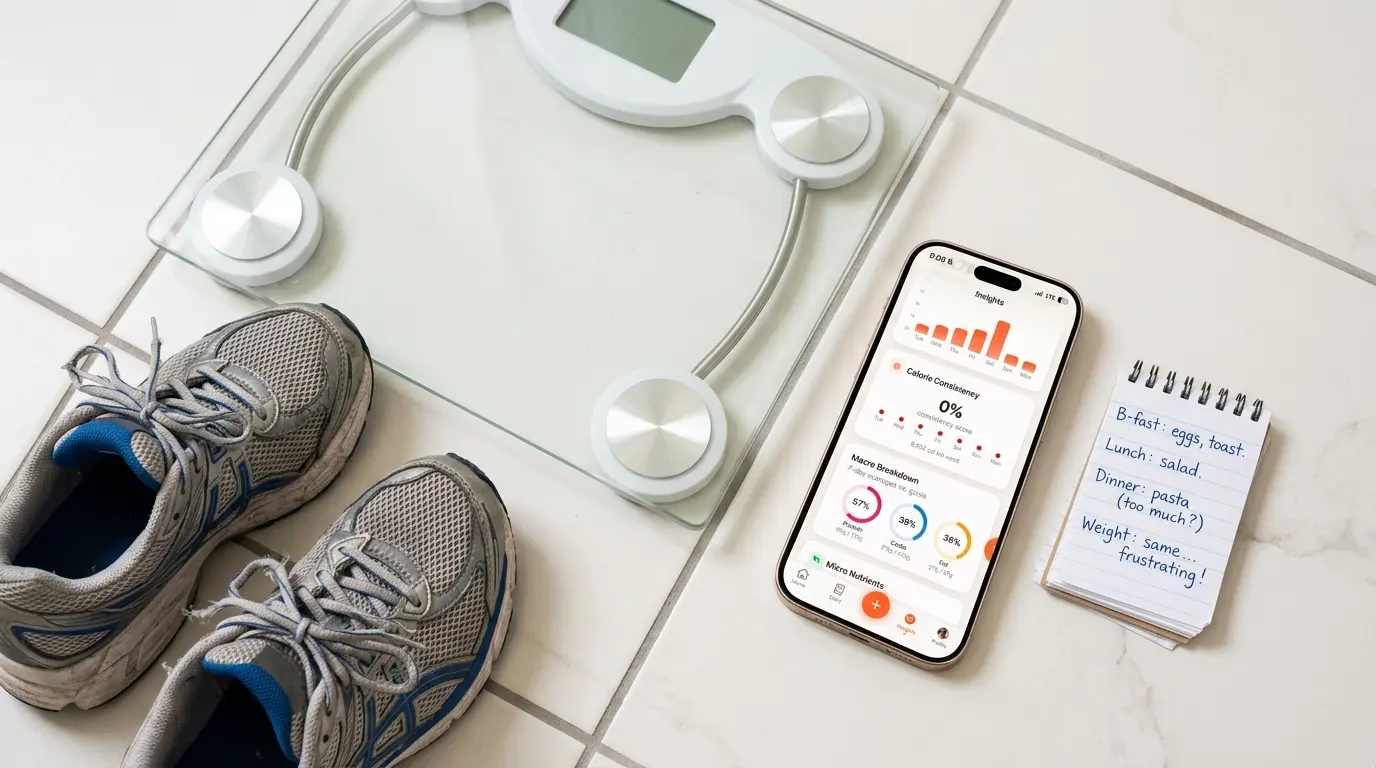
The scale hasn't moved in 3 weeks. You're eating well. You're exercising. What's going on?
If this sounds familiar, you've hit a weight loss plateau — and you're in good company. Research published in the National Library of Medicine shows that virtually everyone who loses weight hits at least one significant plateau. It's not a sign of failure. It's a sign your body has adapted.
The difference between people who break through and people who quit is having a systematic plan. This guide gives you exactly that: 7 specific, ordered strategies to try. Start with Step 1 and work down the list — most people break through within the first three steps.
Why Plateaus Happen (Quick Science)
Before you change anything, it helps to understand why your body stalled. It's not random — there's a clear biological mechanism at work.
Your calorie needs shrink as you lose weight. A smaller body burns fewer calories doing everything — walking, breathing, digesting food, even sleeping. Your Total Daily Energy Expenditure (TDEE) at 180 lbs is meaningfully lower than it was at 200 lbs. The deficit that created steady weight loss three months ago may now be barely below maintenance.
Metabolic adaptation makes it worse. Research from the International Journal of Obesity shows that your body becomes more efficient during prolonged calorie restriction — a survival response called adaptive thermogenesis. Your resting metabolic rate decreases slightly beyond what weight loss alone would predict.
You unconsciously move less. One of the sneakiest adaptations is a reduction in non-exercise activity thermogenesis (NEAT) — the calories you burn fidgeting, standing, walking around your house, and moving throughout the day. Studies show that NEAT can drop by 200–300 calories per day during a prolonged calorie deficit, without you noticing.
The math: the deficit that worked at your starting weight doesn't work at your current weight. Your calorie target needs to shrink with you — or something else needs to change. If you want a deeper dive into all the reasons weight loss stalls, read our guide on why you stopped losing weight.
The 7-Step Plateau-Breaking Playbook
These strategies are ordered intentionally. Start with Step 1 — it's the most common fix and requires the least change. Only move to the next step if the previous one doesn't resolve your plateau within 1–2 weeks.
Step 1 — Audit Your Tracking (Most Common Fix)
Before you change your diet, your exercise, or anything else — confirm that you're actually in a deficit. The single most common reason for a "plateau" is tracking drift: portions have gradually gotten bigger, snacks go unlogged, cooking oils aren't counted, and weekends are a blur.
Research from the New England Journal of Medicine found that people who believed they were eating 1,200 calories per day were actually consuming an average of 2,081 calories — underestimating their intake by nearly 50%. This isn't a willpower problem. It's a measurement problem, and it happens to everyone over time.
Your 7-day audit protocol:
- Track everything for 7 consecutive days — no estimating, no skipping snacks or drinks, no "I'll log it later"
- Include weekends (this is where most tracking falls apart)
- Log cooking oils, sauces, dressings, and beverages
- Weigh portions when possible, or use CalorieCue's photo scanning to catch what manual logging misses
Most plateaus end right here. Before you blame your metabolism, blame your tracking.
Start a 7-day tracking audit today. CalorieCue's AI photo scanning makes it painless — snap every meal and snack, and get accurate calories in seconds. No food scale required. Download CalorieCue free on the App Store.
Step 2 — Recalculate Your TDEE
If your tracking audit checks out and you're genuinely eating what you think you're eating, your calorie target is probably outdated.
Your calorie needs at your current weight are lower than when you started. A person who weighed 200 lbs and now weighs 180 lbs needs roughly 150–200 fewer calories per day just to maintain — which means the deficit that produced a pound of fat loss per week at 200 lbs now produces almost nothing at 180 lbs.
The fix: Recalculate your TDEE every 10–15 lbs lost using our free TDEE calculator. Be honest about your activity level — most people overestimate this. Then set a new deficit of 300–500 calories below your updated TDEE.
Also recalculate after major lifestyle changes: a new job (more or less active), a shift in workout routine, or significant changes to daily movement. Your calorie target should be a living number, not one you set and forget.
Step 3 — Increase Protein
If you're under-eating protein, this single change can break a plateau — and the science is clear on why.
Protein preserves muscle during a deficit. When you lose weight in a calorie deficit, you lose a mix of fat and muscle. Higher protein intake shifts that ratio dramatically in favor of fat loss. A meta-analysis published in the Journal of the American Dietetic Association found that higher protein diets consistently preserved more lean mass during weight loss.
Protein boosts your metabolism. The thermic effect of protein is 20–30% — meaning your body burns 20–30% of protein calories just digesting it, compared to 6–8% for carbs and 2–3% for fat. Swapping 200 calories of carbs for 200 calories of protein means you net fewer usable calories, even at the same intake.
Protein keeps you full. It's the most satiating macronutrient — you'll feel more satisfied on fewer total calories, making your deficit easier to maintain.
Target: Aim for at least 0.7g of protein per pound of body weight. For a 170-pound person, that's roughly 120g per day. If you're currently well below that, increasing protein alone can restart weight loss. Not sure where you stand? Track your macros for a week and find out.
Step 4 — Add or Change Exercise
Your body adapts to exercise just like it adapts to a calorie deficit. If you've been doing the same routine for months, it's time to change the stimulus.
If you only do cardio: Add 2–3 strength training sessions per week. Muscle is metabolically active tissue — it burns calories at rest. Research published in Current Sports Medicine Reports shows that strength training can increase resting metabolic rate by 7–8%, which compounds over time. You don't need to become a powerlifter — bodyweight exercises, resistance bands, or basic dumbbell work all count.
If you already lift: Increase intensity. Add sets, increase weight, reduce rest periods, or try progressive overload (gradually increasing the demands on your muscles). Your body adapts to the same stimulus — give it a new one.
If you do nothing: Start with daily walks. Research from the European Journal of Clinical Nutrition shows that increasing daily steps creates meaningful calorie expenditure without the fatigue and hunger that intense exercise can trigger. Even 7,000–8,000 steps per day makes a real difference — and it's sustainable.
Don't eat back exercise calories. This is one of the most common mistakes during a plateau. Fitness trackers overestimate calorie burn by 20–30% on average. If you're adding exercise to break a plateau, let the extra burn work in your favor — don't compensate by eating more.
Step 5 — Take a Diet Break
This one sounds counterintuitive, but the research backs it up: eating more — strategically — can restart weight loss.
A landmark study from the University of Tasmania (the MATADOR study) found that participants who alternated between 2 weeks of dieting and 2 weeks at maintenance calories lost significantly more fat and experienced less metabolic adaptation than those who dieted continuously for the same total duration.
How a diet break works:
- Eat at your calculated maintenance calories (TDEE, no deficit) for 1–2 weeks
- Continue tracking — this isn't a free-for-all
- This partially reverses metabolic adaptation, restores leptin (the satiety hormone), and reduces cortisol
- When you return to your deficit, your body responds more effectively
This isn't quitting. It's strategic recovery. Think of it like a deload week in training — you're not getting weaker, you're setting up your next phase of progress. A diet break is especially important if you've been in a continuous deficit for 8+ weeks.
Step 6 — Address Sleep and Stress
You can have your calories, protein, and exercise dialed in perfectly — and still stall if your sleep and stress are wrecked.
Sleep deprivation stalls fat loss directly. A study published in the Annals of Internal Medicine found that people in a calorie deficit who slept 5.5 hours per night lost 55% less fat than those who slept 8.5 hours — even though they ate the same number of calories. The sleep-deprived group lost more muscle and less fat. Less than 7 hours of sleep increases ghrelin (hunger hormone), decreases leptin (satiety hormone), and impairs insulin sensitivity.
Chronic stress promotes fat storage. Elevated cortisol encourages your body to store fat — particularly around the midsection — and causes water retention that can mask fat loss on the scale. You might be losing fat but retaining water, and the scale shows nothing.
The fix:
- Sleep: Prioritize 7–9 hours per night. This is non-negotiable for fat loss
- Stress: Identify your primary stressors and address what you can — exercise, meditation, time in nature, and reducing caffeine after noon all help
- Watch for the "whoosh effect": After a period of stress reduction or improved sleep, many people experience a sudden weight drop as their body releases retained water. The fat was already gone — the scale just caught up
Step 7 — Trust the Process (Are You Actually Plateaued?)
Before you overhaul everything, ask an honest question: is this a real plateau, or is it normal fluctuation?
A true plateau is 3 or more weeks at the same weight with a verified calorie deficit. Anything less than that is likely just your body's normal weight fluctuations.
Daily weight can swing 2–5 lbs based on factors that have nothing to do with fat:
- Water retention from sodium, carbs, or exercise-induced inflammation
- Hormonal cycles (especially for women — weight can fluctuate 3–7 lbs around menstruation)
- Food volume in your digestive system (a large meal can "weigh" 2+ lbs before it's processed)
- Stress and cortisol causing water retention
The fix: Track weekly averages, not daily numbers. Weigh yourself at the same time each day (ideally first thing in the morning, after using the bathroom), then average the week. If your weekly average is trending downward — even by 0.2 lbs — you're not plateaued. You're progressing.
Also track non-scale victories:
- Body measurements (waist, hips, thighs)
- How your clothes fit
- Energy levels and mood
- Strength gains in the gym
- Progress photos
Sometimes you're losing fat but gaining muscle — a process called body recomposition that changes your body composition without changing the number on the scale. The scale lies. Your measurements and photos don't.
What NOT to Do When You Hit a Plateau
Some of the most common plateau responses actually make things worse. Avoid these:
Don't crash diet. Dropping to 1,000 calories accelerates metabolic adaptation and muscle loss. You might break through temporarily, but you'll stall even harder — and now with less muscle and a slower metabolism. A moderate calorie deficit is always more effective than an extreme one.
Don't add hours of cardio. Excessive cardio increases cortisol, spikes hunger, and can stall fat loss. More is not always better. Research from the European Journal of Applied Physiology shows that exhaustive endurance exercise significantly elevates cortisol while suppressing testosterone, with recovery taking 48–72 hours for hormones to normalize. If you're already doing 5+ hours of cardio per week, adding more is unlikely to help — and may hurt.
Don't give up. Most people quit right when they're about to break through. Plateaus are temporary — they're a pause, not an endpoint. The strategies in this guide work. Give each one 1–2 weeks before moving to the next.
Don't blame your metabolism. Unless you have a diagnosed thyroid condition, your metabolism isn't "broken." It's adapted — and that's fixable with the strategies above. The American Thyroid Association notes that true metabolic disorders account for a very small percentage of weight-loss difficulties.
Don't compare your timeline to others. Everyone's body responds to calorie deficits differently based on genetics, starting weight, body composition, hormonal status, and history. Focus on your own data and your own trend line. If you find yourself getting frustrated, our guide on how to track without obsessing can help you maintain a healthier relationship with the process.
A few flat or higher weigh-ins are not enough to establish a plateau. Check why weight fluctuates daily and compare averages taken under similar conditions.
Frequently Asked Questions
How long do weight loss plateaus last?
A typical plateau lasts 2–4 weeks, though some persist for 6–8 weeks depending on how long you've been dieting and how aggressive your deficit is. Plateaus are a normal, expected part of the process — virtually everyone who loses significant weight hits at least one. The key is having a systematic approach to break through. Start with a tracking audit (Step 1), recalculate your TDEE (Step 2), and work through the remaining strategies. Most people break through within 1–3 weeks of making targeted changes.
Should I eat less to break a plateau?
Not necessarily — and it's often the wrong move. If you're already eating below 1,400 calories, cutting further risks muscle loss, metabolic slowdown, and nutrient deficiencies that make the plateau worse. Before reducing calories, first audit your tracking accuracy (the most common fix), recalculate your TDEE at your current weight, and check your protein intake. A moderate deficit of 300–500 calories below your TDEE is more sustainable and effective than aggressive restriction. Sometimes the answer is actually eating more — see the diet break strategy (Step 5).
Can eating more break a weight loss plateau?
Yes — in the right context. A strategic diet break (eating at calculated maintenance calories for 1–2 weeks) can help reverse metabolic adaptation, restore hunger and satiety hormones, and improve long-term fat loss outcomes. The MATADOR study found that participants who took periodic diet breaks lost more fat and maintained a higher metabolic rate than those who dieted continuously. This doesn't mean eating whatever you want — it means intentionally and accurately eating at your TDEE for a defined period, then returning to your deficit.
How do I know if it's a real plateau or normal fluctuation?
A true plateau is 3 or more weeks at the same weight while maintaining a verified calorie deficit. Daily weight fluctuations of 2–5 lbs are completely normal — caused by water retention, sodium intake, hormonal cycles, food volume, and exercise-induced inflammation. The best way to tell the difference: track weekly weight averages instead of daily numbers. If your weekly average is declining — even slowly — you're not actually plateaued. Also track body measurements and how your clothes fit, since body recomposition (losing fat while gaining muscle) won't show on the scale.
When should I see a doctor about a weight loss stall?
See a doctor if you've been accurately tracking your food, maintaining a verified calorie deficit, exercising consistently, and following the strategies in this guide for 8–12 weeks with no change in weight, body measurements, or body composition. Medical conditions like hypothyroidism, PCOS, insulin resistance, Cushing's syndrome, and certain medications (antidepressants, corticosteroids, beta-blockers) can significantly impair weight loss. A simple blood panel can rule out most of these causes. The American Thyroid Association recommends thyroid testing as a first step for unexplained weight-loss resistance.
Break Through — Don't Give Up
Plateaus are normal, temporary, and fixable. They happen to virtually everyone who loses weight, and they don't mean your body is broken or your approach isn't working. They mean your body has adapted — and it's time to adapt back.
Start with Step 1: audit your tracking. Before you change your diet, your exercise, or anything else, spend 7 days tracking everything accurately. Most plateaus are tracking problems, not metabolism problems — and a week of honest data will tell you exactly where the gap is.
If the tracking checks out, work through the remaining steps: recalculate your TDEE, increase protein, change your exercise, consider a diet break, fix your sleep, and make sure you're actually plateaued and not just experiencing normal fluctuation.
The people who break through aren't the ones with the best genetics or the most willpower. They're the ones who treat the plateau as a data problem — identify the variable that changed, fix it, and keep going.
Start your 7-day audit today — Download CalorieCue and track every meal.
Download CalorieCue