On this page
- What Each One Actually Tracks
- Why Calorie Counting Alone Is Probably Underselling You
- Why Full Macro Counting Is Overkill for Most People
- The Hybrid: Calories Plus Protein Only
- A Quick Self-Test
- Where People Get Stuck
- When the Method Stops Mattering
- A Quick Reference Table
- Frequently Asked Questions
- The Bottom Line
Calorie Counting vs. Macro Counting: Which Is Right for You?
I'll save you 13 minutes of reading and tell you the honest answer right now: most people should track calories and protein. Not full macros. Not just calories. Both of those, and only those.
That's the answer. The rest of this post is the reasoning, the exceptions, and how to know if you're one of them.
If you've been going back and forth on whether to count calories or count macros, you're not stuck because the question is hard. You're stuck because the people answering it are giving you the wrong question. The "calories or macros?" debate frames this like a binary choice between two complete systems, when in reality the choice almost everyone should make is somewhere in between.
Let me explain why.
What Each One Actually Tracks
Both methods involve writing down what you eat. The difference is what you pay attention to once it's written down.
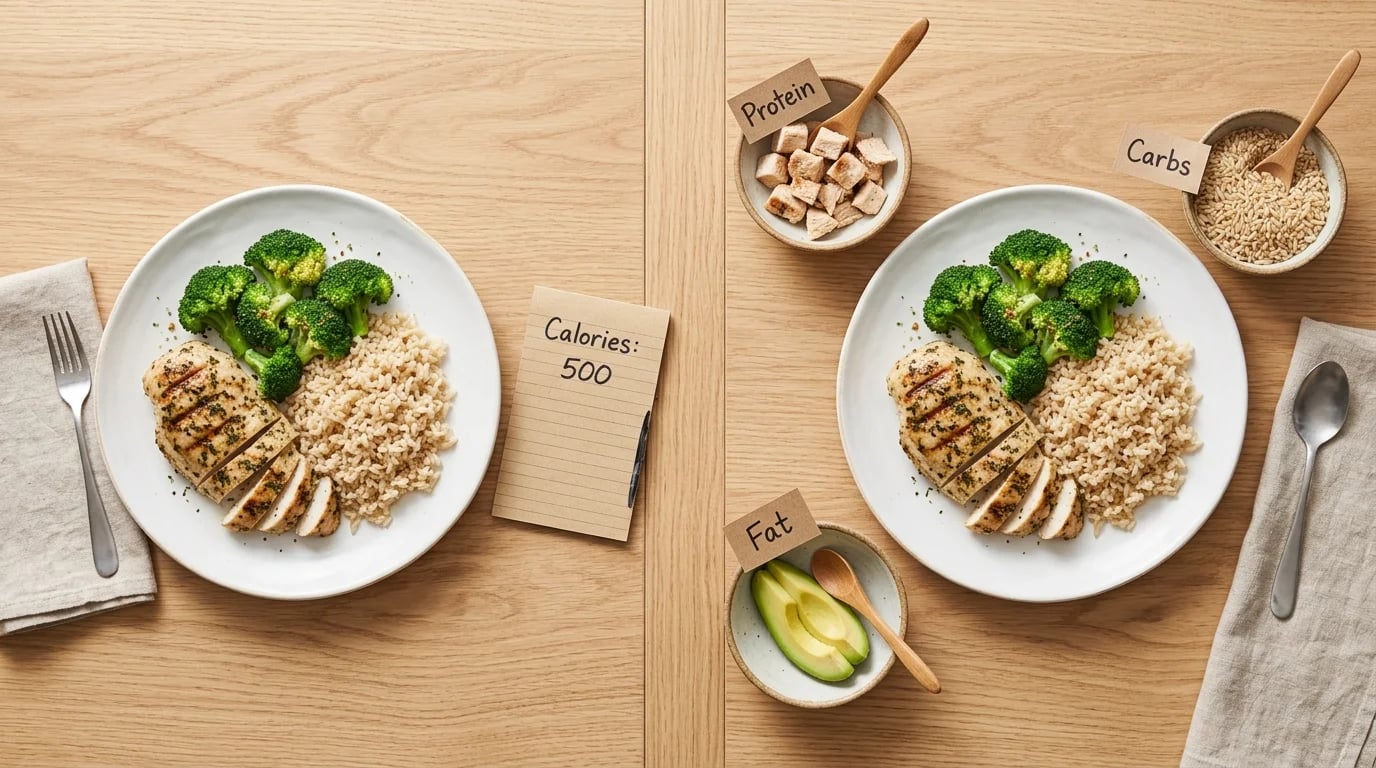
When you count calories, you're tracking total energy. One number per day. Did I stay under my target? Yes or no.
When you count macros, you're tracking that same total energy plus how it breaks down into protein, carbohydrates, and fat. Four numbers per day. Did I hit my calorie target and land within my gram ranges for each macro? It's harder to win because there are more ways to lose.
Here's the thing nobody points out: tracking macros automatically tracks calories. Every gram of protein and carbs is 4 calories. Every gram of fat is 9. Add up the macros and you've added up the calories whether you wanted to or not. The reverse is not true — you can hit a calorie target eating literally anything, with no idea whether it was 30 grams of protein or 130.
So the question isn't really "calories versus macros." The question is whether you want that extra layer of information about what your calories are made of. For some people, that information changes everything. For most, it just adds friction without changing outcomes.
Why Calorie Counting Alone Is Probably Underselling You
Calorie counting works. The research is unambiguous on this. If you eat fewer calories than you burn, you lose weight. It doesn't matter if those calories come from steak, oatmeal, or Skittles — though the last one will leave you miserable. If you're new to the idea, our guide on how to count calories walks through the basics, and how to calculate your calorie deficit covers setting the right target.
But here's what calorie counting alone doesn't tell you: where the weight you're losing is coming from.
Imagine two people who both lose 20 pounds in three months. Person A counted calories and ate whatever fit — bagels, pasta, chips, chicken. Person B counted calories and hit a protein target. Same weight loss on the scale.
Now strip them both naked in front of a mirror. Person A is smaller but soft. The "skinny fat" look — lower number on the scale, but no muscle definition, slow metabolism, and prone to gaining the weight back the moment they stop dieting. Person B looks lean. They kept the muscle they had, lost actual fat, and their metabolism didn't take a hit.
This isn't a hypothetical. The Mayo Clinic explicitly addresses this: when you cut calories without paying attention to protein, you lose muscle along with fat. And losing muscle is bad on every dimension that matters — appearance, metabolism, longevity, strength, daily function.
The fix is almost embarrassingly simple. You don't need to count three macros. You just need to make sure protein is high enough.
Why Full Macro Counting Is Overkill for Most People
Now the other side. The macro-counting community will tell you that hitting specific carb and fat ratios matters. That if you're not at exactly 30/40/30 or whatever your particular guru recommends, you're leaving results on the table.
This is mostly true for athletes and bodybuilders. It's mostly not true for someone trying to lose 25 pounds.
Here's what happens when a regular person tries to track full macros from day one. They calculate their targets. They start logging meals. They realize at 2pm that their carb total is going to be way over and their fat is going to be way under. They restructure dinner. Then their daughter wants pizza and the math falls apart entirely. By Saturday they've stopped tracking and by next Tuesday the app is buried in a folder on their phone.
The complexity isn't theoretical — it's the actual reason most people quit tracking. And quitting tracking is what causes failed weight loss, not the wrong macro ratio.
For someone whose only goal is "lose weight and feel better," carb and fat targets add complexity without adding meaningful results. As long as you're hitting your calorie target and your protein target, the carbs and fats sort themselves out within reasonable ranges.
The exceptions are real but specific. If you're doing serious resistance training, your carb timing around workouts matters. If you have diabetes, your carb distribution matters a lot. If you're competing in a sport with weight classes or aesthetic judgment, every percentage point matters. For these people, full macro counting is genuinely useful — and our how to count macros guide covers it in detail. For everyone else, it's an optimization problem you don't have yet.
The Hybrid: Calories Plus Protein Only
This is what almost every experienced tracker eventually settles into, and almost nobody writes about clearly.
You set a calorie target — start with our TDEE calculator if you don't know yours. You set a protein target — somewhere around 0.7 grams per pound of body weight, or 1.2–1.6 grams per kilogram. You hit both. You don't track carbs. You don't track fat. They land where they land.
Why this works: protein is the only macro that meaningfully changes weight loss outcomes for most people. According to WeightWatchers' analysis, people eating 30% of their calories from protein report 34% greater satiety than those eating 18%. That's not a small effect. That's the difference between feeling satisfied at 1,500 calories and feeling like you're starving at 1,500 calories.
Carbs and fats matter for performance and personal preference. They don't matter much for whether you lose weight, as long as your total calories and protein are right. So why pretend they do?
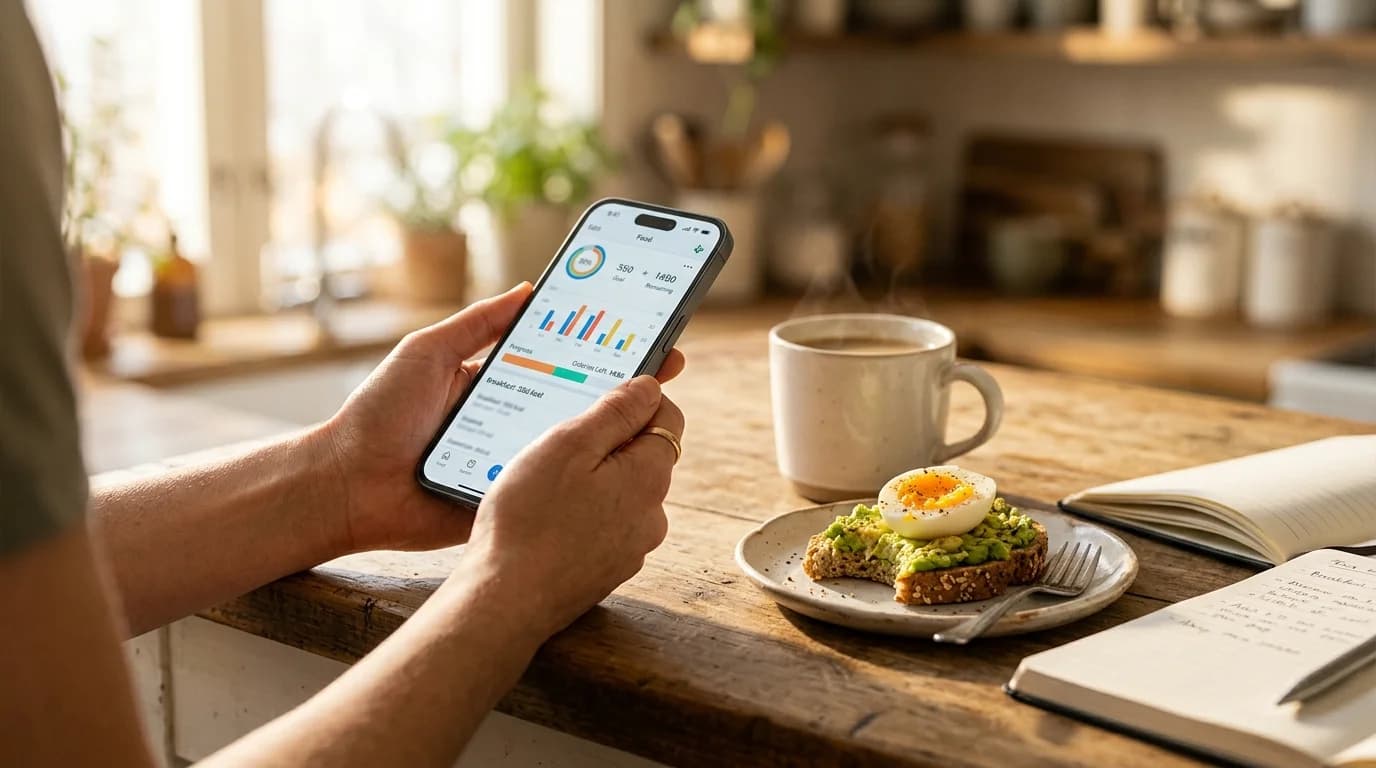
The hybrid is barely more work than pure calorie counting. Modern apps show your protein number automatically when you log a meal. You're not doing extra math — you're just glancing at one extra number. Maybe 30 seconds more per day, total.
This is the honest answer for most people reading this. Don't choose between calories and macros. Choose calories and protein, and let the rest go.
A Quick Self-Test
Three questions. Answer them honestly.
1. Have you tracked calories consistently for at least 30 days in the past?
If no — start with calorie counting alone. Don't add protein yet. Build the habit first, or you'll quit from the complexity.
If yes — go to question 2.
2. Do you lift weights or train seriously (3+ times per week)?
If no — do the hybrid. Calories plus protein. That's it.
If yes — go to question 3.
3. Are you trying to look a specific way (lean, defined, competition-ready) or hit specific performance goals?
If no — the hybrid still covers you. You can layer in carb timing later if you plateau.
If yes — track full macros. The complexity is worth it for your goals.
That's the entire decision. Three questions, no spreadsheet required.
Where People Get Stuck
A few specific situations come up over and over in my conversations with people who track:
"I'm hitting my calorie target but I'm hungry all the time." This is almost always a protein problem. You're probably at 50–70 grams a day and feeling miserable. Get to 100+ and the hunger usually disappears within a week. Read our guide on how to eat more protein for specific ways to do this without overhauling your diet.
"The scale is moving but I look softer." Calorie counting without protein. You're losing muscle along with fat. Switch to the hybrid immediately and add some resistance training if you're not already lifting.
"I tried tracking macros and gave up." Either start over with just calories, or do the hybrid. Don't try full macros again — the complexity didn't work for you and there's no shame in that. Most people who claim to "track macros" are actually doing the hybrid in practice.
"I have diabetes / kidney disease / a specific medical condition." Talk to a registered dietitian, not a blog post. The advice in this post assumes a healthy adult without specific medical needs that would change the macro calculation.
"I'm trying to gain muscle, not lose weight." Same hybrid principle. Calories higher than your maintenance, protein high. Carbs and fats can adjust based on what feels good for your training, but the core formula is the same.
When the Method Stops Mattering
I want to say something that might surprise you given everything else in this post: at some point, the method stops mattering as much as the consistency.
I've watched people lose 60 pounds counting only calories with zero attention to protein. I've watched people lose nothing counting full macros for six months. The difference wasn't the method. It was whether they actually logged their food consistently and stayed in a calorie deficit.
The best tracking method is the one you'll actually do for the next six months. If pure calorie counting is the only thing you can stick with, that's better than starting macros and quitting in three weeks. If you've tried calories before and felt frustrated by the lack of structure, macros might give you the framework you need. Match the method to your psychology, not just to the theoretical optimum.
For more on the psychology side of consistent tracking, our guide on tracking calories without obsessing covers what to do when tracking starts to feel heavy.
A Quick Reference Table
Sometimes you just want the comparison at a glance.
| Factor | Calories Only | Calories + Protein (Hybrid) | Full Macros |
|---|---|---|---|
| Time per meal | 30–60 sec | 30–60 sec | 1–2 min |
| Mental load | Low | Low | Moderate to high |
| Best for weight loss | Yes | Yes | Yes |
| Best for muscle preservation | Limited | Strong | Strong |
| Best for performance | No | Decent | Best |
| Recommended for beginners | Yes | After 30 days | Rarely |
| What most people should do | Starting out | After basics | Specific goals only |
The middle column is the one to pay attention to. That's the column most readers of this post should be in.
Download CalorieCueFrequently Asked Questions
Will I lose weight faster on macros than on calories?
Probably not faster on the scale. Probably better in the mirror. Same total weight loss, but more of it from fat and less from muscle, which is what you actually want.
Is the hybrid really enough?
For probably 80% of people reading this, yes. The remaining 20% have specific reasons (serious training, medical conditions, athletic goals) that justify full macro tracking. Most posts won't tell you this because the macro-counting industry sells programs and apps that depend on you believing you need the full system.
What if I hit my calorie target but my protein is way under?
You're going to feel hungry, and you're probably losing more muscle than fat. Get the protein up. Easiest way: front-load breakfast with eggs or Greek yogurt instead of cereal or toast. That alone usually adds 20–25 grams of protein to your day with no other changes.
Does the macro split (40/30/30, etc.) actually matter for weight loss?
Within reasonable ranges, no. Studies comparing low-fat to low-carb diets find similar weight loss outcomes when calories are equated. The "perfect macro ratio" is mostly a marketing concept. Get protein right, then split carbs and fats based on what you enjoy and what makes you feel good.
How long should I track for?
Long enough to internalize portion sizes and calorie awareness. For most people, that's 3–6 months. After that, you can shift to spot-checking — tracking one week per month, or just tracking when you feel like things are drifting. The skill of estimating calories accurately stays with you even when you stop logging daily.
Can I just eat whole foods and skip tracking entirely?
Some people can. They tend to be the ones who weren't really overeating in the first place — their problem was food quality, not quantity. If your weight has been stable for years and you just want to eat better, you might not need tracking at all. But if you're genuinely overweight, "just eat whole foods" usually doesn't get the calorie math right without measurement.
Does it matter what app I use to track?
Less than you'd think. The best app is the one you'll actually use consistently. Manual entry apps like MyFitnessPal work fine. Photo-based AI apps like CalorieCue work fine. The friction of logging is the real enemy — whichever app reduces that friction most for you is the right one.
The Bottom Line
If you came here looking for permission to skip one or the other, here it is.
You don't need to count full macros to lose weight. You don't need to obsess over carb timing or fat percentages. For most people, those details are noise on top of the actual signal.
But you also shouldn't count only calories if you can avoid it. Adding a single number — protein — to your tracking is a small effort with a large payoff. Better satiety, better body composition, better long-term results. Almost everyone reading this should be doing the hybrid.
Start where you are. If you're new, just count calories for the first month — our guide on how to track calories walks through the simplest setup. When that feels automatic, add protein. If you're already comfortable with calories, add protein today. If you have specific reasons that justify full macros — competition, medical condition, serious training — go for it, but don't add the complexity unless you have an actual reason.
Whatever method you pick, consistency beats optimization every time. A six-month streak of "good enough" tracking will produce better results than a six-week streak of perfect tracking followed by quitting. The goal isn't the prettiest spreadsheet. It's results in real life.
CalorieCue shows both calories and protein automatically when you snap a photo of your meal. If the friction of manual logging is what's broken your consistency before, AI photo tracking might be what makes the hybrid sustainable for you. Seven-day free trial, then paid — and worth trying if traditional tracking has been the obstacle.
Either way, pick one and go. The method matters less than you've been told. The consistency matters more.
Download CalorieCue