On this page
- Macro Cheat Sheet: The Quick Answer
- What Is Inside the Printable Macro Tracking Sheet?
- How to Use a Protein, Carb and Fat Food List
- Protein Foods: Build the Meal Around These
- Carbohydrate Foods: Match the Serving to the Day
- Fat Foods: Measure the Small Portions That Add Up Fast
- Mixed Foods: Why One Food Can Count Toward Two Macros
- How to Build a Meal From Your Macro Targets
- Three Worked Macro-Friendly Meals
- Greek-yogurt breakfast
- Chicken-rice lunch or dinner
- Cottage-cheese snack
- How to Use Your Own Macro Target
- Six Macro Tracking Mistakes to Avoid
- Download the Macro Tracking Cheat Sheet
- Frequently Asked Questions
- What foods count as protein, carbs, and fat?
- Do I need to hit my macros exactly every day?
- Should I track total carbs or net carbs?
- Should macro values be measured raw or cooked?
- Do I need to track macros to lose weight?
- What is included in the free macro cheat sheet PDF?
- The Bottom Line
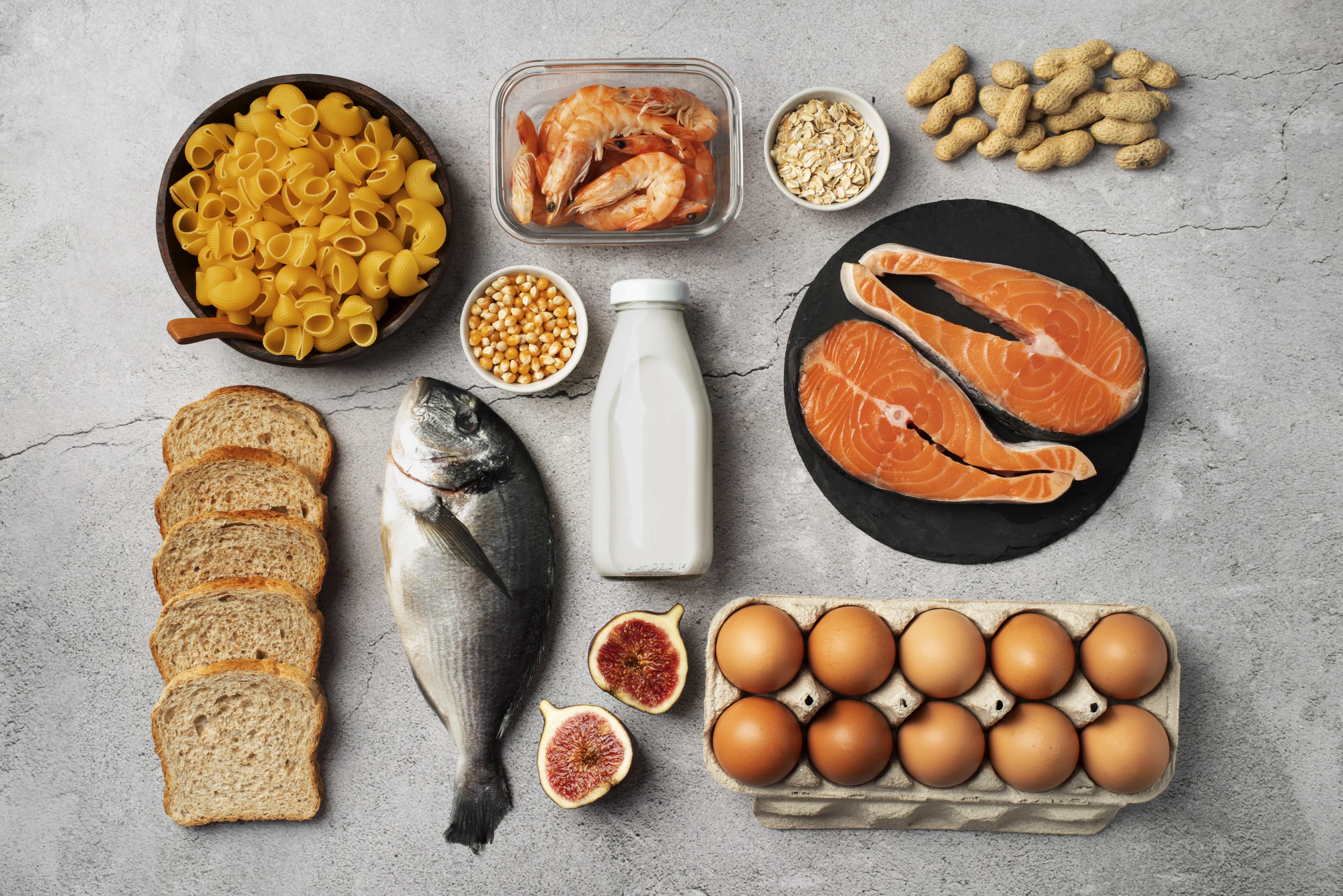
Protein, carbohydrates, and fat are not three separate food kingdoms. Most foods contain a mix of all three. The practical move is to use a food's dominant macro when building a meal, then count its complete macro profile when you track it.
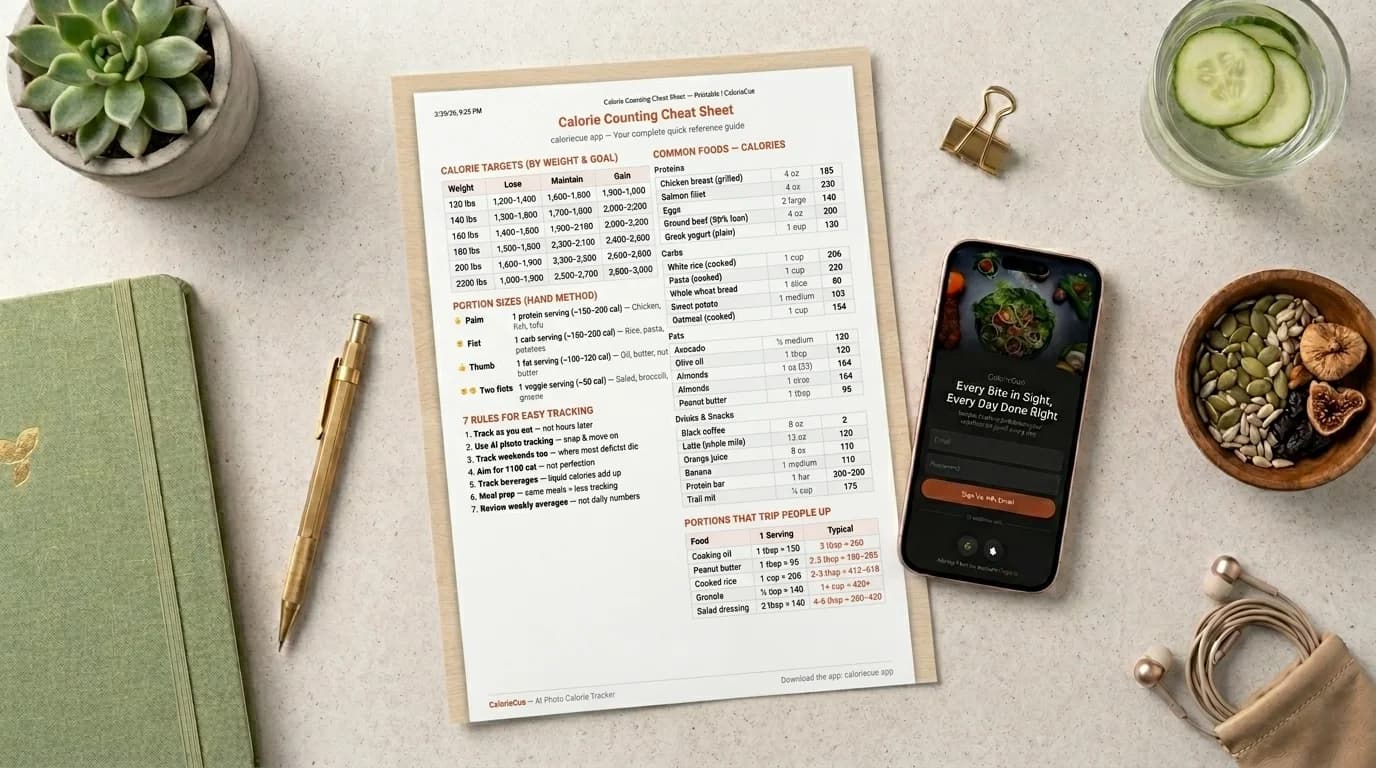
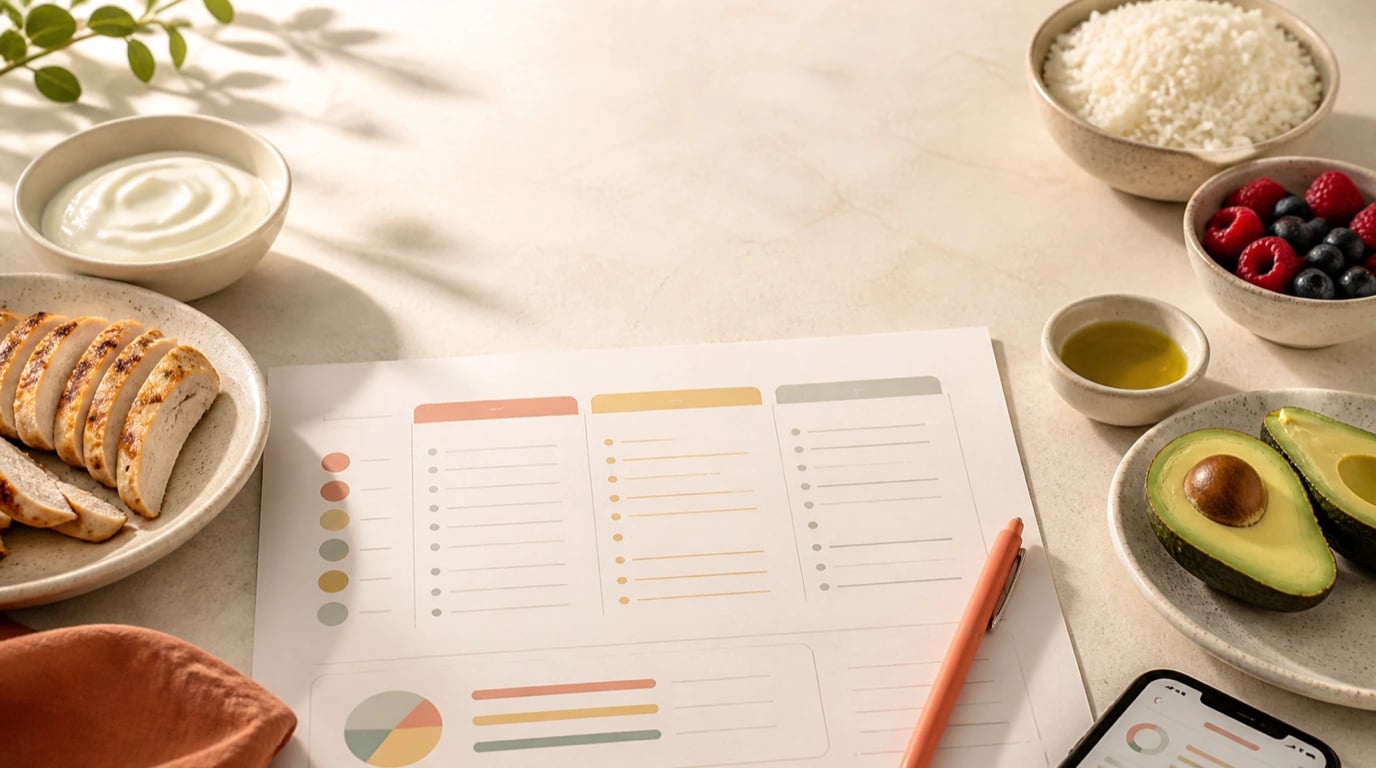
This macro tracking cheat sheet turns that idea into a printable system: common foods with realistic servings, a simple meal builder, and a seven-day log you can use without rebuilding the math every morning.
Macro Cheat Sheet: The Quick Answer
Use this three-part rule when you need a fast macro reference:
- Build around a protein-dominant food. Chicken breast, fish, egg whites, Greek yogurt, cottage cheese, tofu and similar choices make the protein amount visible instead of accidental.
- Add a carbohydrate serving that fits the meal. Rice, oats, potatoes, pasta, bread and fruit are easy to increase or reduce because their portions are recognizable.
- Measure concentrated fat sources. Oil, butter, nuts, seeds, nut butter and avocado can be useful parts of a meal, but a casual pour or scoop is difficult to estimate.
Then log the whole row, not just the dominant number. A cup of lentils is carbohydrate-dominant in this reference, but it also provides protein. Salmon is protein-dominant, but much of its energy comes from fat. Calling a food “protein” is a planning shortcut, not permission to erase its carbs or fat.
The familiar 4/4/9 rule explains the energy math: protein and total carbohydrate provide about 4 calories per gram, while fat provides about 9. That is the general calculation permitted in federal nutrition-label rules under 21 CFR 101.9. Treat it as a useful check, not a promise that every rounded row will multiply to the displayed calorie number. Labels round nutrient values, and the regulation also allows food-specific calculation methods. Our calories-per-gram guide has the full formula and calculator.
What Is Inside the Printable Macro Tracking Sheet?
The download is built as a desk-side or fridge-side reference, not another long lesson. It contains a cover and five working sheets:
- Macro quick start: the dominant-macro rule, the 4/4/9 reference and a repeatable plate-building sequence.
- Protein food list: meat, seafood, eggs, dairy and plant options with a named serving and complete protein, carbohydrate and fat values.
- Carbohydrate, fat and mixed-food lists: practical portions for grains, fruit, oils, nuts, seeds and foods that do not fit neatly into one category.
- Meal builder: three examples showing how individual rows combine into a meal total.
- Seven-day log: space for daily calories and macros, followed by weekly averages so one unusual meal does not become the whole story.
The page you are reading previews the core tables. The printable holds the expanded set, so you can scan more choices without opening multiple browser tabs at the grocery store or while meal prepping.
The food figures are rounded household-serving estimates based on records in USDA FoodData Central, which USDA describes as its comprehensive source of food-composition data. This is the data policy for the table: match the named food, serving and preparation state; keep all three macros; expect brands, varieties and recipes to differ. For a packaged food, its current label is more specific than a generic database entry.
Get the Free Macro Tracking Cheat Sheet PDF
5 printable reference sheets plus a cover: protein, carbohydrate, and fat references; a meal-builder sheet; and a seven-day tracking log. Enter your email and we'll send you the PDF.
How to Use a Protein, Carb and Fat Food List
Start with what you are actually eating. Find the closest row, check that the serving and preparation state match, and scale the full row to your portion. If you eat half the listed amount, halve calories, protein, carbs and fat. If you eat one and a half servings, multiply every value by 1.5.
For meal planning, classification keeps the process quick:
- A protein-dominant food supplies the anchor of the meal.
- A carbohydrate-dominant food is the easiest lever for adding grain, starch or fruit.
- A fat-dominant food adds a concentrated portion that is worth measuring.
- A mixed food needs deliberate placement because two or more macros are meaningful.
For tracking, classification disappears. Enter the complete values. If lunch contains chicken, rice and olive oil, you do not log chicken as protein only or rice as carbs only. You count the small amounts in the other columns too. Those secondary numbers are why a carefully built day can drift from its target when only “main” macros are counted.
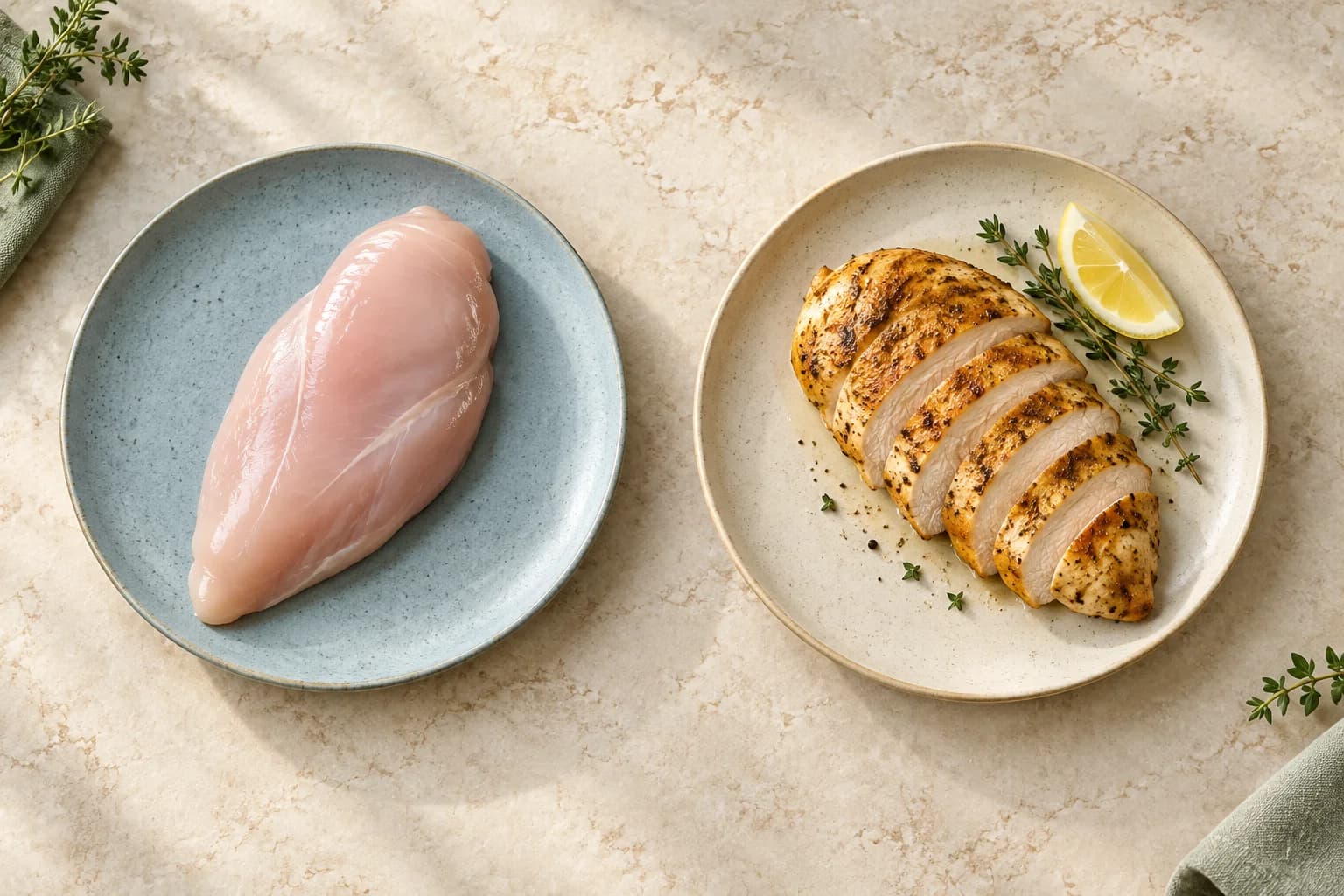
Use one source consistently. Switching between a raw chicken entry and a cooked chicken weight, or between dry oats and prepared oatmeal, creates a mismatch even when both database records are individually valid. The serving description is part of the number.
Protein Foods: Build the Meal Around These
The leaner rows make it easier to add protein without using much of the meal's fat allowance. The higher-fat rows can still fit; they simply occupy two jobs at once. For a larger efficiency comparison, use our protein per calorie chart, or browse high-protein, low-calorie foods when you want more meal-ready choices.
| Protein-dominant food | Serving and state | Calories | Protein | Carbs | Fat |
|---|---|---|---|---|---|
| Chicken breast | 4 oz cooked, skinless, roasted | 187 | 35g | 0g | 4g |
| Turkey breast | 4 oz cooked, skinless, roasted | 167 | 34g | 0g | 2g |
| Pork tenderloin | 4 oz cooked, roasted, lean only | 162 | 30g | 0g | 4g |
| Light tuna | 4 oz canned in water, drained | 102 | 22g | 0g | 1g |
| Pacific cod | 4 oz cooked, dry heat | 96 | 21g | 0g | 1g |
| Shrimp | 4 oz cooked | 112 | 27g | 0g | 0g |
| Egg whites | 3 large, raw, fresh | 51 | 11g | 1g | 0g |
| Greek yogurt (nonfat) | 1 cup (227 g), plain | 138 | 23g | 8g | 1g |
| Cottage cheese (2%) | 1 cup (220 g), low-fat | 185 | 24g | 9g | 5g |
| Firm tofu | 4 oz, drained, raw | 163 | 20g | 3g | 10g |
Notice the practical differences. Tuna and cod are close to protein-only in this serving. Cottage cheese brings carbohydrate and fat with its protein. Tofu is useful as a protein anchor, but treating it as zero-fat would undercount the meal. Choose by the complete row and by what you enjoy, tolerate and can prepare consistently.
Carbohydrate Foods: Match the Serving to the Day
Carb portions are easy to adapt because many common choices come in cups, pieces or slices. Keep the preparation state attached to the measurement: one cup of cooked rice is not one cup of dry rice, and half a cup of dry oats is not half a cup of cooked oatmeal.
| Carbohydrate-dominant food | Serving and state | Calories | Protein | Carbs | Fat |
|---|---|---|---|---|---|
| White rice | 1 cup cooked, long-grain | 205 | 4g | 45g | 0g |
| Brown rice | 1 cup cooked, medium-grain | 218 | 5g | 46g | 2g |
| Oats | 1/2 cup dry (40 g), rolled | 152 | 5g | 27g | 3g |
| Quinoa | 1 cup cooked | 222 | 8g | 39g | 4g |
| White potato | 1 medium (173 g), baked, flesh and skin | 164 | 5g | 37g | 0g |
| Sweet potato | 1 medium baked in skin | 103 | 2g | 24g | 0g |
| Whole-wheat bread | 1 slice (32 g), commercially prepared | 81 | 4g | 14g | 1g |
| Pasta | 1 cup cooked (140 g), enriched, unsalted | 221 | 8g | 43g | 1g |
| Banana | 1 medium, raw | 105 | 1g | 27g | 0g |
| Blueberries | 1 cup, raw | 84 | 1g | 21g | 0g |
Match the serving to the meal rather than assigning a moral label to the food. A full cup of rice may suit one plate; half a cup may suit another. Fruit and bread can make smaller adjustments. The useful question is not “Is rice allowed?” It is “What portion completes this meal and how will I record it?”
Fat Foods: Measure the Small Portions That Add Up Fast
Fat contains about 9 calories per gram under the general 4/4/9 calculation, so a small change in a poured or scooped serving can move a meal total quickly. This is a measurement issue, not a reason to avoid fat. Use tablespoons, teaspoons or a scale when accuracy matters, especially for oil and nut butter.
| Fat-dominant food | Serving and state | Calories | Protein | Carbs | Fat |
|---|---|---|---|---|---|
| Olive oil | 1 tbsp, measured | 119 | 0g | 0g | 14g |
| Butter | 1 tbsp, salted | 102 | 0g | 0g | 12g |
| Avocado | 1/2 avocado (about 101 g), raw | 161 | 2g | 9g | 15g |
| Almonds | 1 oz (about 23), raw | 164 | 6g | 6g | 14g |
| Walnuts | 1 oz, raw | 185 | 4g | 4g | 18g |
| Peanut butter | 2 tbsp, smooth, unsalted | 191 | 7g | 7g | 16g |
| Chia seeds | 2 tbsp (28 g), dried | 136 | 5g | 12g | 9g |
| Tahini | 1 tbsp, roasted sesame paste | 89 | 3g | 3g | 8g |
Oils and butter are the simplest entries because nearly all the energy is fat. Nuts, seeds, avocado and nut butter are mixed in composition even when they are used as the fat portion. Count their protein and carbohydrate too. If you spread one tablespoon of peanut butter rather than the listed two, scale the entire row by half: about 96 calories, 4g protein, 4g carbs and 8g fat after rounding.
Mixed Foods: Why One Food Can Count Toward Two Macros
Mixed foods expose the limitation of single-category lists. They are not exceptions or “bad” entries. They simply do more than one job, which can be convenient when you plan for it.
| Mixed food | Serving and state | Calories | Protein | Carbs | Fat |
|---|---|---|---|---|---|
| Whole eggs | 1 large, hard-boiled | 78 | 6g | 1g | 5g |
| Salmon | 4 oz Atlantic, cooked, dry heat | 234 | 25g | 0g | 14g |
| Tofu | 4 oz firm, drained, raw | 163 | 20g | 3g | 10g |
| Tempeh | 4 oz (USDA preparation unspecified) | 218 | 23g | 9g | 12g |
| Lentils | 1 cup cooked, boiled, unsalted | 230 | 18g | 40g | 1g |
| Black beans | 1 cup cooked, boiled, unsalted | 227 | 15g | 41g | 1g |
| Greek yogurt | 1 cup (227 g), plain, lowfat | 166 | 23g | 9g | 4g |
| Cottage cheese | 1 cup (220 g), low-fat, 2% milkfat | 185 | 24g | 9g | 5g |
Salmon can be the protein anchor and a major fat source. Lentils and black beans can be the carbohydrate base and add meaningful protein. Tempeh contributes both protein and fat. When a meal is running high in one macro, check whether the “other” foods are contributing more than you assumed before removing the main food.
This is also why two macro apps can appear different when they use different entries. “Salmon” without a species, cooking state and serving weight is not a complete description. Choose the closest specific entry, save it if you eat it often, and compare like with like.
How to Build a Meal From Your Macro Targets
This sheet is most useful when each meal follows the same quick sequence:
- Write the meal budget. Use part of your own daily target as a planning boundary. It does not need to be an equal split across meals.
- Pick the protein anchor. Start with one row whose protein contribution is easy to see.
- Add a carb portion. Select the food and scale the serving to the day, appetite and activity you have planned.
- Add produce and flavor. Track meaningful quantities, especially dressings, sauces, sweeteners and cooking oil.
- Check the complete totals. Include every P/C/F column, including the secondary macros.
- Adjust one lever. Change rice, bread, fruit, oil, nuts or another simple portion instead of redesigning the meal.
Suppose a meal needs more carbohydrate but its fat amount is already where you want it. White rice, potato or fruit is a more direct adjustment than adding granola or peanut butter, because the latter also adds substantial fat. If protein is short and fat is already high, cod, tuna, turkey breast or egg whites offers a more direct correction than salmon or whole eggs. The rows make that tradeoff visible.
Vegetables, sauces and cooking ingredients still count even when they are not shown in the short preview. The printable is a starting reference, not a closed list of everything you can eat.
Three Worked Macro-Friendly Meals
These examples use the exact rounded entries in the printable. They are examples of addition, not prescribed meals or daily targets. For more complete combinations built around the same idea, see high-protein meals under 500 calories.
Greek-yogurt breakfast
| Item | Calories | Protein | Carbs | Fat |
|---|---|---|---|---|
| 1 cup nonfat Greek yogurt | 138 | 23g | 8g | 1g |
| 1/2 cup dry rolled oats | 152 | 5g | 27g | 3g |
| 1 cup blueberries | 84 | 1g | 21g | 0g |
| 1 tbsp chia seeds | 68 | 2g | 6g | 4g |
| Meal total | 442 | 31g | 62g | 8g |
The yogurt anchors protein, oats and berries provide most of the carbohydrate, and chia supplies the measured fat portion while contributing to the other columns.
Chicken-rice lunch or dinner
| Item | Calories | Protein | Carbs | Fat |
|---|---|---|---|---|
| 4 oz roasted chicken breast | 187 | 35g | 0g | 4g |
| 1 cup cooked white rice | 205 | 4g | 45g | 0g |
| 1 cup boiled broccoli, drained | 55 | 4g | 11g | 1g |
| 1 tsp olive oil | 40 | 0g | 0g | 5g |
| Meal total | 487 | 43g | 56g | 10g |
The adjustment levers are obvious: change the rice for carbohydrate, chicken for protein, or measured oil for fat. Broccoli is included in the total rather than treated as nutritionally invisible.
Cottage-cheese snack
| Item | Calories | Protein | Carbs | Fat |
|---|---|---|---|---|
| 1 cup 2% cottage cheese | 185 | 24g | 9g | 5g |
| 1 medium apple | 95 | 0g | 25g | 0g |
| 1 tbsp peanut butter | 96 | 4g | 4g | 8g |
| Meal total | 376 | 28g | 38g | 13g |
The cottage cheese and peanut butter both add protein and fat. Logging only the “protein food,” “fruit” and “fat food” labels would miss that overlap; adding the complete rows captures it.
How to Use Your Own Macro Target
Bring your target to this sheet; do not use the sheet to invent one. If you need a step-by-step calculation, read how to count macros. If you are still deciding how much detail is useful, compare calorie counting and macro counting. If you first need an energy estimate, use the TDEE calculator. A registered dietitian or other qualified clinician can personalize an approach when medical conditions, pregnancy, growth, eating-disorder history or performance requirements make generic planning inappropriate.
For context only, the National Academies' population-level Acceptable Macronutrient Distribution Ranges for adults are 45–65% of energy from carbohydrate, 20–35% from fat and 10–35% from protein. The underlying Dietary Reference Intakes report describes these as ranges expressed as a percent of energy for healthy populations. This article does not prescribe an individual ratio. A population reference cannot choose a personal target from your health history, preferences, training or care plan.
Once you have your own numbers, write them at the top of the seven-day log. Record daily totals without turning each gram into a pass-fail grade. At the end of the week, calculate each average by adding the seven daily numbers and dividing by seven. Use that pattern to decide whether a repeat meal needs a small portion change.
Six Macro Tracking Mistakes to Avoid
- Counting only the dominant macro. “Chicken equals protein” is useful while assembling a plate, but chicken's fat still belongs in the log. Enter every column.
- Mixing raw and cooked entries. Cooking changes water content and therefore the weight of a serving. Match the preparation state named in your source.
- Copying a generic entry over a current package label. Brands and formulations vary. Use the label for that product and keep USDA-based rows as references for comparable whole foods.
- Eyeballing oils, spreads and dressings. A measured tablespoon is reproducible; a pour is not. Measure the concentrated additions that are hard to see after cooking.
- Using net carbs in one place and total carbs in another. This sheet uses total carbohydrate. If your prescribed or chosen method differs, define it once and stay consistent instead of comparing unlike totals.
- Changing several foods after one unusual day. Review repeatable patterns and weekly averages. A correction is easier to evaluate when you adjust one serving at a time.
The goal is not a mathematically perfect record of digestion. It is a consistent, auditable estimate you can use. When a number looks surprising, first check serving size, preparation state and the selected database entry.
Download the Macro Tracking Cheat Sheet
The free PDF packages the quick start, expanded food lists, three meal examples and seven-day log into printable pages. Keep a copy where you plan meals, and write your usual portions beside the closest reference rows.
Get the Free Macro Tracking Cheat Sheet PDF
5 printable reference sheets plus a cover: protein, carbohydrate, and fat references; a meal-builder sheet; and a seven-day tracking log. Enter your email and we'll send you the PDF.
The paper reference is best for planning and pattern review. A photo log is faster when the food is already on your plate, especially for a mixed meal that does not match one neat row.
Plan with the sheet; track with a photo.
Download CalorieCueFrequently Asked Questions
What foods count as protein, carbs, and fat?
Chicken breast, fish, lean meat, egg whites and low-fat dairy are protein-dominant. Grains, potatoes, fruit and bread are carbohydrate-dominant. Oils, butter, avocado, nuts and seeds are fat-dominant. Those categories help you plan quickly, but most foods contain more than one macro. Track the complete protein, carbohydrate and fat profile shown for the serving.
Do I need to hit my macros exactly every day?
No. A target helps organize choices; it is not a daily pass-fail line. Record consistently, prioritize the pattern that matters for your plan, and review weekly averages. That approach keeps a single celebration, restaurant meal or low-appetite day from triggering an unnecessary overhaul.
Should I track total carbs or net carbs?
Use the definition your chosen method requires and apply it consistently. Standard Nutrition Facts labels declare total carbohydrate. Net carbs are a separate calculation commonly used in some low-carbohydrate approaches. The downloadable sheet uses total carbohydrate so its values align with the referenced food-composition records.
Should macro values be measured raw or cooked?
Use the same preparation state as the source entry. Raw and cooked weights are not interchangeable because cooking can change water content. “4 oz cooked, roasted chicken breast” should be compared with a cooked portion, while “1/2 cup dry oats” should be measured before adding water. Read the whole serving description, not only the amount.
Do I need to track macros to lose weight?
No. Detailed macro tracking is optional. Some people use calories, portions, structured meals or another sustainable method. Macros add information about meal composition and can make protein or other targets easier to monitor, but the extra detail is useful only when it supports the plan rather than making eating harder to manage.
What is included in the free macro cheat sheet PDF?
The download has a cover plus five printable reference sheets: a macro quick start; a protein-food list; carbohydrate, fat and mixed-food lists; a meal builder with three worked examples; and a seven-day macro log with space for weekly averages. The tables include complete P/C/F values rather than a single category number.
The Bottom Line
Use dominant macros to plan, complete macros to track, and named serving states to keep the comparison consistent. Start with a protein anchor, add a carb portion, measure concentrated fats, and treat mixed foods as two- or three-column contributors.
The printable is deliberately different from the tutorial: it is the food list and weekly worksheet you keep nearby after you already have a target. Download it, mark your usual servings, and make one clear adjustment at a time.