On this page
- The Simple Science of Eating for Weight Loss
- The Best Foods for Weight Loss
- High-Protein Foods: Your Secret Weapon
- High-Fiber Foods: The Fullness Factor
- High-Volume, Low-Calorie Foods
- Healthy Fats: Important, But in Moderation
- Foods to Limit (Not Eliminate)
- What a Day of Weight-Loss-Friendly Eating Looks Like
- ~1,500 Calories
- ~1,800 Calories
- ~2,000 Calories
- 5 Weight Loss Food Myths Debunked
- 1. "Carbs make you fat"
- 2. "You need to eat clean to lose weight"
- 3. "Eating after 8pm causes weight gain"
- 4. "Fat-free foods are better for weight loss"
- 5. "You should eat as little as possible"
- Frequently Asked Questions
- What should I eat for breakfast to lose weight?
- What are the best snacks for weight loss?
- Can I eat carbs and still lose weight?
- Is fruit good or bad for weight loss?
- What foods should I avoid to lose belly fat?
- The Bottom Line
You don't need a special diet to lose weight. You don't need to cut carbs, go keto, or live on salads. You need to eat the right foods in the right amounts.
Weight loss ultimately comes down to energy balance — consuming fewer calories than you burn. But what you eat has a massive impact on how easy or painful that process feels. Some foods leave you full and satisfied on 400 calories. Others leave you ravenous after 800. Choosing the right ones makes staying in a calorie deficit almost effortless.
This guide is your practical food playbook — no fads, no eliminating entire food groups, just smarter choices that work with your body instead of against it.
The Simple Science of Eating for Weight Loss
Weight loss = calorie deficit. But the foods you choose determine whether hitting that deficit feels like white-knuckling through hunger or living comfortably with energy to spare.
Two nutrients matter most for satiety:
- Protein has the highest thermic effect of any macronutrient — your body burns 20-30% of protein calories just digesting it. It also preserves muscle during weight loss and keeps hunger hormones suppressed for hours.
- Fiber slows digestion, stabilizes blood sugar, and physically fills your stomach with negligible calories. The result is lasting fullness without a caloric cost.
High-volume, low-calorie foods round out the strategy: you can eat a huge amount of leafy greens, cucumbers, and broth-based soups for very few calories, keeping your stomach full while your daily total stays low.
Understanding your daily calorie needs is the foundation — but building your meals around protein, fiber, and volume is what makes those targets achievable. If you haven't calculated yours yet, our free TDEE calculator gives you a personalized number in under a minute.
The Best Foods for Weight Loss
High-Protein Foods: Your Secret Weapon
Best sources: Chicken breast, turkey, white fish, salmon, shrimp, eggs, egg whites, Greek yogurt, cottage cheese, tofu, tempeh, edamame, lentils, chickpeas, low-fat cheese
Protein is the single most important nutrient during weight loss. Here's why it's so powerful:
- Thermic effect: Your body uses 20-30% of protein's calories just to digest it — compared to 5-10% for carbs and 0-3% for fat
- Muscle preservation: A calorie deficit without adequate protein leads to muscle loss, which slows your metabolism over time
- Satiety: Protein suppresses ghrelin (the hunger hormone) and boosts satiety hormones more than any other macronutrient
- Calorie density: Most lean protein sources are relatively low in calories for the volume they provide
Aim for 25–30g of protein per meal. That looks like: 4 oz chicken breast (35g), 1 cup Greek yogurt (17g), 3 eggs (18g), or 1 cup cooked lentils (18g).
If you're tracking your macros — which makes hitting protein targets far easier — see our macro tracking guide.
High-Fiber Foods: The Fullness Factor
Best sources: Broccoli, Brussels sprouts, spinach, kale, carrots, artichokes, berries, apples, pears, oats, quinoa, brown rice, black beans, kidney beans, lentils, split peas, sweet potatoes, chia seeds, flaxseeds
Fiber is calorie-free bulk. It physically takes up space in your stomach, slows gastric emptying, and feeds the gut bacteria that regulate appetite hormones. The result: you eat less without feeling deprived.
Most Americans get only 10-15g of fiber per day — half the recommended amount. The research is unambiguous: higher fiber intake is strongly associated with lower body weight and easier weight management.
Aim for 25–30g of fiber per day. Practical ways to hit that target:
- Add a cup of beans or lentils to one meal (15g)
- Start breakfast with oats + berries (6-8g)
- Fill half your plate with non-starchy vegetables at lunch and dinner (4-6g per serving)
High-Volume, Low-Calorie Foods
Best sources: Spinach, arugula, romaine, cucumber, celery, tomatoes, bell peppers, zucchini, mushrooms, cauliflower, broccoli, watermelon, strawberries, grapefruit, broth-based soups, air-popped popcorn
These are the foods that let you eat a mountain of food for almost no calories. A massive salad with two cups of greens, a cup of cherry tomatoes, half a cucumber, and some peppers totals around 50 calories. A broth-based vegetable soup can fill you up for under 100 calories.
Strategy: Fill half your plate with these at every meal. They displace higher-calorie foods, add bulk to your stomach, and contribute vitamins and minerals — all at negligible caloric cost.
Healthy Fats: Important, But in Moderation
Best sources: Avocado, olive oil, almonds, walnuts, cashews, pumpkin seeds, sunflower seeds, salmon, sardines, mackerel
Healthy fats are essential for hormone production, fat-soluble vitamin absorption, and brain function. Don't cut them out entirely — but be mindful of portions.
Fat contains 9 calories per gram — more than double protein or carbs (both 4 cal/g). This means:
- 1 tablespoon of olive oil: 120 calories
- 1 oz (small handful) of almonds: 165 calories
- Half an avocado: 120 calories
None of these are bad — they provide real nutritional value. But they add up quickly if you're not paying attention. Measure rather than eyeball your fat servings until you develop an intuitive sense of portion sizes.
Foods to Limit (Not Eliminate)
The goal here is not a banned foods list. Labeling foods as "off limits" tends to backfire — it intensifies cravings, leads to guilt, and sets up an all-or-nothing mindset that derails long-term consistency. Instead, think in terms of frequency and portions.
Ultra-processed foods (chips, cookies, fast food, packaged snacks) are specifically engineered to be hyper-palatable and override your satiety signals. They're calorie-dense, low in protein and fiber, and nearly impossible to eat in moderate quantities. Keep them occasional, not daily.
Sugary drinks (soda, juice, energy drinks, sweetened coffee drinks) are some of the most problematic foods for weight loss. Liquid calories don't trigger fullness signals the way solid food does — you can drink 300 calories in minutes and still feel hungry. A large flavored latte can cost you 400+ calories before you've even eaten.
Refined carbohydrates (white bread, pastries, white rice, sugary cereals, crackers) digest rapidly, spike blood sugar, and lead to an energy crash followed by intense hunger within hours. They're not inherently "bad," but they're far less satiating per calorie than their whole-grain counterparts.
Alcohol contains 7 calories per gram — nearly as much as fat — and those calories come with zero nutritional value. Beyond the calories themselves, alcohol lowers inhibitions around food, disrupts fat-burning metabolism, and interferes with sleep quality, which impacts hunger hormones the next day.
No food has to be completely off the table. The question is: how often and how much? If you love chips, have them once a week in a measured portion instead of eating from the bag three times a week. Progress comes from patterns, not perfection. For a deeper look at managing portions without deprivation, see our portion control guide.
What a Day of Weight-Loss-Friendly Eating Looks Like
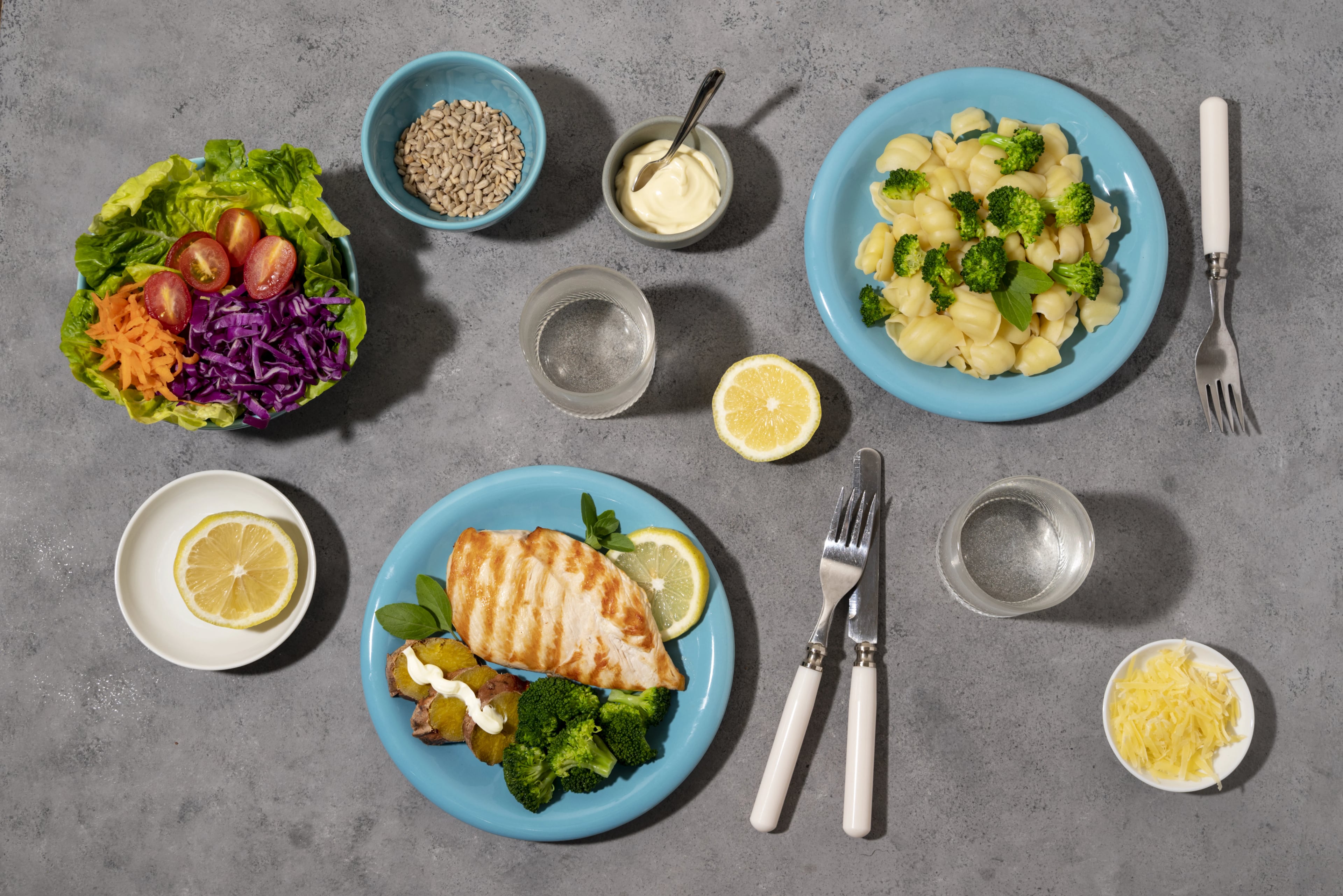
Here are three sample days built around the principles above. All follow the plate method: roughly half vegetables, a quarter protein, and a quarter carbs or starches.
~1,500 Calories
Breakfast — Greek yogurt parfait: 1 cup nonfat Greek yogurt, ½ cup berries, 2 tbsp granola (~280 cal, 22g protein, 5g fiber)
Lunch — Large chicken salad: 4 oz grilled chicken breast, 3 cups mixed greens, cucumber, cherry tomatoes, 1 tbsp olive oil + lemon dressing (~380 cal, 38g protein, 6g fiber)
Snack — 1 medium apple + 1 tbsp almond butter (~185 cal, 4g protein, 5g fiber)
Dinner — Sheet pan salmon: 5 oz salmon, 2 cups roasted broccoli and zucchini, ½ cup brown rice (~520 cal, 40g protein, 8g fiber)
Totals: ~1,365 cal | 104g protein | 24g fiber
~1,800 Calories
Breakfast — Veggie egg scramble: 3 eggs scrambled with spinach, bell peppers, and mushrooms; 1 slice whole-grain toast (~380 cal, 24g protein, 5g fiber)
Lunch — Turkey and avocado wrap: whole-wheat tortilla, 4 oz sliced turkey breast, ¼ avocado, lettuce, tomato, mustard; side of baby carrots (~430 cal, 32g protein, 8g fiber)
Snack — Cottage cheese with cucumber: ¾ cup low-fat cottage cheese, sliced cucumber (~180 cal, 19g protein, 1g fiber)
Dinner — Beef stir-fry: 5 oz lean ground beef, 3 cups mixed vegetables (broccoli, snap peas, carrots), 2 tbsp low-sodium soy sauce, ¾ cup brown rice (~620 cal, 38g protein, 9g fiber)
Snack — 1 small banana + 10 almonds (~185 cal, 5g protein, 4g fiber)
Totals: ~1,795 cal | 118g protein | 27g fiber
~2,000 Calories
Breakfast — Overnight oats: ½ cup rolled oats, 1 cup unsweetened almond milk, 1 scoop protein powder, 1 tbsp chia seeds, ½ cup raspberries (~420 cal, 35g protein, 10g fiber)
Lunch — Lentil soup + side salad: 2 cups lentil soup, large green salad with balsamic vinegar (~480 cal, 22g protein, 14g fiber)
Snack — 1 cup Greek yogurt + 1 tbsp honey (~170 cal, 17g protein, 0g fiber)
Dinner — Grilled chicken thigh (5 oz), roasted sweet potato (medium), 2 cups steamed broccoli, side salad with olive oil dressing (~620 cal, 42g protein, 10g fiber)
Snack — String cheese + an orange (~185 cal, 8g protein, 3g fiber)
Totals: ~1,875 cal | 124g protein | 37g fiber
Each of these meals can be logged in seconds with CalorieCue — snap a photo and the AI breaks down calories, protein, carbs, and fat instantly. No database searching, no manual entry. It also makes it easy to spot if you're consistently under on protein or fiber. For a structured approach to preparing these meals in advance, our meal prep guide walks through the whole process.
5 Weight Loss Food Myths Debunked
1. "Carbs make you fat"
No — excess calories make you fat. Carbohydrates are not uniquely fattening. What matters is total calorie intake. Many people lose weight successfully while eating rice, potatoes, oats, and fruit every day. The reason low-carb diets work for some people is that cutting an entire food group reduces total calorie intake, not because carbs have any magical fat-storing property. Yes, you can eat carbs and still lose weight.
2. "You need to eat clean to lose weight"
"Clean eating" has no scientific definition, but its spirit — eating whole, minimally processed foods — does make weight loss easier because those foods tend to be more filling per calorie. However, you do not need to eat perfectly to lose weight. The deciding factor is a calorie deficit. You could technically lose weight eating nothing but Twinkies (don't) if you maintained a deficit. Food quality matters for health, energy, and satiety — but the math still rules.
3. "Eating after 8pm causes weight gain"
Your body doesn't have a metabolic clock that starts storing fat after a certain hour. What matters is total daily calorie intake, not the timing. The reason late-night eating is often associated with weight gain is behavioral — people tend to snack mindlessly in the evening, adding hundreds of untracked calories. If you can stay within your daily target, eating at 10pm is no different metabolically than eating at 6pm.
4. "Fat-free foods are better for weight loss"
Fat-free processed foods are one of the great marketing deceptions in nutrition history. When fat is removed from a food product, it usually loses flavor — so manufacturers add sugar, starch, and additives to compensate. Fat-free salad dressing, fat-free yogurt, and reduced-fat peanut butter often have more sugar and nearly as many calories as their full-fat versions. Worse, they're less satisfying, so you tend to eat more. Choose whole foods over "diet" products.
5. "You should eat as little as possible"
This is one of the most counterproductive approaches to weight loss. Severely restricting calories (below 1,200 for women, 1,500 for men) causes your body to slow its metabolic rate, break down muscle tissue for energy, and ramp up hunger hormones dramatically. The result: you feel terrible, lose muscle instead of fat, and eventually rebound — often gaining back more than you lost. A moderate deficit of 300-500 calories is far more effective long-term than starving yourself short-term.
If meal timing is your main question, compare intermittent fasting and calorie counting. Decide whether a schedule helps you eat consistently before adding another rule.
Frequently Asked Questions
What should I eat for breakfast to lose weight?
The best weight-loss breakfasts are high in protein and fiber — this combination keeps you full through the morning and prevents the blood sugar crash that drives mid-morning snacking. Aim for at least 20-25g of protein. Good options: Greek yogurt with berries, a three-egg scramble with vegetables, overnight oats with protein powder, or cottage cheese with fruit. Avoid starting your day with sugary cereals, pastries, or flavored coffee drinks — these spike blood sugar and leave you hungry again within an hour.
What are the best snacks for weight loss?
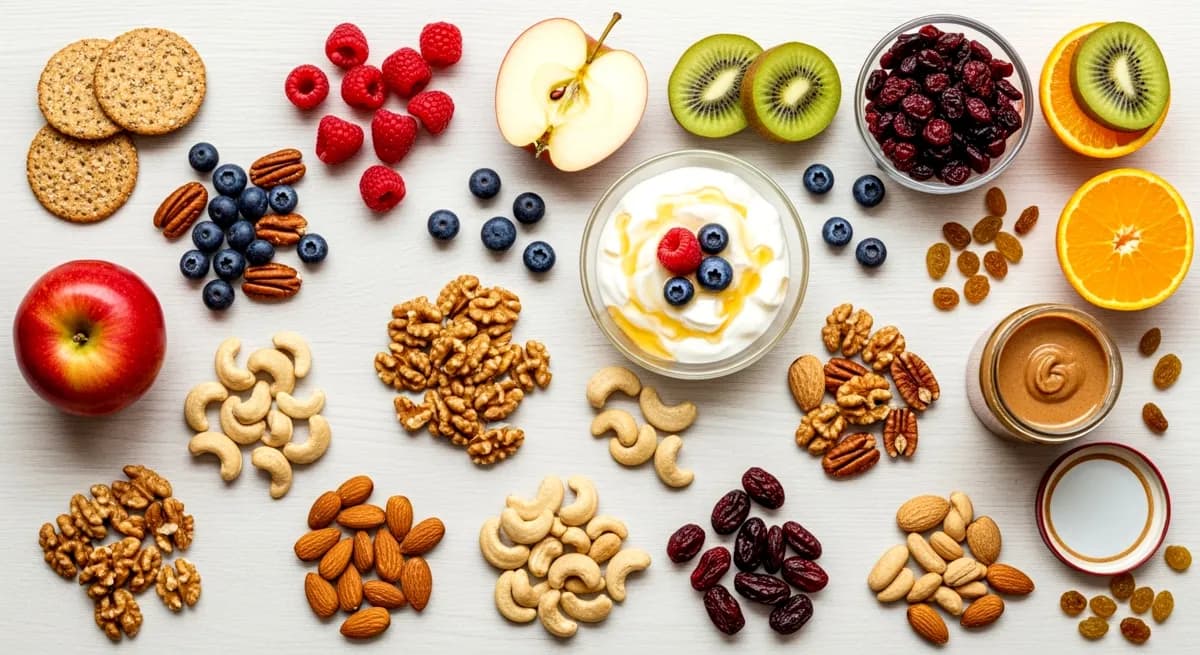
The most effective weight-loss snacks combine protein with either fiber or healthy fat. This slows digestion and keeps you satisfied between meals without adding significant calories. Smart options include: Greek yogurt (high protein), an apple with nut butter (fiber + fat), cottage cheese with cucumber (high protein, low cal), hard-boiled eggs (protein + fat), or raw vegetables with hummus (fiber + protein). Avoid snacking on processed options like crackers, chips, or granola bars, which are calorie-dense and leave you wanting more.
Can I eat carbs and still lose weight?
Yes — absolutely. As explained above, carbohydrates are not inherently fattening. Many successful weight-loss approaches include carbs: Mediterranean diets, balanced plate methods, and flexible dieting all incorporate grains, fruits, and legumes. The key is choosing carbs that also bring protein or fiber (beans, lentils, oats, whole grains, fruit) over refined carbs that provide quick energy but minimal fullness (white bread, pastries, sugary drinks). A calorie deficit is what produces fat loss — not carbohydrate restriction.
Is fruit good or bad for weight loss?
Fruit is excellent for weight loss. Despite concerns about natural sugar content, whole fruit comes packaged with fiber, water, and nutrients that dramatically slow its digestion. You can't eat enough fruit to gain weight from fructose — the fiber stops you long before that. Studies consistently show that higher fruit intake is associated with lower body weight. Eating two apples is very different metabolically from drinking two glasses of apple juice: the apples contain fiber and require chewing, both of which slow digestion and trigger satiety signals. The juice removes the fiber and delivers the sugar far faster.
What foods should I avoid to lose belly fat?
There's no food that specifically targets belly fat — spot reduction is a myth. Abdominal fat responds to an overall calorie deficit like any other body fat. That said, certain foods are particularly associated with excess visceral (belly) fat accumulation: sugary beverages, refined carbohydrates, alcohol, and ultra-processed foods. These tend to be calorie-dense, easy to overeat, and can promote inflammation and poor blood sugar regulation. Replacing them with whole foods — vegetables, lean proteins, legumes, whole grains — while maintaining a moderate calorie deficit is the most evidence-based approach to reducing belly fat over time.
The Bottom Line
You don't need a complex or restrictive diet to lose weight. You need a sustainable approach built on foods that work with your biology:
- Eat more protein — it preserves muscle, curbs hunger, and burns more calories to digest
- Load up on fiber — it fills you up for almost no caloric cost
- Fill half your plate with vegetables — high volume, low calories, high nutrient density
- Limit ultra-processed foods and sugary drinks — they override satiety and add empty calories
- Keep portions in check — even healthy foods add up if quantities aren't managed
No food has to be completely off limits. No meal has to be perfect. Consistency across weeks and months is what produces lasting results — not perfection for three days followed by burnout.
The most sustainable diet is the one you can maintain without feeling miserable. Build your meals around the foods above, stay aware of your calorie intake, and adjust as you go.
Download CalorieCue